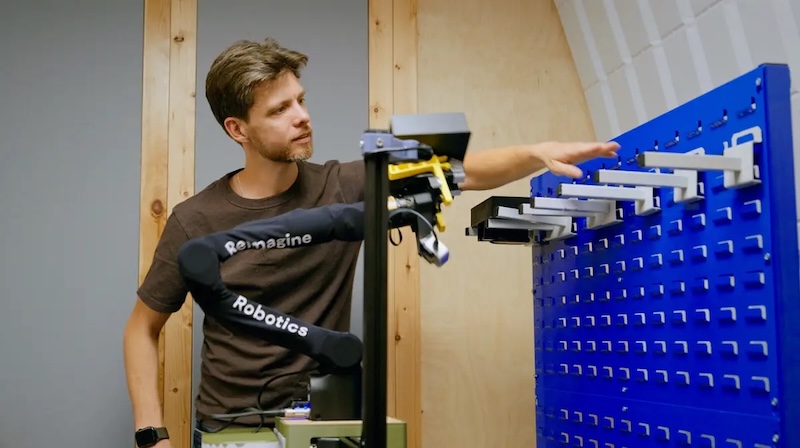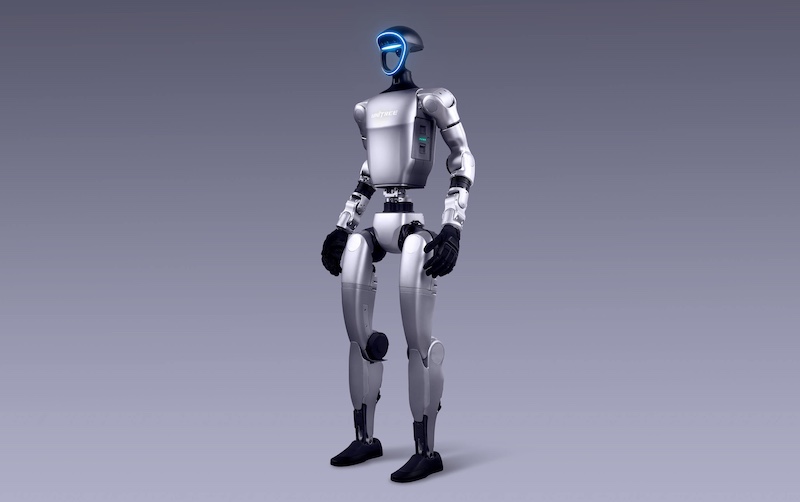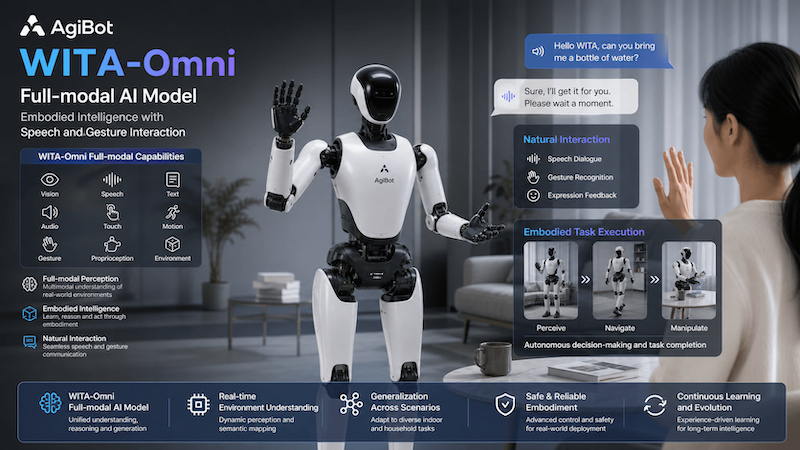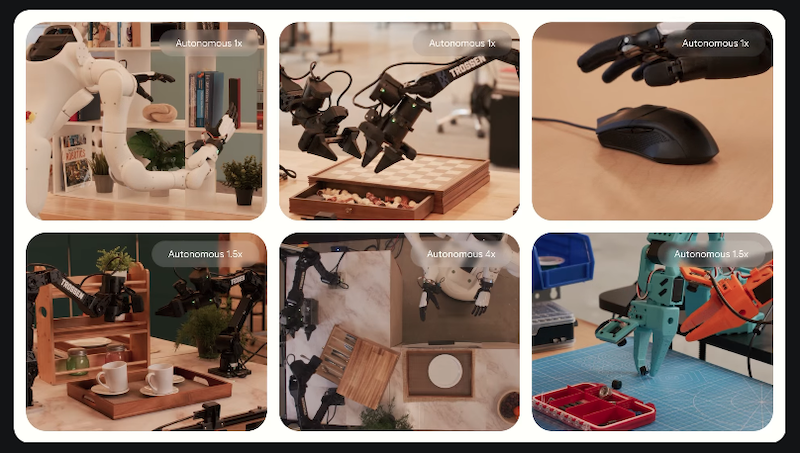
The next leap in robotics won’t come from faster processors or more sophisticated mechanical design. It will come from better data, specifically, from training environments that replicate how the physical world actually behaves. [Read more…] about Why robotics can’t advance without physical AI
embodied ai
Interview with CreateMe CEO Campbell Myers: From stitching to bonding – physical AI could transform the way clothes are made
For decades, apparel manufacturing has remained one of the most labor-intensive sectors in global industry. While robots have transformed automotive production, electronics assembly, and warehouse operations, handling soft, deformable materials such as fabric has proven far more difficult to automate.
Textiles stretch, wrinkle, drape, and shift unpredictably, creating challenges that traditional industrial automation systems were never designed to solve.
As interest in embodied AI and physical AI continues to grow, many researchers and technology companies see deformable-material manipulation as one of the most important remaining frontiers in robotics. [Read more…] about Interview with CreateMe CEO Campbell Myers: From stitching to bonding – physical AI could transform the way clothes are made
Interview with Workr Robotics CEO Ken Macken: ‘Paying for automation by the hour’
Industrial robotics is entering a new phase. Advances in artificial intelligence, large language models, and so-called embodied AI have sparked renewed excitement about robots that can understand, reason about, and interact with the physical world.
High-profile collaborations between companies such as Google DeepMind and Boston Dynamics have fueled speculation that increasingly capable general-purpose robots may soon find their way onto factory floors.
But not everyone in the industry is convinced that these developments represent an immediate breakthrough for manufacturing. [Read more…] about Interview with Workr Robotics CEO Ken Macken: ‘Paying for automation by the hour’
Genesis AI launches simulation platform to accelerate robotics development
Genesis AI has launched Genesis World 1.0, a new robotics simulation platform designed to dramatically reduce the time required to develop, test, and evaluate robotic AI systems.
The company says the platform can compress robotics evaluation cycles from days to minutes by enabling large-scale testing in photorealistic virtual environments rather than relying solely on physical robots.
According to Genesis AI, a robotics foundation model evaluation that would typically require nearly a week of continuous testing on real hardware can be completed in approximately 30 minutes using Genesis World 1.0 running on GPU infrastructure. [Read more…] about Genesis AI launches simulation platform to accelerate robotics development
Physical AI’s looming data rights battle: Interview with Kate Shen of Anaxi Labs
As artificial intelligence continues its rapid expansion into the physical world, much of the industry’s attention has focused on increasingly capable robots, larger AI models, and the vast datasets required to train them.
But a growing number of observers are asking a different question: who owns the data that makes physical AI possible, and who should benefit from it?
Kate Shen, co-founder of Anaxi Labs, is among those pushing the debate into the spotlight. Her company is developing infrastructure for what it describes as a global AI and robotics data supply chain, with a particular emphasis on worker consent, data ownership, compensation, and regulatory compliance. [Read more…] about Physical AI’s looming data rights battle: Interview with Kate Shen of Anaxi Labs
Open source hardware for robotics: Democratizing robot building
Most discussions about open-source robotics focus on software. The Robot Operating System (ROS) has become the best-known example, providing developers with a common framework for building and operating robots.
Yet software is only part of the story.
Over the past two decades, a growing ecosystem of open-source hardware platforms has dramatically lowered the barriers to robotics development. [Read more…] about Open source hardware for robotics: Democratizing robot building
Figure ramps up humanoid robot manufacturing at unprecedented speed
Humanoid robotics companies have spent years producing carefully choreographed demonstrations and highly controlled prototypes. The real challenge, however, has always been manufacturing scale.
Building one impressive humanoid robot is difficult. Building hundreds reliably, repeatedly, and economically is something else entirely.
Figure AI now claims to be crossing that threshold. [Read more…] about Figure ramps up humanoid robot manufacturing at unprecedented speed
Figure partners with Catalyst Brands to deploy humanoid robots in logistics operations
Figure AI has signed a commercial agreement with Catalyst Brands to deploy humanoid robots across the retailer’s distribution and logistics network.
The partnership will begin at Catalyst Brands’ distribution center in Reno, Nevada, where Figure’s humanoid robots will be used to automate physically demanding supply chain tasks.
Catalyst Brands operates several well-known retail chains, including JCPenney, Aéropostale, and Brooks Brothers. [Read more…] about Figure partners with Catalyst Brands to deploy humanoid robots in logistics operations
China to assign digital ID numbers to humanoid robots for lifecycle tracking
China is introducing a national digital identification system for humanoid robots as authorities seek to monitor safety risks and standardize management across the rapidly growing sector.
According to state broadcaster CCTV, the initiative will assign unique digital identity numbers to humanoid robots throughout their operational lifecycle, from manufacturing and deployment to recycling and disposal.
The system is intended to help regulators track products more effectively as China accelerates development of humanoid robotics for industrial, commercial, and domestic applications. [Read more…] about China to assign digital ID numbers to humanoid robots for lifecycle tracking
CVPR 2026 fields 16,000+ paper submissions on technical advances in AI
The program committee of the 2026 Conference on Computer Vision and Pattern Recognition (CVPR), one of the world’s leading artificial intelligence (AI) and computer vision research events, has released the details of this year’s technical program.
Co-sponsored by the IEEE Computer Society (CS) and the Computer Vision Foundation (CVF), CVPR 2026 drew a record number of paper submissions – 16,092, a 24 percent increase over 2025. Through a rigorous peer-review process, about one-quarter were accepted to the program, resulting in 4,089 paper presentations.
“CVPR submissions have more than doubled over the past five years, but the acceptance rate has remained highly competitive, consistently in the low-to-mid 20 percent range,” said Alexander G. Schwing, associate professor, electrical and computer engineering, University of Illinois Urbana-Champaign, CVPR 2026 program co-chair. [Read more…] about CVPR 2026 fields 16,000+ paper submissions on technical advances in AI