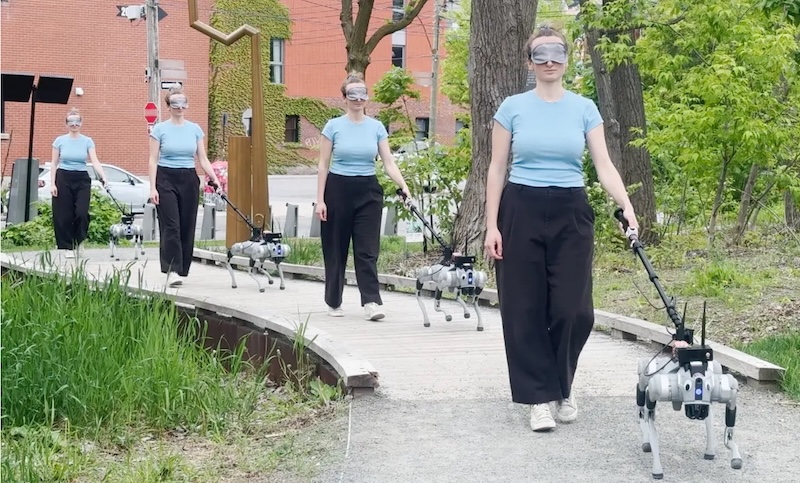
Researchers have introduced what they describe as the world’s first fully autonomous robotic guide dog, an AI-powered mobile robot designed to help blind and visually impaired people navigate both indoor and outdoor environments.
Named Milo, the robot has been developed as a lower-cost alternative to traditional guide dogs, which require extensive training and are often in short supply.
According to the developers, certified guide dogs in Canada can cost tens of thousands of dollars to train, and applicants may wait several years before receiving one.
They say Milo could be manufactured for less than $2,000, making the technology more widely accessible while people wait for a trained guide dog.
Unlike many autonomous robots that rely on pre-mapped environments, Milo is designed to navigate unfamiliar locations without requiring a prior 3D scan.
The robot uses onboard artificial intelligence to identify paths, avoid pedestrians and obstacles, and guide its user through indoor and outdoor spaces without relying on an internet connection or cloud computing.
The developers said the navigation system was trained using reinforcement learning inside a custom simulator that generated a wide variety of virtual environments and obstacles.
The robot interprets its surroundings using a bird’s-eye-view representation, enabling it to navigate consistently under different lighting and environmental conditions.
Milo also builds and maintains a map of its surroundings as it travels, allowing it to remember obstacles that are no longer directly visible rather than reacting only to what its sensors currently detect.
To guide users safely, the robot tracks the handler’s position using sensors integrated into a telescopic handle. A directional control pad allows users to adjust walking speed and indicate which direction they wish to travel at intersections.
The developers said they evaluated the system on indoor and outdoor obstacle courses, measuring navigation accuracy, travel speed and obstacle clearance.
Alongside a research paper describing the project, the team has released Milo as an open-source platform, making its hardware designs, simulation software and pre-trained AI models publicly available to encourage further research and development.
The developers say the combination of lower cost, autonomous operation and open-source availability could make robotic mobility assistance more accessible to people who are unable to obtain a traditional guide dog.
