• Skip to primary navigation
  • Skip to main content
  • Skip to primary sidebar
  • Skip to secondary sidebar
  • About
    • Contact
    • Privacy
    • Terms of use
  • Shop
    • Cart
    • Checkout
    • My Account
  • Advertise
    • Advertising
      • Buy ad space
    • Case studies
    • Design
    • Email marketing
    • Features list
    • Lead generation
    • Magazine
    • Press releases
    • Publishing
    • Sponsor an article
    • Webcasting
    • Webinars
    • White papers
    • Writing
  • Subscribe to Newsletter

Robotics & Automation News

Where Innovation Meets Imagination

  • Home
  • News
  • Features
  • Editorial Sections A-Z
    • Agriculture
    • Aircraft
    • Artificial Intelligence
    • Automation
    • Autonomous Vehicles
    • Business
    • Computing
    • Construction
    • Culture
    • Design
    • Drones
    • Economy
    • Energy
    • Engineering
    • Environment
    • Health
    • Humanoids
    • Industrial robots
    • Industry
    • Infrastructure
    • Investments
    • Logistics
    • Manufacturing
    • Marine
    • Material handling
    • Materials
    • Mining
    • Promoted
    • Research
    • Robotics
    • Science
    • Sensors
    • Service robots
    • Software
    • Space
    • Technology
    • Transportation
    • Warehouse robots
    • Wearables
  • Press releases
  • Events

Research

Empowering STEM Education and Research in the Americas: Elephant Robotics Introduces Integrated Educational Robotics Solutions

June 26, 2026 by Sam Francis

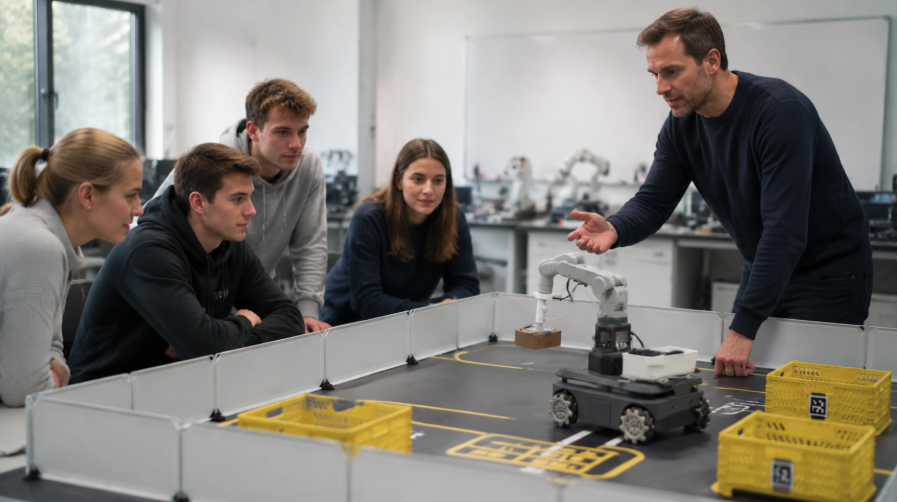
STEM education has experienced rapid growth in recent years, driven by increasing demand for practical engineering skills, artificial intelligence literacy, and interdisciplinary innovation.

However, for schools, universities, and research laboratories, building effective robotics environments has long remained a challenge.

In many cases, instructors must integrate robotic arms, mobile platforms, sensors, and open-source software from multiple vendors, often spending weeks resolving compatibility issues before meaningful teaching or experimentation can begin. [Read more…] about Empowering STEM Education and Research in the Americas: Elephant Robotics Introduces Integrated Educational Robotics Solutions

Filed Under: Design, Research, Robotics Tagged With: AI education, americas, automation news, autonomous systems, cobots, collaborative robots, educational robotics, educational technology, elephant robotics, embodied ai, engineering education, logistics robots, machine vision, mechArm 270, mobile robots, myAGV, myBuddy, myCobot, robotics and automation, robotics and automation news, robotics education, robotics news, robotics research, robotics training, stem education, STEM learning

8 Tips to Evaluate LMS Pricing Plans

May 29, 2026 by Abdul Montaqim

Choosing a learning platform affects budgets long before the first lesson opens. Many pricing pages appear clear, yet real expense often sits in implementation work, service limits, learner volume, and renewal language.

Careful review helps decision-makers avoid avoidable waste and protect program quality. The eight tips below give procurement, finance, and training leaders a practical method for judging offers with better evidence, steadier assumptions, and fewer unpleasant surprises after signature. [Read more…] about 8 Tips to Evaluate LMS Pricing Plans

Filed Under: Research, Software Tagged With: Absorb LMS, automation news, business software, compliance training, corporate learning, corporate training, digital learning, digital transformation, e-learning platform, educational technology, employee onboarding, employee training, enterprise learning, enterprise software, HR technology, learning analytics, learning management software, learning management system, learning technology, LMS evaluation, LMS implementation, LMS pricing, LMS procurement, LMS software, LMS support, online learning, organizational learning, robotics and automation, robotics and automation news, robotics news, SaaS pricing, staff development, training management, training platform, training programs, training ROI, training technology, workforce development, workforce training, workplace learning

Hello Robot unveils Stretch 4: A simply useful robot that puts people first

May 12, 2026 by David Edwards

Hello Robot, the team behind the Stretch mobile manipulation platform, have announced the release of Stretch 4.

Available now for $29,950, Stretch 4 is an open-source robotics platform designed for researchers, developers, and application engineers building the next wave of Physical AI applications for general purpose robotics.

“In the last few years, Physical AI has brought us videos of robots doing amazing stunts. But these videos are missing something critical – the people the robots are meant to benefit,” says Aaron Edsinger, co-founder and CEO of Hello Robot. [Read more…] about Hello Robot unveils Stretch 4: A simply useful robot that puts people first

Filed Under: Design, Home robots, Research Tagged With: ai robotics, assistive robotics, automation news, Autonomous robots, collaborative robotics, healthcare robotics, Hello Robot, home robotics, human-robot interaction, manipulation robotics, mobile manipulation robot, mobile robots, Nvidia Jetson Orin NX, omnidirectional robot, open source robotics, physical ai, robot safety, robotics and automation, robotics and automation news, robotics news, robotics platform, robotics research, service robots, Stretch 4

Interview with the CEO of Mitsubishi Electric Research Laboratories: ‘Uncertainty in the real world’

April 29, 2026 by David Edwards

As robotics continues to move from controlled environments into more complex, real-world settings, the role of research institutions in shaping the next generation of systems is becoming increasingly significant.

One of the organizations operating at this intersection is Mitsubishi Electric Research Laboratories (MERL), the North America-based R&D arm of Mitsubishi Electric.

Led by president and CEO Anthony Vetro, MERL focuses on advancing core technologies that underpin robotics, including perception, control systems, and machine learning. Its work spans multiple domains, from industrial automation to energy systems, with an emphasis on bridging the gap between theoretical research and practical deployment. [Read more…] about Interview with the CEO of Mitsubishi Electric Research Laboratories: ‘Uncertainty in the real world’

Filed Under: Features, Industry, Manufacturing, Research Tagged With: Anthony Vetro, augmented reality robotics, automation news, force control robotics, human-robot interaction, industrial automation, MERL, Mitsubishi Electric Research Laboratories, physical ai, robot training systems, robotic manipulation, robotics and automation, robotics and automation news, robotics news, robotics research

Where to Buy Affordable Laboratory Equipment Online

April 20, 2026 by David Edwards

In this day and age, buying large-scale lab equipment can be instant and quick with professional providers. But first, you need to know where to look.

To buy lab equipment online, you must follow this buyer’s guide to make sure you get quality and authorised tools.

You can get high-quality dispersers, calorimeters, magnetic stirrers, and more, with the IKA lab equipment selection. Here is everything you need to know to start. [Read more…] about Where to Buy Affordable Laboratory Equipment Online

Filed Under: Health, Research, Science Tagged With: affordable lab equipment, automation news, buy lab equipment, eBay lab equipment, IKA lab equipment, industrial lab equipment, ISO certification lab equipment, lab equipment buyer guide, lab equipment online, lab instruments, laboratory automation tools, laboratory equipment, laboratory tools, refurbished lab equipment, research equipment, robotics and automation, robotics and automation news, robotics news, scientific equipment suppliers, USA Lab equipment

The Desert Digitalises: How Dubai is Engineering a Global Hub for Robotics and Automation

April 8, 2026 by Sam Francis

Dubai highway logistics network with trucks moving goods across the city

Dubai has long established itself as a city of superlatives, known for its rapid urban development and architectural marvels. However, a significant shift is currently under way beneath the skyline: the transition from being a primary importer of technology to a global developer of it.

This evolution is perhaps most visible in the fields of robotics and automation, where the United Arab Emirates (UAE) is no longer just an observer of global trends but a central architect of its own high-tech future. [Read more…] about The Desert Digitalises: How Dubai is Engineering a Global Hub for Robotics and Automation

Filed Under: Automation, Research, Robotics Tagged With: ai and robotics, automation news, Dubai robotics, industrial robotics, logistics automation, Middle East robotics, robotics and automation, robotics and automation news, robotics investment, robotics news, smart cities, UAE automation

ABB Robotics survey shows EV confidence as production shifts from disruption to delivery

March 13, 2026 by Sam Francis

Automotive manufacturers worldwide are showing growing confidence in their ability to build electric vehicles efficiently and at scale, according to ABB Robotics’ latest Automotive Manufacturing Outlook Survey, as EV production becomes a more established and predictable manufacturing discipline.

“This year’s survey presents a more positive picture of EV manufacturing than we have seen in previous years,” said Joerg Reger, managing director of ABB Robotics automotive business line.

“Key indicators such as manufacturing time, cost and integration show that EV production is increasingly becoming a known quantity. [Read more…] about ABB Robotics survey shows EV confidence as production shifts from disruption to delivery

Filed Under: Features, Manufacturing, Research Tagged With: ABB Robotics survey, automation news, automotive factory robotics, automotive manufacturing trends, electric vehicle production, EV assembly automation, EV manufacturing automation, hybrid vehicle manufacturing, robotics and automation, robotics and automation news, robotics news

What are Biosafety Cabinets?

March 13, 2026 by Sam Francis

Picture a glass-fronted workstation that behaves a bit like an invisible shield. Air flows in carefully controlled patterns, almost choreographed, to keep hazardous particles from escaping while also protecting whatever sample sits inside.

That airflow matters. A lot.

Air is pulled inward through the cabinet’s front opening, forming a barrier that prevents stray microbes or hazardous aerosols from drifting out toward the operator or the surrounding room.

At the same time, filtered air flows downward over the work surface. Think of it as a gentle sterile “air curtain.” It sweeps contaminants away from samples so the materials you’re working with remain clean.

In short? The cabinet protects three things simultaneously: the person working, the experiment itself, and the wider laboratory environment. A neat trick for a metal box with a fan and filters.

Choosing the right cabinet is not trivial

Labs don’t just grab whichever unit is on sale that month. Selection depends on a few practical questions.

What kind of organisms are involved?
How dangerous are they?
Will chemicals or radioactive compounds be used alongside the biological work?

These questions tie into something called risk groups, which run from relatively harmless microbes to truly nasty pathogens.

Roughly speaking:

  • Risk Group 1-3 organisms: standard biosafety cabinets usually do the job
  • Risk Group 4 agents: that’s the serious territory. Think maximum containment systems
  • Experiments involving volatile chemicals or radionuclides: special airflow designs are needed

Different cabinet classes exist precisely because no single design fits every situation.

The different classes of biosafety cabinets

Not all cabinets are created equal. Some are fairly basic. Others resemble miniature containment vaults.

Class I

This is the simplest design you’ll encounter. Air is pulled inward and then filtered before being exhausted. It protects the person operating the cabinet and the lab environment.

What it doesn’t do particularly well is protect the sample itself from contamination.

Still, for work involving lower risk microorganisms, it’s perfectly adequate.

Class II

Now we’re talking about the workhorse of modern laboratories. If you step into a university research facility or hospital microbiology lab, chances are high you’ll see one of these humming away.

Class II cabinets protect everything: the user, the room, and the sample.

Here’s how they manage that balancing act:

Roughly 70 percent of the air inside the cabinet recirculates as filtered downward airflow. The remaining portion is exhausted after passing through high-efficiency filters. That combination maintains sterile conditions inside while preventing hazardous particles from escaping.

Most labs rely on Type A2 cabinets, the most common configuration.

Occasionally, when toxic chemicals are involved, these cabinets are connected to exhaust ducts to keep fumes moving out of the workspace.

Class II Type B2

This variant takes things a step further. Instead of recirculating air inside the cabinet, all air is exhausted after filtration.

Nothing cycles back through the workspace.

Because of that design, Type B2 cabinets are often used when biological work is combined with toxic chemicals. No recirculation means less chance of hazardous buildup.

Some safety engineers even argue they’re the safest version of Class II cabinets, simply because the full-exhaust system acts like a built-in safety net.

Class III

This is the heavy-duty containment option. The “space suit” of bio safety cabinet.

Everything inside is completely sealed off. Operators manipulate materials through glove ports built into the cabinet wall. Air entering and leaving the system is heavily filtered, often more than once.

These cabinets are typically reserved for work involving the most dangerous pathogens known. The kind of organisms that make epidemiologists lose sleep.

A quick note on biosafety levels

Laboratories themselves are categorized by biosafety levels, which define how dangerous the materials being handled are.

There are four main levels.

  1. BSL-1 is the lowest tier. Harmless microbes used in teaching labs usually fall here. Basic precautions, handwashing sinks, and common sense are generally enough.
  2. BSL-2 involves pathogens that can cause disease but are manageable with standard safety practices. Think organisms like certain hepatitis viruses or Salmonella.
  3. BSL-3 laboratories deal with pathogens capable of causing serious illness, often transmitted through the air. Tuberculosis bacteria, for instance, belong here. Specialized ventilation and strict procedures become essential.
  4. Then there’s BSL-4. Rare facilities. Extreme containment. These labs handle agents such as hemorrhagic fever viruses where vaccines or treatments may not exist. Workers typically wear full-body positive-pressure suits, and Class III cabinets often form part of the containment system.

Filters: the unsung heroes

If the cabinet is the fortress, the filters are the gatekeepers.

There are two types dominate modern biosafety cabinets.

  • HEPA filters, which capture 99.99 percent of particles around 0.3 microns in size.
  • And ULPA filters, which are even finer, trapping about 99.999 percent of particles down to roughly 0.12 microns.

ULPA filters are often described as roughly ten times more efficient than standard HEPA filters. Not that HEPA is weak. It’s already incredibly effective.

But when dealing with biological hazards, “almost perfect” sometimes isn’t quite perfect enough.

Design details matter more than you’d think

You might assume all cabinets look roughly the same. Front window. Steel work surface. Maybe a control panel.

Yet small design choices can make a surprising difference.

For instance, airflow enters through a grille near the front of the cabinet. If a researcher accidentally blocks that grille with their arms or equipment, airflow can become disrupted. That, in turn, weakens the protective barrier.

Manufacturers try to reduce that risk with clever tweaks, like raised armrests or curved air grilles that discourage obstruction.

Controls and alarms

Older cabinets were almost laughably simple. Flip a switch. Fan starts. Light turns on.

Modern units are smarter.

Some now include digital microprocessor systems that monitor airflow velocity, sash position, filter performance, and other parameters. If something drifts out of safe operating range, alarms kick in.

Windows, trays, and ergonomics

Many cabinets use tempered safety glass that stays largely intact if shattered, reducing the chance of hazardous exposure. Some windows tilt forward slightly rather than standing perfectly vertical, which reduces glare and makes long work sessions easier on the eyes.

Inside the cabinet, the work surface can be a single solid tray or multiple removable panels.

Single trays contain spills better. Multi-piece trays are easier to lift out and clean.

Like so many things in lab design, it’s a trade-off.

And yes, ergonomics count

Researchers may spend hours inside a biosafety cabinet. Poor design can quickly turn that into an uncomfortable experience.

Good cabinets consider things like:

  • Control panels placed where both seated and standing operators can reach them
  • Bright but glare-free lighting inside the work area
  • Quiet blowers, ideally under about 67 decibels
  • UV lamps positioned so they don’t shine directly into someone’s eyes

Little details. They matter after the fourth hour of repetitive pipetting.

A few practical safety habits

Owning a biosafety cabinet doesn’t magically make work safe. Proper use still matters.

A few rules that experienced lab workers repeat endlessly:

  • Don’t confuse biosafety cabinets with laminar flow hoods. They serve different purposes.
  • Never ignore alarms. If the cabinet complains, something’s wrong.
  • Avoid using open flames inside the cabinet.
  • Don’t turn it into a storage shelf.
  • Keep airflow unobstructed whenever possible.

Also important: certification. Cabinets should be tested regularly, usually once a year, to confirm that airflow patterns and filters are still performing properly.

Because when containment fails, the consequences can escalate quickly.

Filed Under: Research, Science Tagged With: automation news, biosafety cabinets, biosafety level labs, Class II biosafety cabinet, HEPA filtration laboratories, lab airflow containment, laboratory containment systems, laboratory safety equipment, robotics and automation, robotics and automation news, robotics news

MassRobotics, AWS, and Nvidia launch second cohort of physical AI fellowship

March 12, 2026 by David Edwards

MassRobotics, Amazon Web Services (AWS), and Nvidia have announced the second cohort of the Physical AI Fellowship, a program designed to support robotics startups developing artificial intelligence systems for real-world machines.

The virtual program provides technical guidance, computing resources, and access to a global robotics ecosystem to help startups develop and scale “physical AI” technologies. The initiative builds on the inaugural fellowship cohort launched in late 2025.

The 2026 cohort includes nine startups working across sectors such as agriculture, construction, renewable energy, industrial automation, logistics, teleoperation, robotics data infrastructure, and humanoid robotics. [Read more…] about MassRobotics, AWS, and Nvidia launch second cohort of physical AI fellowship

Filed Under: Artificial Intelligence, Business, News, Research Tagged With: AI robotics innovation programs, automation news, AWS robotics startups, MassRobotics physical AI fellowship, Nvidia Isaac robotics platform, Nvidia robotics AI, physical AI startups, robotics and automation, robotics and automation news, robotics news, robotics startup accelerator, robotics startup funding ecosystem, robotics summit Boston, robotics venture ecosystem

International Society of Automation partners with Wiley to scale publishing content

February 12, 2026 by Sam Francis

Wiley, a publisher of authoritative content and research intelligence for the advancement of scientific discovery, innovation and learning, and the International Society of Automation (ISA), the professional society for automation, have announced a strategic co-publishing partnership designed to expand global access to ISA’s authoritative technical and educational publishing content.

ISA chose to partner with Wiley to better serve the automation community and its tens of thousands of members worldwide. The partnership combines ISA’s technical leadership and quality content with Wiley’s editorial expertise and global reach.

This collaboration preserves ISA’s editorial independence while leveraging Wiley’s global infrastructure to deliver new and revised titles annually, responding to the growing need for industrial automation content around the world. [Read more…] about International Society of Automation partners with Wiley to scale publishing content

Filed Under: Research Tagged With: Automation Body of Knowledge, automation news, automation standards, industrial automation education, International Society of Automation, ISA publishing, robotics and automation, robotics and automation news, robotics news, Wiley publishing

  • Page 1
  • Page 2
  • Page 3
  • Interim pages omitted …
  • Page 7
  • Go to Next Page »

Primary Sidebar

Search this website

Latest articles

  • The Hardware Powering the Hybrid Industrial Workforce
  • How to Choose a Robot Vacuum and Mop That Actually Fits Your Home
  • How Modern Software Helps Construction Companies in Qatar Work Smarter and Safer
  • Antivirus vs malware: Why antivirus alone is no longer enough
  • X Square Robot builds a full-stack approach to embodied AI and general-purpose robotics
  • AGIBOT debuts A3 humanoid robot in Europe and launches UK Robot-as-a-Service model
  • What Are the Biggest Challenges in Modern Electronics Manufacturing?
  • What Are the Best AI Tools for Creating Content Faster in 2026?
  • Why Does Quality Wiring Matter More Than Ever in Modern Electronic Devices?
  • Why Are Custom Harness Solutions Essential for Next Generation Technology?

Secondary Sidebar

Latest news

  • The Hardware Powering the Hybrid Industrial Workforce
  • How to Choose a Robot Vacuum and Mop That Actually Fits Your Home
  • How Modern Software Helps Construction Companies in Qatar Work Smarter and Safer
  • Antivirus vs malware: Why antivirus alone is no longer enough
  • X Square Robot builds a full-stack approach to embodied AI and general-purpose robotics
  • AGIBOT debuts A3 humanoid robot in Europe and launches UK Robot-as-a-Service model
  • What Are the Biggest Challenges in Modern Electronics Manufacturing?
  • What Are the Best AI Tools for Creating Content Faster in 2026?
  • Why Does Quality Wiring Matter More Than Ever in Modern Electronic Devices?
  • Why Are Custom Harness Solutions Essential for Next Generation Technology?

Copyright © 2026 · News Pro on Genesis Framework · WordPress · Log in

We use cookies on our website to give you the most relevant experience by remembering your preferences and repeat visits. By clicking “Accept”, you consent to the use of ALL the cookies.
Do not sell my personal information.
Cookie SettingsAccept
Manage consent

Privacy Overview

This website uses cookies to improve your experience while you navigate through the website. Out of these, the cookies that are categorized as necessary are stored on your browser as they are essential for the working of basic functionalities of the website. We also use third-party cookies that help us analyze and understand how you use this website. These cookies will be stored in your browser only with your consent. You also have the option to opt-out of these cookies. But opting out of some of these cookies may affect your browsing experience.
Necessary
Always Enabled
Necessary cookies are absolutely essential for the website to function properly. These cookies ensure basic functionalities and security features of the website, anonymously.
CookieDurationDescription
cookielawinfo-checkbox-analytics11 monthsThis cookie is set by GDPR Cookie Consent plugin. The cookie is used to store the user consent for the cookies in the category "Analytics".
cookielawinfo-checkbox-functional11 monthsThe cookie is set by GDPR cookie consent to record the user consent for the cookies in the category "Functional".
cookielawinfo-checkbox-necessary11 monthsThis cookie is set by GDPR Cookie Consent plugin. The cookies is used to store the user consent for the cookies in the category "Necessary".
cookielawinfo-checkbox-others11 monthsThis cookie is set by GDPR Cookie Consent plugin. The cookie is used to store the user consent for the cookies in the category "Other.
cookielawinfo-checkbox-performance11 monthsThis cookie is set by GDPR Cookie Consent plugin. The cookie is used to store the user consent for the cookies in the category "Performance".
viewed_cookie_policy11 monthsThe cookie is set by the GDPR Cookie Consent plugin and is used to store whether or not user has consented to the use of cookies. It does not store any personal data.
Functional
Functional cookies help to perform certain functionalities like sharing the content of the website on social media platforms, collect feedbacks, and other third-party features.
Performance
Performance cookies are used to understand and analyze the key performance indexes of the website which helps in delivering a better user experience for the visitors.
Analytics
Analytical cookies are used to understand how visitors interact with the website. These cookies help provide information on metrics the number of visitors, bounce rate, traffic source, etc.
Advertisement
Advertisement cookies are used to provide visitors with relevant ads and marketing campaigns. These cookies track visitors across websites and collect information to provide customized ads.
Others
Other uncategorized cookies are those that are being analyzed and have not been classified into a category as yet.
SAVE & ACCEPT