Having already produced and delivered more than 10,000 robots globally, with its products deployed in real-world industrial and infrastructure scenarios, GENISOM AI made its debut at ICRA 2026 during June 2-4 with a clear message: Embodied AI is moving from research to reality.
At the event, the company demonstrated its GENISOM M1 and GENISOM L1 robot platforms alongside technologies supporting simulation, navigation, motion control, and embodied intelligence for operation in complex environments, demonstrating end-to-end capabilities from simulation to real-world deployment.
GENISOM AI builds a full-stack embodied intelligence system that connects core robotic components, robot platforms, simulation, navigation, motion control, agentic intelligence, scalable manufacturing, and real-world deployment.
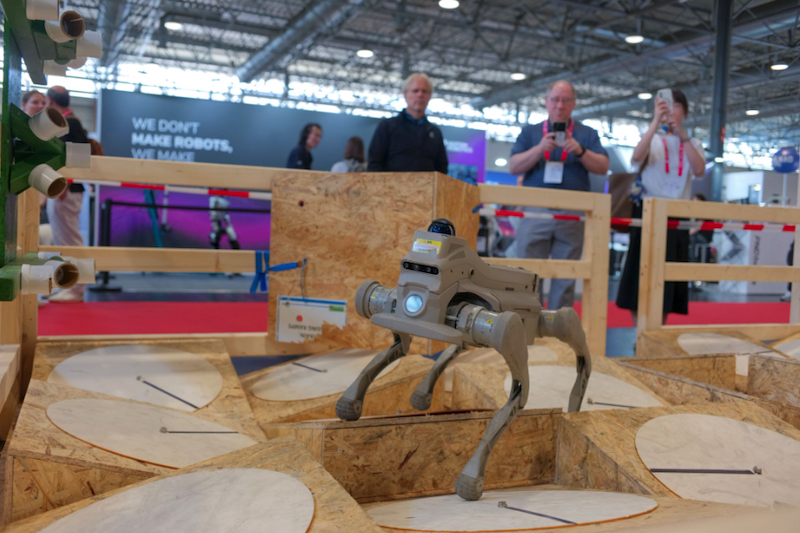
GENISOM AI showcased its quadruped robot in a live challenge environment at ICRA 2026
GENISOM AI’s ICRA 2026 Debut
ICRA 2026 serves as an important stage for GENISOM AI to introduce its robotics ecosystem to a wider global audience. The company’s exhibition will focus on how robots can be developed, tested, and deployed through an integrated technical system.
Instead of presenting separate products and technologies, GENISOM AI is connecting them through one accessible theme: “From Simulation to Real-World Deployment”.
This approach helps general technology readers understand how simulation platforms, navigation systems, joint modules, and motion control work together to support robots in real environments.
Through the ICRA 2026 event, the company demonstrated how full-stack robotics support real-world applications across industry, infrastructure, security, emergency response, and education.
GENISOM M1 Built for Industrial and Field Applications
The GENISOM M1 is one of the main products GENISOM AI showcased at ICRA 2026. It is designed for complex environments such as industrial inspections, emergency response, security patrols, and power infrastructure inspection.
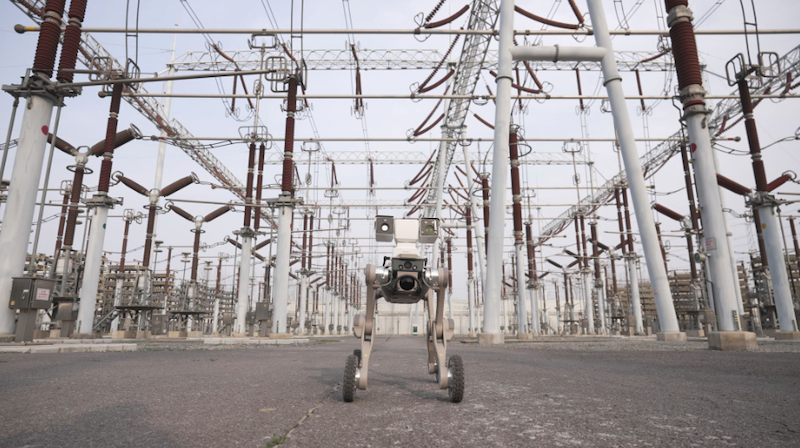
GENISOM AI’s quadruped robots support autonomous inspection in power infrastructure environments
With a 30 kg continuous walking payload and IP67 protection, the GENISOM M1 is suitable for outdoor, industrial, and demanding operational environments.
Its dual hot-swappable batteries support continuous operation, with battery life of up to five hours. These features make it practical for fieldwork where reliability, endurance, and adaptability are important.
In power grid inspections, the GENISOM M1 can support teams working around substations, power lines, and other infrastructure.
In industrial environments, it can assist with routine inspection tasks in areas that may be difficult, dangerous, or time-consuming for human workers to access.
For emergency response, the robot’s mobility and payload capacity can help carry sensors, communication tools, or other equipment into challenging locations.
For the GENISOM M1, the company’s P85MAX-S joint actuator delivers up to 180 N·m peak torque, supporting high-load movement and terrain adaptability. GENISOM AI also demonstrated its in-house joint actuator modules and motion control technology alongside the robot platforms at ICRA 2026.
These systems play a key role in how the robots move, balance, carry loads, and adapt to different environments. By developing core components internally, the company can more closely align hardware and software across its robotic platforms.
GENISOM L1 and L1-W for Research, Education, and Flexible Deployment
The GENISOM L1-W features a hybrid wheeled-legged mobility system, combining the terrain adaptability of legged robots with the movement efficiency of wheels. This makes it useful in environments where robots may need to move across both flat surfaces and more complex terrain.
The University of Manchester team won first place in the IROS 2025 Quadruped Robot Challenge using GENISOM L1 EDU, showing the platform’s effectiveness in a demanding robotics environment.
GENISOM L1 EDU supports SLAM, 3D mapping, and open-source development, making it relevant for universities, laboratories, and developers exploring robotics applications. For education and research users, this provides a platform for testing ideas, developing software, and studying real-world robotic behavior.
Real-World Applications Across Industry and Infrastructure
Technology remains an important part of GENISOM AI’s story, but the focus is on practical value rather than complex algorithmic explanations.
The MATRiX simulation platform helps robots train and validate capabilities in simulation before entering real-world environments. This allows developers to test movement, navigation, and operational behavior before physical deployment.
RoamerX, GENISOM AI’s autonomous navigation system, supports mapping, path planning, and obstacle avoidance. In simple terms, it helps robots understand where they are, plan where they need to go, and respond to obstacles along the way.
The technologies and products shown at ICRA 2026 are connected to clear application scenarios. GENISOM AI’s robots can support power line inspections, industrial inspections, security patrols, emergency response, logistics and transportation, and research and education.
Full-Stack Robotics Beyond Quadruped Platforms
GENISOM AI’s ICRA 2026 showcase was not only about robotic dogs on the exhibition floor. It pointed to a broader robotics business built around in-house components, robot platforms, manufacturing capacity, simulation tools, navigation systems, and deployment software.
With more than 10,000 units in production and delivery and platforms already used in industrial inspection, security patrol, emergency response, and research and education, the company’s full-stack approach appears tied less to a laboratory roadmap than to real-world deployment.
The same foundation also gives GENISOM AI a way to support partners through components, partners through components, customized platforms, production support, software tools, and secondary-development resources.
