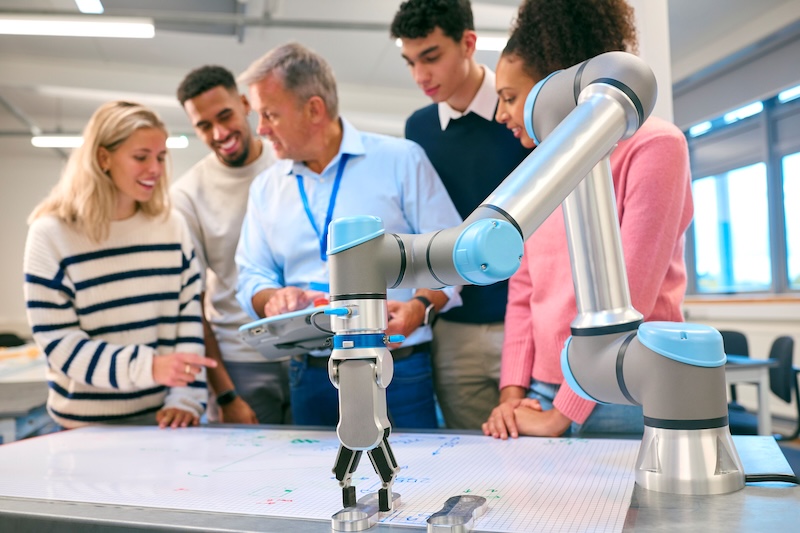
However, once these systems are deployed, they are prone to face unique challenges. Lighting conditions, variations in human behavior, the variety of surfaces encountered, and background noise are examples of factors that can contribute to these newfound friction points in untested scenarios.
The Limits of Testing
Predictable Labs vs. Real World Environments
Laboratories are designed to be predictable, repeatable, and controlled hard environments. However, robots also need to be resilient, predictable, drive away from humans, and have an understanding of human behavior. These requirements are in the nature of robotics design and testing.
When it comes to deployment, robots should be capable of understanding unpredictable changes, handling errors or mistakes in their performance, providing safety guarantees, and running to their full potential. After all, labs cannot fully simulate real-world environments.
The Benefits of Field Testing Early in the Test Pipeline
Introducing environments where robots can be used will help to identify flaws early in design in the navigation, sensing, and decision-making process.
This vastly speeds up the design feedback loop cycle instead of having to identify and fix problems in testing later in deployment.
Building a Strong Robotics Deployment Pipeline
Enabling Platforms to Iterate Development on Robots
Once robotic design reaches the phase out of the lab environments and is being tested, engineers will need to iterate on their process and support testing the design for the operational requirements in the environment where robots will eventually be deployed.
Human-Robot Integration as Automation Deployment Focus
Designing Technology That People Will Trust
Autonomous behaviors are still incredibly dependent on human acceptance and expectations from robotics technology. The best technical solution is unlikely to succeed if the autonomous capabilities cannot be easily understood and trusted by non-experts.
Factors like signaling intentions, predictability of movement, natural user interfaces, and safety points must be considered and developed to ensure user acceptance and adoption.
When deploying robots, it is important to focus cohesively on aspects such as fine-tuning implementation and increasing the consumer trust aspect of the technology. Users are more likely to accept the new technology if they have good familiarity with it.
The Role of the Feedback Loop in Deployment
Using Real Data to Optimize Performance
Robots in the world produce a wealth of operational data: drivetrain performance, error recovery success, navigation success rates, task completion data, and battery management performance.
Getting this feedback loop design helps to strengthen design autonomy, improve reliability, and prevent recurrence of design failure.
Bridging the Gap by Building Iteration-Based Innovation
Bringing a robotics deployment from concept all the way to completion begins with early introduced environments and finding ways to grow data collection and iteration over time.
When the team gets comfortable being in production, they calibrate models with integration data from different sources. Many data science teams have created custom calibration solutions and processes for collecting ground-truth or truth data.
Device Development companies, like the team at haapd.com are bringing robotics deployment from concept all the way to completion, beginning with early introduced environments and finding ways to grow data collection and iteration over time.
Main image: Robotic systems often perform well in a controlled environment.
