For a long time, coffee roasting was seen as something almost mystical. Experienced masters relied on their ears (listening for the “first crack”), their eyes, and even their intuition.
But when a business scales from a single coffee shop to an industrial facility, intuition becomes a liability. The cost of a single mistake is dozens of kilograms of expensive raw beans ruined and a hit to the company’s reputation.
Today’s market demands consistency. Customers expect their bag of coffee to have the exact same flavor as the one they bought last week.
Achieving this on analog, manually operated equipment is incredibly difficult. Human error, fluctuating humidity, and even voltage drops in the power grid all stand in the way.
That’s why Integra Sources was contacted by a manufacturer of coffee roasters. The company makes both small-scale models and industrial machines. The customer had an ambitious goal: to transform their mechanical roasters into smart IoT devices.
Project goals
- Automate roaster control systems.
- Enable automatic adaptation to changes in ambient humidity, temperature, and bean moisture levels.
- Ensure hardware compatibility across the client’s entire product line.
- Provide support for third-party software that the client’s customers already know and use.
What We Created
The heart of the designed system is the controller. It aggregates data from various sensors via the RS-485 interface and generates the necessary commands.
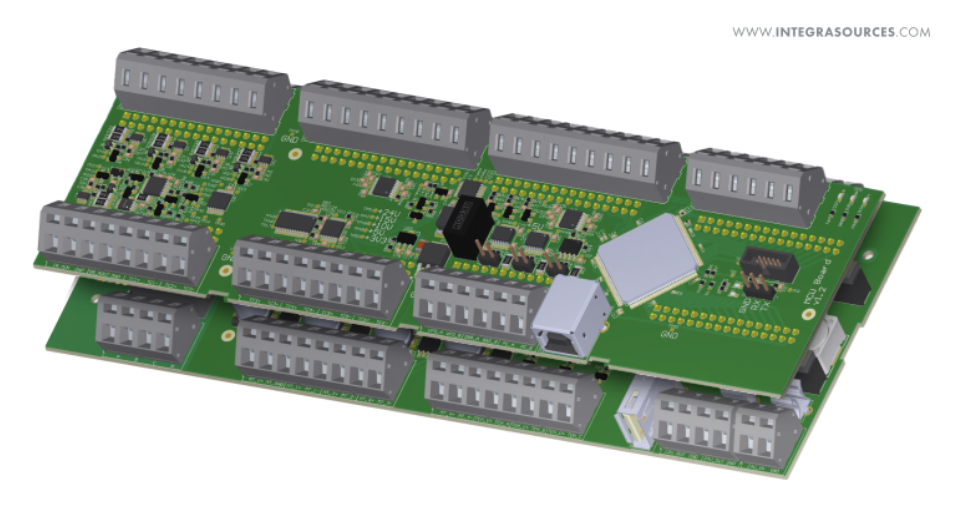
The controller is paired with a Raspberry Pi single-board computer (SBC) that handles the user interface. Data is transmitted from the roaster to the SBC via both USB and RS-485.
While USB is a more common and faster interface, it isn’t always reliable in industrial environments with their electromagnetic interference. To solve this, Integra’s engineers built in the ability to switch interfaces to ensure stability.
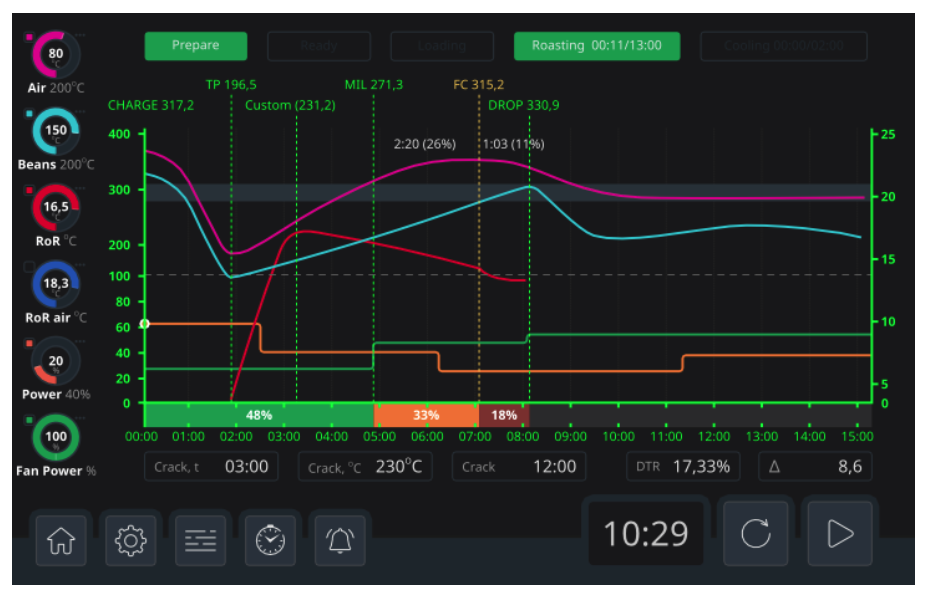
We developed custom software for managing the roasting cycle. The program analyzes sensor data and allows the operator to control process parameters, monitor temperature curves, and create custom roasting scripts—all via a 13-inch touchscreen display.
How the Solution Works
The system offers two automated roasting modes and full manual control.
Manual Control allows the operator to oversee every aspect of the process. In this mode, the roasting cycle can be halted at any moment by hitting a large emergency stop button.
Scripted Automatic Roasting follows a pre-defined temperature algorithm. This mode is ideal for precisely replicating specific recipes. Once created, these roasting profiles can be saved and uploaded to other machines.
Checkpoint-Based Automatic Roasting allows the operator to set specific milestones and link them to events, such as reaching a target temperature or loading the beans. This provides the flexibility to adapt the process to changing conditions, for instance, if the beans’ moisture content is higher than it should be.
Key Features
Checkpoint-Based Roasting
The primary cause of flavor inconsistency is environmental instability: warehouse humidity and factory floor temperatures are constantly fluctuating. To solve this, we implemented automatic roasting via checkpoints.
Instead of following a rigid, linear timeline, the system uses flexible checkpoints tied to the physical parameters of the beans or the environment.
Rather than simply moving forward based on time, the process waits for specific triggers such as reaching a target chamber temperature.
This flexibility allows the roasting profile to be dynamically adjusted in real-time, neutralizing the impact of external conditions or variations in the raw materials.
Versatility
To ensure the system works seamlessly across the client’s entire range of roasters, we designed a universal controller.
What the printed circuit board can do is determined when components are mounted. For simpler models, specific circuits are simply left out, reducing production costs and streamlining production.
As a result, the manufacturing of various device types is unified under a single standard, which accelerates the rollout of new batches and simplifies long-term maintenance.
Third-Party Software Support
Many professionals are used to existing tools and are often reluctant to switch to new ones. Understanding this, the team made the platform compatible with popular roasting monitoring applications.
This eliminates the entry barrier for new customers: they don’t have to change their established workflows or manually migrate data. The equipment becomes an immediate, plug-and-play part of their existing tech stack.
Over-the-Air Updates
Traditional maintenance for industrial equipment usually requires an expensive onsite visit from a specialist and significant production downtime. We reduced these overheads by integrating Over-the-Air firmware updates into the system.
This ensures that the client is always running the latest version of the software. Any algorithm improvements or bug fixes are deployed in the background, drastically increasing system reliability and boosting user loyalty.
Engineering Challenges
Theory and lab simulations rarely match what is reality happening inside a functioning industrial machine. During the commissioning phase, we encountered several issues that required not just software tweaks, but a significant overhaul of the circuit design.
The Battle for Data Integrity
On the test bench, the temperature sensors performed perfectly; however, on the actual roaster, the data was erratic. It was because of long, unshielded thermocouple wires used in the client’s roasters.
These wires caused the IC that processes sensor data and converts it into temperature readings to pick up interference from the frequency changer. The chip interpreted this noise as a voltage spike and would freeze up.
The Solution: Rather than requiring the client to replace all their wiring with shielded cables, we integrated an additional RC filter circuit into the measurement path.
Microsecond Precision
The designed device controls the roaster’s heating elements via solid-state relays. To extend their lifespan and minimize noise, the team implemented zero-cross switching: the relays switch on and off exactly as the AC voltage crosses zero. To keep system costs down, we used standard relays without built-in zero-cross detection.
But to work correctly, the system has to detect the moment when the voltage crosses zero without any lag. A traditional optocoupler-based circuit caused floating delays: the internal LED requires some time to get the necessary current, and this duration fluctuates based on several variables.
The Solution: Instead of the standard approach, the team used comparators in the zero-cross detector circuit. This slashed the delay down to tens of microseconds, ensuring pinpoint accuracy for the relay triggers.
Results: From Iron Oven to Digital Platform
This project shows how technology can transform traditional industrial equipment into a modern IoT solution. When the development was completed, the customer achieved the following:
- Digitally Repeatable Quality: Thanks to adaptive algorithms and checkpoints, the impact of environmental factors on coffee flavor has been minimized. Automation also significantly reduces the risk of human error.
- A New Standard of Service: Integrating OTA updates and remote access via RustDesk has changed technical support. Instead of on-site dispatch, it can be often done online. Bug fixes and feature expansions are now just a click away.
- Production Optimization and Scalability: A single, universal platform (hardware + software) is compatible with the client’s entire equipment line. This unified approach lowered manufacturing costs and streamlined production scaling.
- Openness and User Loyalty: Compatibility with industry-standard third-party software allows professional roasters to switch to our client’s equipment despite being used to other tools.
The project resulted in a high-tech product featuring adaptive control and high-level automation. It scales effortlessly and integrates with external software, significantly sharpening the client’s competitive edge in the market.
