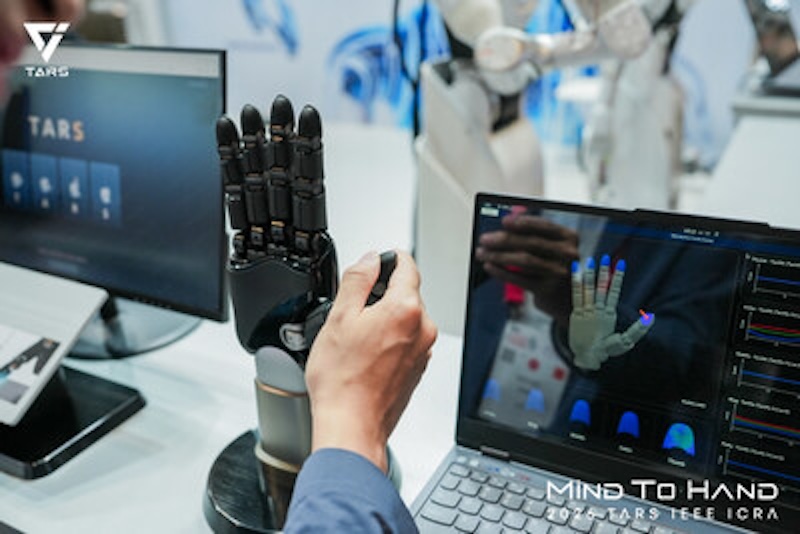
TARS has capped a landmark appearance at ICRA 2026, IEEE’s international robotics conference, with the international debut of its DexHand platform, drawing significant attention among industrialists and academics.
Dr Ding, TARS’ chief scientist and co-founder, delivered the keynote address in the plenary session.
TARS’ DexHand demonstration showcased all 26 English alphabet sign-language gestures and invited to engage in real-time mirror-control interaction, thus offering live proof of the system’s biomimetic fidelity and low-latency responsiveness.
At the heart of DexHand is a 21-DoF architecture modelled 1:1 on human metacarpal and phalangeal topology. Unlike conventional parallel-joint designs that introduce kinematic distortion during complex movements, DexHand replicates the spatial convergence of the thumb’s CMC and MCP joints, eliminating the motion blind spots.
Its self-developed joints integrate high-precision reducers, reducing backlash to an extremely small range and delivering silky-smooth micro-manipulation.
This biomimetic structure also solves one of embodied AI’s most pressing bottlenecks: the gap between simulation and reality. TARS’ SenseHub captures data from real human motion and map it, thus improving data utilization without any loss.
DexHand’s fingertips integrate ultra-high-resolution miniature camera modules capable of capturing microscopic textures as fine as 0.05mm at over 240Hz.
Its AWE 3.0 embodied foundation model, enables the robot to understand physical properties such as hardness, roughness, and slip risk, and to predict occurrence rather than merely reacting after the fact.
On the manufacturing side, DexHand’s rigid quasi-direct-drive design, using just three motor types and reducer types, is purpose-built for automated assembly lines.
“IEEE’s ICRA 2026 was the ideal stage to showcase TARS’ embodied AI solutions in practice,” said TARS’ chief scientist and co-founder Dr Ding. “TARS’ DexHand is the optimized interface between human intelligence and robotic action.”
