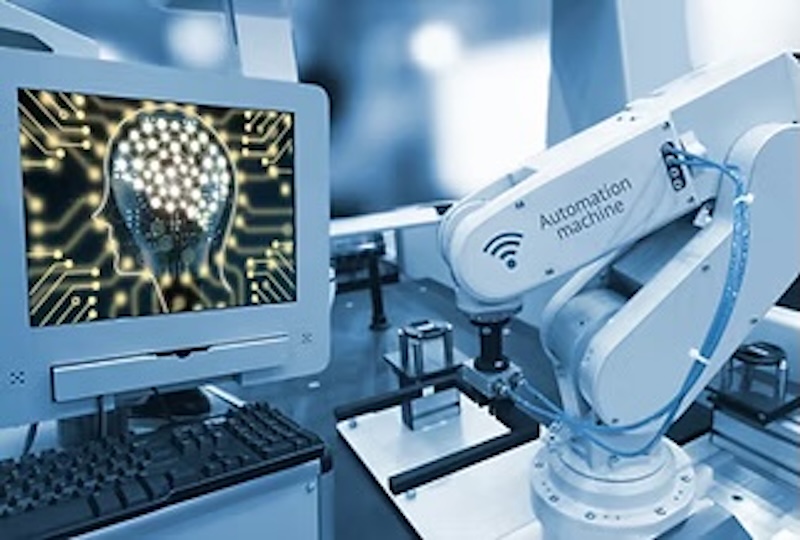
Artificial intelligence may dominate the headlines, but the future of robotics will depend on much more than software alone.
While many companies are racing to develop foundation models and increasingly capable AI systems, others argue that the real challenge lies in combining intelligence with hardware that can operate reliably in the physical world.
One company taking that approach is GMEX Robotics, a Nasdaq-listed developer of AI-enabled robotic systems for industrial, commercial, and consumer applications.
The company is pursuing opportunities across a wide range of markets, from industrial automation and logistics to hospitality and food service, where it recently secured its first commercial deployment order for its Bon Vivant 3.0 cooking robot platform.
At the center of the company’s strategy is what it describes as a “Terminal + Brain” architecture – a combination of intelligent hardware platforms and AI software designed to work together as a unified system.

Unlike many robotics startups that focus primarily on software, GMEX argues that physical robots provide a critical source of real-world data and user interaction that can help create long-term competitive advantages.
In this Q&A, Jun Wu, director of GMEX Robotics, discusses the company’s “hardware-first AI” philosophy, the lessons it has drawn from its background in biomechanics and fitness technology, and why he believes the next phase of robotics growth will be driven by vertically integrated platforms rather than standalone hardware or software products.
Wu also shares his views on the commercialization challenges facing the robotics industry, the growing importance of supply-chain automation, and how manufacturers are adapting to geopolitical pressures and changing global production networks.
Along the way, he outlines why hospitality, food service, industrial automation, and logistics may be among the sectors most ready for large-scale deployment of autonomous systems.
For investors and industry observers alike, the conversation provides an interesting perspective on one of the key debates shaping modern robotics: whether the long-term winners will be robot manufacturers, AI software developers, or the companies capable of bringing both together into a single, scalable platform.
Interview with Jun Wu

Robotics & Automation News: GMEX Robotics appears to span several areas simultaneously – industrial automation, logistics, healthcare robotics, autonomous delivery, and even robotic cooking systems. How would you define GMEX’s core identity as a robotics company?
Jun Wu: We are a human performance technology company blending decades of precision fitness engineering with next-generation AI robotics.
Think of our core identity as an integrated “Terminal + Brain” closed-loop system. We are applying our biomechanics expertise to build smart, human-centric robots in the consumer, commercial, and industrial spaces.
R&AN: Much of the robotics industry today is heavily focused on AI software and foundation models. GMEX has spoken about a “hardware-first AI advantage”. What does that mean in practical terms, and why do you believe hardware design remains strategically important?
JW: A pure-software approach just misses the mark because it lacks a physical entry point, which is exactly how we stand out from traditional software robotics startups. Every robot we deploy acts as a natural, high-frequency node for real-world AI inference.
This hardware-first foundation gives us continuous data flow and user stickiness that software alone simply can’t match. Plus, our AI routing platform lets us move away from low-margin, one-time hardware sales and into recurring, high-margin AI services.
R&AN: Your company’s background includes biomechanics, motion systems, and precision fitness engineering. How transferable are those capabilities to robotics, and what lessons from human movement influence your robot designs?
JW: They are absolutely foundational to everything we do. Our fitness division is still going strong and actually acts as a real-world laboratory for us to study human movement, daily routines, and ergonomics.
Because of this background, we design all our robots to work right alongside people, enhancing human capability rather than replacing it. For us, safety and usability are completely non-negotiable.
R&AN: Many robotics companies demonstrate impressive prototypes but struggle with large-scale commercialization. What do you see as the biggest barriers preventing robotics from moving more quickly into widespread real-world deployment?
JW: It really comes down to three major roadblocks. First, traditional robots rely on “dumb hardware” with fragmented intelligence, making them way too rigid for complex, real-world environments. Second, the hardware industry is stuck in severe price wars, leaving companies struggling to capture high-margin software value.
Finally, there is a massive issue with disconnected data silos. Without a unified system to seamlessly capture both physical behavioral data and AI inference data, companies lose out on building a real competitive moat.
R&AN: GMEX has highlighted applications ranging from hospital logistics to hospitality automation and industrial robotics. Which sectors do you believe are currently the most commercially ready for autonomous systems, and why?
JW: Just to clarify, our immediate focus is on hospitality, consumer, and industrial applications rather than hospital logistics. We see hospitality and food service as incredibly ready right now.
In fact, we just landed our first deployment order for our Bon Vivant 3.0 cooking robots, which kicks off a planned rollout of at least 50 systems across an Australian hospitality group. At the same time, industrial automation and logistics are definitely primed for scale as the market pushes toward a projected $94 billion by 2031.
R&AN: The global robotics industry is attracting huge levels of investment and intense competition, particularly around humanoids and embodied AI. How do you see the competitive landscape evolving over the next five years?
JW: The biggest shift will be moving away from being just device manufacturers and evolving into true ecosystem orchestrators. We are building a foundational infrastructure that connects hardware terminals to an AI routing operating system, and eventually to a full ecosystem of applications.
The companies that achieve premium valuations over the next few years will be the ones that successfully transition to subscriptions, over-the-air updates, and usage-based AI services.
R&AN: Supply chain resilience and manufacturing localization have become major concerns globally. How is the robotics sector adapting to shifting supply chains, geopolitical pressures, and increasing demand for domestic automation capabilities?
JW: The robotics sector is tackling these pressures head-on by turning manual, vulnerable processes into highly efficient, automated systems. GMEX is doing this by providing holistic supply chain automation that covers everything from warehouse fulfillment to last-mile drone delivery.
Our intelligent robots provide continuous, accurate stock-level visibility across entire facilities, which completely eliminates costly over-ordering and stockouts to keep local supply chains incredibly resilient.
R&AN: Looking ahead, do you believe the long-term winners in robotics will primarily be hardware manufacturers, AI software companies, vertically integrated platform providers, or companies that specialize in solving specific operational problems?
JW: The ultimate winners are going to be vertically integrated platform providers who create a complete, closed-loop ecosystem. Hardware brings the real-world scenarios and scale, while the AI platform delivers the intelligence and the high-margin revenue.
Pure hardware is destined for commoditization, and pure software struggles without a physical anchor. Only the combination of the two builds the kind of exclusive data moat needed to lead long-term.
R&AN: GMEX has announced developments across multiple robotics categories in a relatively short period of time. How do you prioritize focus internally, and how important is specialization versus platform breadth in today’s robotics market?
JW: Even though we are launching products across different categories, we are actually building one unified “Terminal + Brain” system. Our AI aggregation platform is the common thread that allows any of our robots to dynamically select and switch models.
However, our commercial rollout is highly specialized right now. We intentionally started with a relatable consumer domain with our culinary AI, which helps us build brand awareness and a data flywheel before we expand deeper into complex enterprise and industrial applications.
