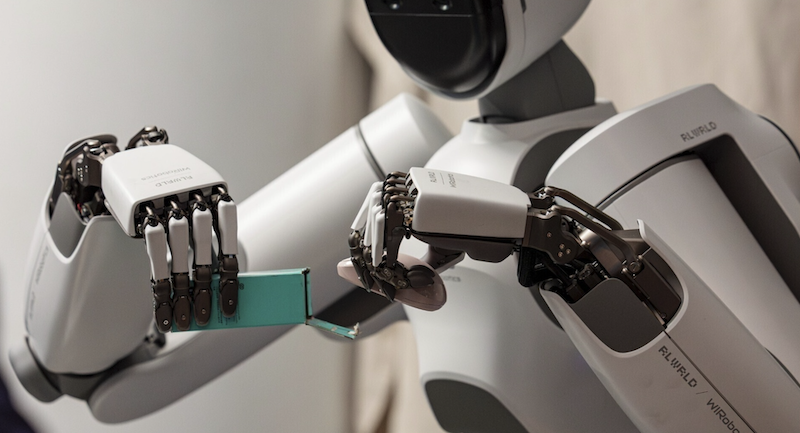
RLWRLD, a physical AI company developing the proprietary Robotics Foundation Model RLDX-1, has been named a World Economic Forum Technology Pioneer 2026.
The WEF Technology Pioneers program selects 100 innovative technology companies each year that are positioned to drive long-term, paradigm-shifting impact on global industries and society.
According to the WEF’s official analysis report, Meet the Technology Pioneers, this year’s selection centered on companies providing the foundational software and core infrastructure to support large-scale deployment of autonomous AI systems, ones that perceive, reason, and act directly in the physical world, going beyond conversational chatbots and application-layer software.
Among the physical AI companies selected in this year’s cohort, RLWRLD is the only one placed under the “Centre for AI Excellence” rather than “Advanced Manufacturing”.
The designation affirms RLWRLD’s value as a “universal brain” capable of integrating flexibly with world-class hardware and robotics manufacturers at any time, and establishes the ecosystem foundation for the company to grow alongside diverse manufacturing and logistics robot hardware platforms on the global stage.
Alongside the selection, the WEF officially published a physical AI article authored by RLWRLD’s leadership (CEO Junghee Ryu, CSO Jeeyun Ahn, and technical strategist Junho Cho) on its website: “Hand dexterity remains a barrier to automation. Here’s why a common benchmark could help.”
Through the article, RLWRLD’s leadership notes that while the humanoid and physical AI boom is accelerating amid a global labor shortage, dexterous manipulation, the precise handling of objects by robots, remains the single greatest bottleneck and last-mile barrier in industrial automation.
As a concrete solution, the article formally introduces DexBench, a globally recognized standard framework for objectively measuring and validating robotic manipulation performance based on real-world requirements from manufacturing, logistics, and service environments, going beyond the constraints of laboratory testing.
The article also addresses the need for standardized metrics and shared data infrastructure that the global robotics community can collectively adopt to accelerate advances in robotic manipulation.
Notably, the article directly names key ecosystem partners that have begun supporting and adopting the DexBench standard metrics, including Lotte, SK Telecom, CJ Logistics, Hyosung, and HL Mando in Korea, as well as global industry leaders Fuji, ANA, and Mitsui Chemicals.
Through this, RLWRLD moves beyond a technology selection to lead global physical AI discourse, bringing the need for a shared robotics manipulation standard into the public agenda and rallying support from major enterprises around the world.
RLWRLD is also directly cited in the WEF report as a global innovation case study. In a section examining serial entrepreneurs building infrastructure-layer technology, the forum highlights that, “Junghee Ryu, who previously founded computer vision company Olaworks and successfully sold it to Intel, has returned with RLWRLD to build a foundation model for robotics.”
The recognition builds on a strong run of milestones: RLWRLD recently claimed the Grand Prize at the InnoVEX Pitch Contest at Computex 2026 in Taiwan and completed a successful global roadshow as a recognized core partner in Nvidia’s physical AI ecosystem.
Over the next two years, RLWRLD will participate as an official member of the WEF Innovator community, receiving invitations to Davos and other major global forums to build international networks with policy, technology, and market leaders worldwide.
CEO Junghee Ryu will attend the WEF Annual Meeting of the New Champions (Summer Davos) in Dalian, China, from June 23 to 25, where he will engage with global leaders on the agenda for next-generation AI infrastructure.
Junghee Ryu, CEO of RLWRLD, says: “Being placed under the ‘Centre for AI Excellence’ as a Technology Pioneer 2026 is global validation that RLWRLD’s technology is the innovative software infrastructure capable of bringing physical AI from possibility into real-world industrial deployment.
“We will establish the global standard for physical AI technology through comprehensive collaboration with global technology leaders including Nvidia, AWS, and Microsoft, as well as world-class robotics manufacturing and hardware partners around the world.”
