• Skip to primary navigation
  • Skip to main content
  • Skip to primary sidebar
  • Skip to secondary sidebar
  • About
    • Contact
    • Privacy
    • Terms of use
  • Shop
    • Cart
    • Checkout
    • My Account
  • Advertise
    • Advertising
      • Buy ad space
    • Case studies
    • Design
    • Email marketing
    • Features list
    • Lead generation
    • Magazine
    • Press releases
    • Publishing
    • Sponsor an article
    • Webcasting
    • Webinars
    • White papers
    • Writing
  • Subscribe to Newsletter

Robotics & Automation News

Where Innovation Meets Imagination

  • Home
  • News
  • Features
  • Editorial Sections A-Z
    • Agriculture
    • Aircraft
    • Artificial Intelligence
    • Automation
    • Autonomous Vehicles
    • Business
    • Computing
    • Construction
    • Culture
    • Design
    • Drones
    • Economy
    • Energy
    • Engineering
    • Environment
    • Health
    • Humanoids
    • Industrial robots
    • Industry
    • Infrastructure
    • Investments
    • Logistics
    • Manufacturing
    • Marine
    • Material handling
    • Materials
    • Mining
    • Promoted
    • Research
    • Robotics
    • Science
    • Sensors
    • Service robots
    • Software
    • Space
    • Technology
    • Transportation
    • Warehouse robots
    • Wearables
  • Press releases
  • Events

From backflips to folding laundry: How X Square Robot is building the missing ‘brain’ for embodied AI

June 17, 2026 by Sam Francis

While robotics companies around the world continue to showcase humanoids performing backflips, running obstacle courses, and dancing on stage, one Chinese firm is pursuing a more difficult – and arguably more consequential – goal: teaching robots to operate in the messy, unpredictable environments where people actually live and work.

According to X Square Robot founder and CEO Wang Qian, the industry’s hardware foundations are largely in place. Humanoid locomotion, dexterous hands, and force-control systems have all advanced rapidly. The remaining challenge is intelligence.

“The hardware is largely there,” Wang said. “The real bottleneck is the brain.”

To address that gap, X Square Robot has open-sourced three technologies over the past several weeks:

  • Wall-OSS-0.5, a Vision-Language-Action (VLA) model;
  • WALL-WM, a World Action Model designed to understand physical events; and
  • XRZero-G0, a robot-free data collection and training framework aimed at dramatically reducing data costs.

Can pretraining teach robots real skills?

VLA models have become one of embodied AI’s dominant approaches, but a fundamental question remains: does pretraining itself teach robots useful skills, or is it merely preparation for task-specific fine-tuning?

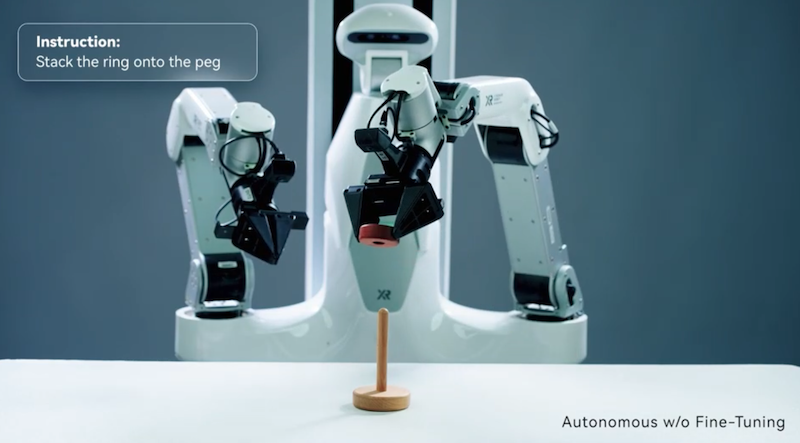
Wall-OSS-0.5 was designed to answer that question. Rather than evaluating a fine-tuned model, X Square Robot deployed the pretrained model directly on physical robots and tested it across 17 real-world tasks.

The system achieved strong zero-shot performance in object sorting, ring stacking, and even deformable-object manipulation.

At the core of the model is a “gradient-bridged” training framework.

Instead of separating perception and control into different modules, Wall-OSS-0.5 converts robot actions into action tokens that are learned alongside language and visual representations during pretraining.

This allows perception, language understanding, and action generation to evolve within a unified model.

The company found that action training not only improved manipulation ability but also enhanced visual grounding performance, suggesting that physical interaction can strengthen a model’s understanding of the world.

Teaching robots how the world works

While Wall-OSS-0.5 demonstrated the promise of VLA pretraining, X Square Robot believes imitation alone is not enough.

Most VLA systems learn action trajectories but do not truly understand physical cause and effect. They can repeat behaviors seen during training but often struggle when confronted with unfamiliar situations.

To address this limitation, the company introduced WALL-WM, a World Action Model that shifts learning from fixed action sequences to meaningful physical events such as reaching, grasping, lifting, and placing.

Unlike traditional architectures that separate perception, language, and control, WALL-WM aligns visual observations, language descriptions, and actions around real-world events.

The goal is to enable robots not only to act, but also to predict outcomes, reason about physical changes, and adapt when plans fail.

According to the company, this approach represents a step toward robots that learn from experience and continuously improve their understanding of the physical world.

Solving embodied AI’s data bottleneck

If world models are the brain, data remains the fuel.

Collecting high-quality robot demonstrations is expensive, time-consuming, and difficult to scale. X Square Robot’s answer is XRZero-G0, a hardware-software framework for robot-free data collection and training.

The system combines wearable interfaces, multi-view sensing, automated quality inspection, and real-robot validation to improve data quality while lowering collection costs.

Through controlled experiments, X Square Robot found that combining ten robot-free demonstrations with one real-robot demonstration could achieve performance comparable to datasets built entirely from real-robot data.

The company has also released more than 2,000 hours of multimodal data covering roughly 3,000 tasks to support broader research in embodied AI.

Building the infrastructure for embodied intelligence

Together, the three releases address some of the most important challenges facing embodied AI.

Wall-OSS-0.5 explores whether pretraining can directly produce transferable robot skills. WALL-WM examines how robots can model and reason about the physical world. XRZero-G0 tackles the data bottleneck that underpins both approaches.

Taken together, they form a full-stack framework spanning data, world models, and robot foundation models.

For Wang, the CEO, the industry’s defining moment may be closer than many expect. The challenge is no longer teaching robots how to move, but teaching them how to understand the world they navigate.

“The Aha Moment for embodied intelligence,” he said, “may be much closer than people think.”

Print Friendly, PDF & Email

Share this:

  • Print (Opens in new window) Print
  • Share on Facebook (Opens in new window) Facebook
  • Share on LinkedIn (Opens in new window) LinkedIn
  • Share on Reddit (Opens in new window) Reddit
  • Share on X (Opens in new window) X
  • Share on Tumblr (Opens in new window) Tumblr
  • Share on Pinterest (Opens in new window) Pinterest
  • Share on WhatsApp (Opens in new window) WhatsApp
  • Share on Telegram (Opens in new window) Telegram

Related stories you might also like…

Filed Under: Computing, Humanoids, News, Robot simulation Tagged With: ai robotics, artificial intelligence, automation news, Autonomous robots, computer vision, embodied ai, foundation models, humanoid robots, machine learning, physical ai, robot foundation models, robot learning, robot training, robotics and automation, robotics and automation news, robotics news, vision language action, VLA model, world model, x square robot

Primary Sidebar

Search this website

Latest articles

  • Intrinsic’s vision for physical AI: Building the software-defined factory
  • AI-powered robot automates Serrano ham labeling for the first time
  • Siemens partners with Databricks and FFT to turn production data into scalable AI-driven insights
  • Eclipse Automation unveils immersive factory planning platform at Automate 2026
  • Doosan Robotics launches AI-powered palletizing solution for high-mix manufacturing
  • How a Parking Management System Boosts Revenue and Cuts Overhead
  • Manufacturing future: the best countries to start or relocate your tech startup in 2026
  • How JLCMC is Redefining Industrial Automation Solutions for Modern Factories
  • 8 Red Flags to Watch for When Hiring a Web Design Agency
  • Opinion: Why robot dogs are leading the pack in factory floor efficiency

Secondary Sidebar

Latest news

  • Intrinsic’s vision for physical AI: Building the software-defined factory
  • AI-powered robot automates Serrano ham labeling for the first time
  • Siemens partners with Databricks and FFT to turn production data into scalable AI-driven insights
  • Eclipse Automation unveils immersive factory planning platform at Automate 2026
  • Doosan Robotics launches AI-powered palletizing solution for high-mix manufacturing
  • How a Parking Management System Boosts Revenue and Cuts Overhead
  • Manufacturing future: the best countries to start or relocate your tech startup in 2026
  • How JLCMC is Redefining Industrial Automation Solutions for Modern Factories
  • 8 Red Flags to Watch for When Hiring a Web Design Agency
  • Opinion: Why robot dogs are leading the pack in factory floor efficiency

Copyright © 2026 · News Pro on Genesis Framework · WordPress · Log in

We use cookies on our website to give you the most relevant experience by remembering your preferences and repeat visits. By clicking “Accept”, you consent to the use of ALL the cookies.
Do not sell my personal information.
Cookie SettingsAccept
Manage consent

Privacy Overview

This website uses cookies to improve your experience while you navigate through the website. Out of these, the cookies that are categorized as necessary are stored on your browser as they are essential for the working of basic functionalities of the website. We also use third-party cookies that help us analyze and understand how you use this website. These cookies will be stored in your browser only with your consent. You also have the option to opt-out of these cookies. But opting out of some of these cookies may affect your browsing experience.
Necessary
Always Enabled
Necessary cookies are absolutely essential for the website to function properly. These cookies ensure basic functionalities and security features of the website, anonymously.
CookieDurationDescription
cookielawinfo-checkbox-analytics11 monthsThis cookie is set by GDPR Cookie Consent plugin. The cookie is used to store the user consent for the cookies in the category "Analytics".
cookielawinfo-checkbox-functional11 monthsThe cookie is set by GDPR cookie consent to record the user consent for the cookies in the category "Functional".
cookielawinfo-checkbox-necessary11 monthsThis cookie is set by GDPR Cookie Consent plugin. The cookies is used to store the user consent for the cookies in the category "Necessary".
cookielawinfo-checkbox-others11 monthsThis cookie is set by GDPR Cookie Consent plugin. The cookie is used to store the user consent for the cookies in the category "Other.
cookielawinfo-checkbox-performance11 monthsThis cookie is set by GDPR Cookie Consent plugin. The cookie is used to store the user consent for the cookies in the category "Performance".
viewed_cookie_policy11 monthsThe cookie is set by the GDPR Cookie Consent plugin and is used to store whether or not user has consented to the use of cookies. It does not store any personal data.
Functional
Functional cookies help to perform certain functionalities like sharing the content of the website on social media platforms, collect feedbacks, and other third-party features.
Performance
Performance cookies are used to understand and analyze the key performance indexes of the website which helps in delivering a better user experience for the visitors.
Analytics
Analytical cookies are used to understand how visitors interact with the website. These cookies help provide information on metrics the number of visitors, bounce rate, traffic source, etc.
Advertisement
Advertisement cookies are used to provide visitors with relevant ads and marketing campaigns. These cookies track visitors across websites and collect information to provide customized ads.
Others
Other uncategorized cookies are those that are being analyzed and have not been classified into a category as yet.
SAVE & ACCEPT