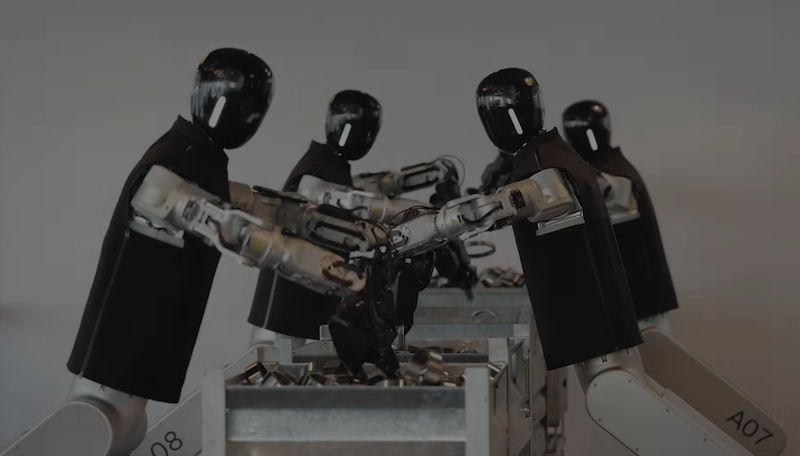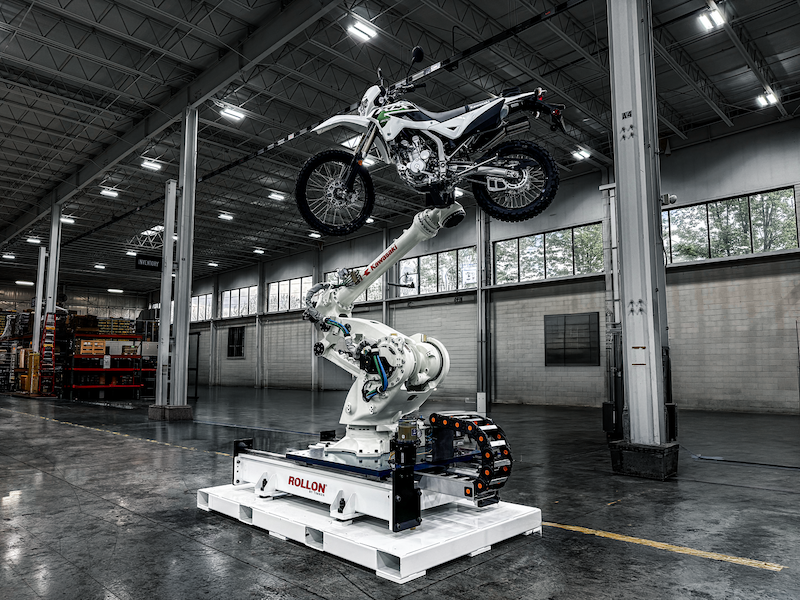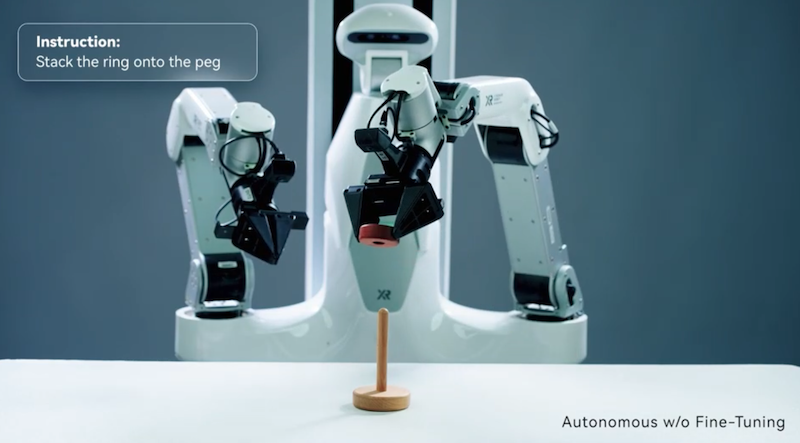
The next leap in robotics won’t come from faster processors or more sophisticated mechanical design. It will come from better data, specifically, from training environments that replicate how the physical world actually behaves. [Read more…] about Why robotics can’t advance without physical AI
machine learning
Genesis AI launches simulation platform to accelerate robotics development
Genesis AI has launched Genesis World 1.0, a new robotics simulation platform designed to dramatically reduce the time required to develop, test, and evaluate robotic AI systems.
The company says the platform can compress robotics evaluation cycles from days to minutes by enabling large-scale testing in photorealistic virtual environments rather than relying solely on physical robots.
According to Genesis AI, a robotics foundation model evaluation that would typically require nearly a week of continuous testing on real hardware can be completed in approximately 30 minutes using Genesis World 1.0 running on GPU infrastructure. [Read more…] about Genesis AI launches simulation platform to accelerate robotics development
CVPR 2026 fields 16,000+ paper submissions on technical advances in AI
The program committee of the 2026 Conference on Computer Vision and Pattern Recognition (CVPR), one of the world’s leading artificial intelligence (AI) and computer vision research events, has released the details of this year’s technical program.
Co-sponsored by the IEEE Computer Society (CS) and the Computer Vision Foundation (CVF), CVPR 2026 drew a record number of paper submissions – 16,092, a 24 percent increase over 2025. Through a rigorous peer-review process, about one-quarter were accepted to the program, resulting in 4,089 paper presentations.
“CVPR submissions have more than doubled over the past five years, but the acceptance rate has remained highly competitive, consistently in the low-to-mid 20 percent range,” said Alexander G. Schwing, associate professor, electrical and computer engineering, University of Illinois Urbana-Champaign, CVPR 2026 program co-chair. [Read more…] about CVPR 2026 fields 16,000+ paper submissions on technical advances in AI
Virginia Tech researchers control soft robotics with ‘AI’s cousin’: ‘Reservoir computing’
Soft robotics – machines made of flexible, muscle-like materials – can bend and stretch in fluid ways that put the rigid robots of old sci-fi movies to shame.
But the flexibility that lets them pick ripe tomatoes or navigate a search-and-rescue site comes at a cost: soft robotics are notoriously difficult to control.
Virginia Tech researchers are working to solve that problem using a new computing approach inspired by the complex architecture of neurons in the brain. [Read more…] about Virginia Tech researchers control soft robotics with ‘AI’s cousin’: ‘Reservoir computing’
How AI and Automation Are Reshaping Enterprise Customer Loyalty in 2026
AI and automation are changing how enterprises build and maintain customer loyalty in 2026.
Companies now use predictive analytics, agentic AI, and real-time personalization to retain customers, reduce churn, and increase lifetime value, moving well beyond points-based rewards programs.
In this guide, we’ll break down how these tools are reshaping loyalty across three areas: churn prevention, personalization at scale, and the shift toward invisible, emotionally driven loyalty experiences. [Read more…] about How AI and Automation Are Reshaping Enterprise Customer Loyalty in 2026
CVPR 2026 to showcase next generation of embodied AI, robotics, and autonomous systems
This year’s CVPR – Conference on Computer Vision and Pattern Recognition – will bring together more than 100 technology companies, AI developers, robotics firms, and autonomous systems specialists in Denver next month as the event highlights the latest advances in embodied AI, machine vision, robotics, and autonomous technologies.
Co-sponsored by IEEE Computer Society and the Computer Vision Foundation, the conference will run from June 3-7 at the Colorado Convention Center, with the exhibition floor open June 5-7. [Read more…] about CVPR 2026 to showcase next generation of embodied AI, robotics, and autonomous systems
IEEE explores future of ‘networked AI’ where robots learn collectively
Researchers are increasingly exploring a future in which robots and AI systems do not operate as isolated machines, but instead learn collectively across connected networks – sharing information, adapting to changing environments, and continuously optimizing their own behavior in real time.
That growing area of research – often referred to as “networked AI” – is now the focus of a new special issue from the IEEE Signal Processing Society and the IEEE Journal of Selected Topics in Signal Processing, which have issued a call for papers examining “Autonomous and Evolutive Optimization in Networked AI”.
While the academic terminology may sound abstract, many of the themes are closely connected to emerging trends already reshaping robotics and industrial automation, including multi-agent robotics, distributed AI systems, edge intelligence, autonomous vehicles, warehouse robot fleets, and collaborative industrial automation. [Read more…] about IEEE explores future of ‘networked AI’ where robots learn collectively
How AI is powering the next generation of robots – insights from a leading global conference
The 2026 Conference on Computer Vision and Pattern Recognition Conference (CVPR), which annually unveils the latest research in support of artificial intelligence (AI), embodied AI and robotics, multi-modal AI, wearable AI, spatial computing, AI agents, and much more, will serve as one of the foremost forums to showcase how advances in AI are accelerating next-gen robotics from concept to real-world deployment.
Co-sponsored by the IEEE Computer Society (CS) and the Computer Vision Foundation (CVF), CVPR, an annual launchpad for breakthroughs in AI, and this year for robotics, will convene the leading research, companies, and applications redefining what robots can see, understand, and do.
Through its program, CVPR 2026, which takes place 3-7 June at the Colorado Convention Center in Denver, Colorado, USA, will reveal how AI is fueling rapid innovation in robotics, automation, and embodied intelligence. [Read more…] about How AI is powering the next generation of robots – insights from a leading global conference
League of Legends and the Future of AI-Driven Competitive Gaming Platforms
The competitive gaming industry increasingly relies on sophisticated artificial intelligence systems to manage player experiences, optimize performance, and maintain fair competition.
League of Legends stands as a prime example of how AI-driven platforms are reshaping the landscape of digital competition and creating new paradigms for interactive entertainment technology. [Read more…] about League of Legends and the Future of AI-Driven Competitive Gaming Platforms
Reinforcement learning in robotics: Robots that learn from experience
Reinforcement learning (RL) is transforming the way robots interact with the world.
Unlike traditional programming or supervised learning, which depend on pre-defined rules or labeled datasets, RL enables robots to learn through trial and error – much like how humans and animals acquire new skills.
This approach is increasingly vital as robots are deployed in complex, unstructured environments where adaptability is key. [Read more…] about Reinforcement learning in robotics: Robots that learn from experience