Although Omron and Kuka have demonstrated similar systems before, a table tennis-playing robot may still sound like a novelty to some. After all, industrial robots already assemble cars, sort parcels and weld metal with remarkable precision.
But for researchers working at the intersection of robotics and artificial intelligence, table tennis represents one of the most demanding real-world tests imaginable.
A successful table tennis player must perceive a fast-moving object, predict its trajectory, decide on a response, position themselves correctly and execute a precise movement – all within fractions of a second. The challenge combines vision, motion planning, control, prediction and decision-making in a constantly changing environment.
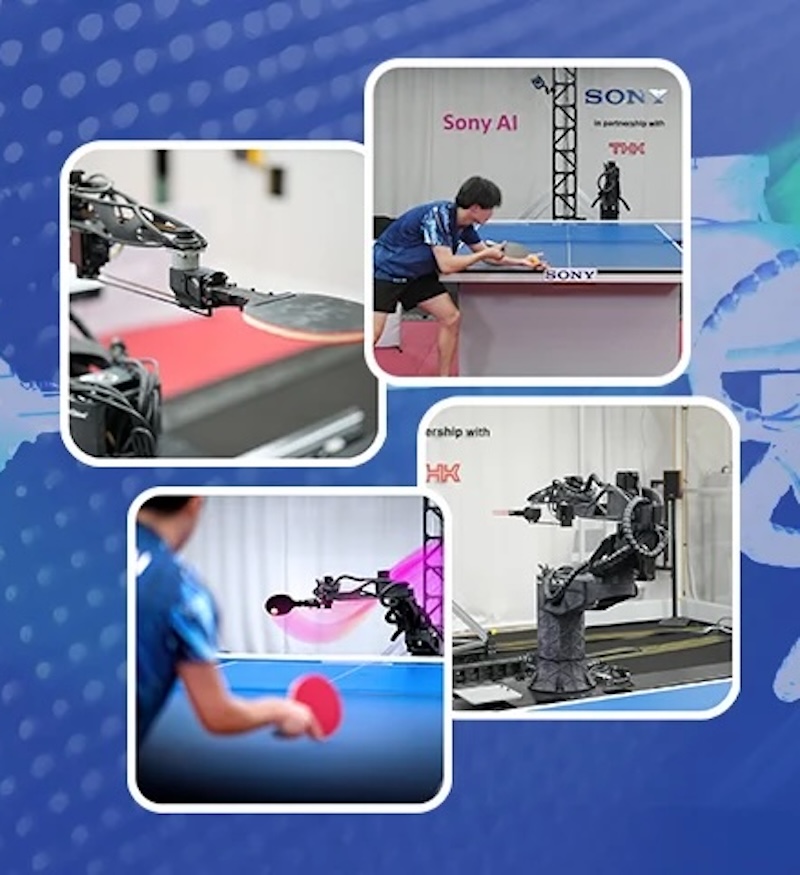
That is why Sony AI has spent several years developing Ace, an autonomous table tennis robot that has become a proving ground for advances in physical AI.
The company recently revealed that Ace has progressed beyond the results described in its Nature paper published earlier this year.
Between February and April 2026, the system recorded victories against seven professionally ranked table tennis players under official competition rules, including former world No. 5 Miu Hirano and Miyuu Kihara, currently ranked No. 26 in the world.
While Sony is careful not to claim the robot has surpassed the world’s best human players, the results represent what the company describes as the first demonstration of an autonomous robotic system defeating professionally ranked opponents in a competitive sport under official rules.
Perhaps more significant than the victories themselves is how Ace achieved them.
According to Sony AI, most of the improvements came not from redesigning the machine but from retraining and scaling its AI models.
The researchers expanded the size of the neural networks controlling the robot, refined its reinforcement learning algorithms, improved its simulation environment and introduced new training objectives designed to encourage anticipation rather than simple reaction.
The project also highlights a growing trend across robotics: the combination of physics-based simulation and machine learning.
Ace learned from vast amounts of simulated gameplay before transferring those skills into the real world, where additional experience against stronger opponents was used to further refine performance.
Hardware improvements played a role as well. Engineers reduced weight through topology optimization, upgraded motors to increase acceleration and improved perception latency from approximately 10 milliseconds to 8.5 milliseconds, giving the robot additional reaction time against high-speed shots.
The broader significance extends well beyond sport.
Many of the same capabilities required to return a spinning table tennis ball are also required for future robots operating in factories, warehouses and other dynamic environments.
Robots must interpret complex sensory information, predict outcomes and adapt their behavior in real time when conditions change.
In that sense, table tennis serves as a benchmark for a larger goal: building robotic systems capable of responding intelligently to the unpredictability of the physical world.
Whether Ace ever reaches the level of the world’s top table tennis professionals may ultimately be less important than the technologies developed along the way.
The project demonstrates how advances in simulation, reinforcement learning, perception and control can combine to create increasingly capable physical AI systems.
For the robotics industry, that may be the most valuable lesson of all.
