
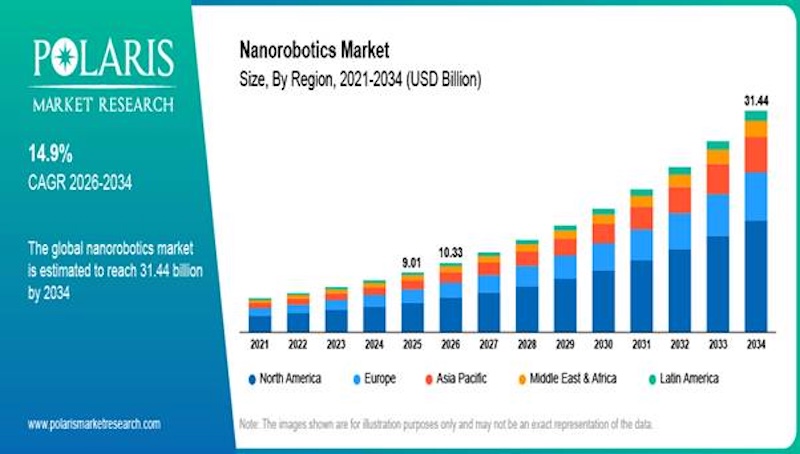
The global nanorobotics market is forecast to reach $31.44 billion by 2034, driven by growing applications in targeted drug delivery, precision medicine and regenerative medicine, according to new research from Polaris Market Research.
The research firm estimates the market at approximately $9 billion in 2025 and expects it to expand at a compound annual growth rate of 14.9 percent through 2034.
Drug delivery currently represents the largest commercial application for nanorobotics, with research increasingly focused on using nanoscale systems to deliver therapeutics to specific cells while limiting their effects on healthy tissue.
Polaris points to several recent research projects demonstrating the potential of the technology. Researchers at Sweden’s Karolinska Institute have developed a DNA-based nanorobot designed to activate within the tumor microenvironment, which reduced tumor growth by 70 percent in preclinical models.
Researchers at the Institute for Bioengineering of Catalonia, or IBEC, have demonstrated autonomous therapeutic nanorobots that reduced bladder tumors by up to 90 percent in preclinical testing.
Meanwhile, researchers at the University of Basel have developed a modular, self-assembling nanorobot that reduced cancer cell viability to 16 percent under laboratory conditions.
Beyond drug delivery, Polaris identifies cell-repair nanorobots as the fastest-growing device category, while regenerative medicine is expected to be the fastest-growing application. Growth in areas including stem cell therapies, tissue engineering and organoid research is expected to increase demand for nanoscale technologies.
Hospitals currently represent the largest group of buyers, although research institutes are increasing their adoption more rapidly, according to the report.
Significant geographical differences are also emerging. North America currently accounts for approximately 41 percent of the global nanorobotics market, supported by research funding, established healthcare infrastructure and regulatory pathways for nanotechnology-based medical devices.
Asia Pacific, however, is forecast to record the fastest growth, at almost 19 percent annually. Polaris attributes the expansion partly to increasing biotechnology and precision medicine investment in China, Japan, South Korea and India.
Europe is also investing in the field through collaborative research programs, including the EU-backed i-NANOSWARMS project, which is investigating intelligent nanorobot swarms for applications including targeted drug delivery.
The current competitive landscape includes established scientific instrumentation companies such as Thermo Fisher Scientific, Bruker, Oxford Instruments, JEOL and Park Systems, alongside specialist companies including Kleindiek Nanotechnik and Nanonics Imaging.
Polaris expects the structure of the industry to change as nanorobotics progresses beyond imaging and manipulation technologies toward therapeutic applications, potentially creating opportunities for consolidation between established nanoscale technology companies and biotechnology developers.
Main image courtesy of Springer Nature
