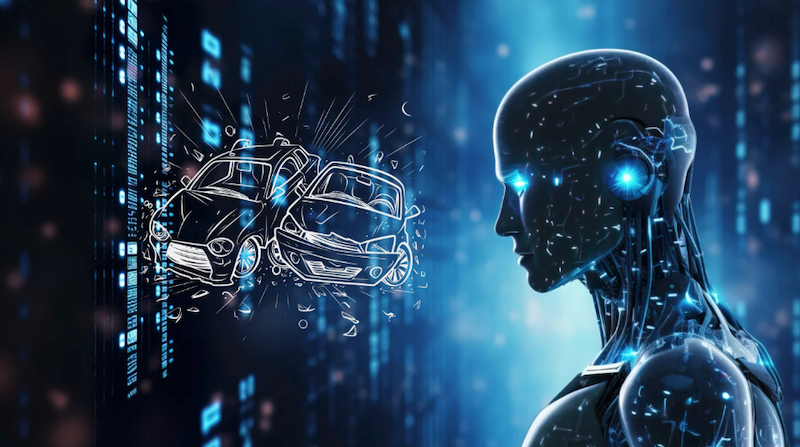
Artificial intelligence has moved from research labs into everyday driving faster than most people realize. Modern vehicles already use AI to detect lane drift, judge following distance, and apply emergency braking before a driver can react.
The next question researchers are asking is bigger: can AI actually predict when and where a crash is about to happen, not just respond to one already in motion?
How Predictive Systems Work
Traditional safety systems are reactive. A camera detects an object in the road and the car brakes. Predictive AI systems try to work a step earlier.
They pull in data from multiple sources at once, including vehicle speed, steering input, following distance, weather conditions, and even driver eye movement, then use pattern recognition trained on massive datasets of past crashes to flag situations that resemble the early stages of a collision.
Some systems go further by analyzing traffic flow across an entire road network. City transportation departments are beginning to test AI models that watch live traffic camera feeds and sensor data to spot patterns associated with a higher crash risk, such as sudden braking clusters near a merge point or a spike in near-miss events at a particular intersection during certain hours.
In theory, that information can trigger a dynamic response, like adjusting a signal timing or sending an alert to nearby connected vehicles, before a crash actually happens.
The Data Behind the Push for Prediction
The case for investing in predictive technology is strong when you look at how many crashes trace back to human decision-making.
Federal crash investigators have found that a driver-related factor, such as misjudging another vehicle’s speed or failing to notice a hazard in time, is identified as the critical last event in the vast majority of crashes studied.
Researchers are careful to note that this figure describes the final link in a chain of events rather than a full assignment of blame, since road design, vehicle condition, and other drivers often set up the situation a driver ultimately fails to handle.
Even with that caveat, the pattern is consistent enough that predictive AI aimed at driver behavior has real potential to reduce serious crashes.
National crash numbers show why the stakes are high. NHTSA’s early estimates for 2025 point to about 36,640 traffic deaths nationwide, down 6.7 percent from 2024 and among the lowest fatality rates per mile driven in the agency’s recorded history.
That progress came even as Americans logged more miles on the road than the year before, which suggests that safety technology and enforcement are doing real work. Locally, the picture is tougher.
Houston recorded 300 traffic deaths in 2025, and Harris County as a whole saw 517, with lane control failures and impaired driving cited as leading factors in fatal crashes.
Where AI is Already Making a Difference
Insurance companies have used AI-driven telematics for years, tracking hard braking events, speeding patterns, and phone use behind the wheel to build individualized risk profiles.
Some fleet operators use similar systems paired with in-cab cameras that flag drowsy or distracted driving in real time, prompting an alert before a driver drifts out of a lane.
Automakers are building predictive collision avoidance directly into newer vehicles, using sensor fusion to anticipate a pedestrian stepping off a curb or a vehicle merging without a signal.
These tools are not perfect. AI models can misread a scenario, and heavy reliance on prediction raises real questions about privacy, driver monitoring, and who is responsible when a system fails to catch a dangerous situation in time.
Still, the trend line points toward more predictive technology in vehicles and on roads over the next decade, not less.
Why This Matters After a Crash Happens
Even the most advanced prediction system cannot stop every collision, and when a crash does happen, the data these systems generate is becoming increasingly important to how the case gets resolved. Modern vehicles record speed, braking, steering angle, and other inputs in the moments before impact.
That data, combined with roadway sensor information and traffic camera footage, can offer an objective account of what actually happened, one that is far harder for an insurance company to dispute than a driver’s word alone.
This is a topic Hank Stout, co-founding partner of Sutliff & Stout, has explored directly. Stout recently launched the Houston Car and Truck Accident Law podcast, where he breaks down what happens in the days and weeks after a serious wreck and how the evidence gathered, including vehicle data and crash reconstruction, shapes the outcome of a claim.
Sutliff & Stout has earned a reputation across the Houston area for great communication with clients and consistently strong reviews, built on more than two decades of handling car and truck accident cases.
The Road Ahead
Predicting a crash with perfect accuracy is probably not realistic given how many variables are involved in any single moment on the road. But AI does not need to be perfect to make a difference.
Even modest improvements in identifying high-risk moments, whether that is a driver’s attention drifting or a dangerous merge pattern building at an intersection, translate into fewer serious injuries and fatalities over time.
As more vehicles ship with predictive safety features and more cities adopt AI-assisted traffic monitoring, the technology will keep closing the gap between reacting to accidents and anticipating them.
For drivers, that shift matters in two ways. It may mean fewer close calls behind the wheel, and it means better documentation when a crash does happen, which matters enormously if you ever need to prove what occurred and hold the right party accountable.
Final Thoughts
AI is not yet able to stop every accident before it starts, but the direction of travel is clear. Predictive systems are getting better at spotting risk earlier, vehicles are collecting more data than ever about how a crash unfolds, and that information is reshaping both road safety and the legal process that follows a serious wreck.
The technology still has limits, but it is already changing what “prevention” looks like on modern roads.
