The right computer vision development company is the one that fits the environment where your model will run. These could be a camera SoC, a cloud SaaS product, a medical device, or a live video system.
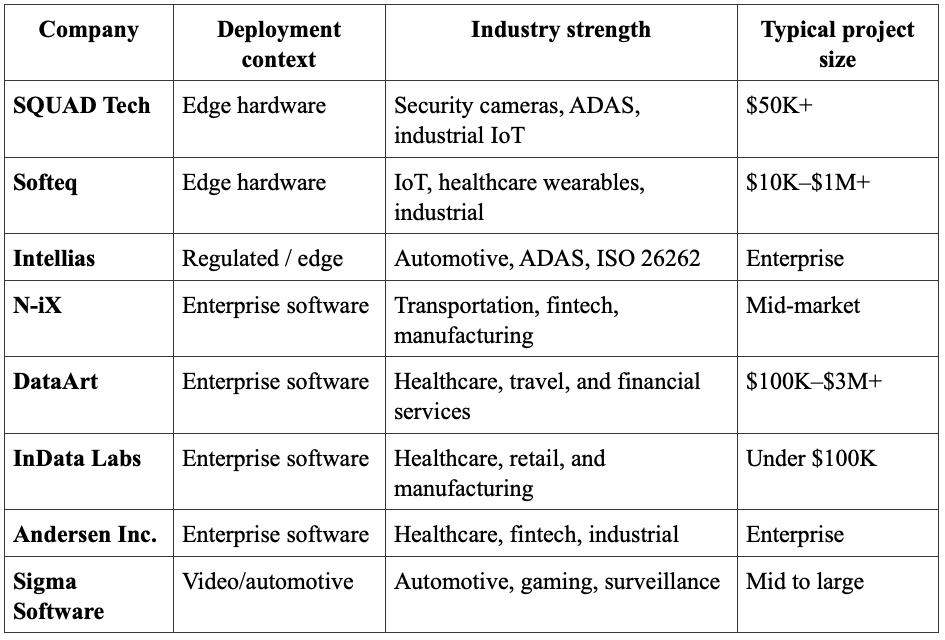
SQUAD is a strong choice for edge hardware and smart camera products. Intellias and Softeq are good options for embedded AI in automotive and IoT. N-iX and DataArt fit enterprise SaaS and data-heavy systems.
InData Labs is a good match for healthcare, retail, and research-heavy work. Andersen Inc. and Sigma Software are solid choices for enterprise delivery and automotive-focused projects.
Where Most CV Projects Go Wrong
Computer vision failures happen because the vendor is a poor fit for the real deployment environment. A team can have strong ML credentials and still ship a system that looks good in testing but breaks in production.
This is because the model was evaluated in ideal conditions, such as a GPU cluster, clean training data, and controlled lighting, but deployed in very different ones, like a 4MP factory camera, an embedded processor with 512 MB of RAM, or a dashcam dealing with rain and glare.
Before you shortlist any vendor, don’t ask, “Are they good at CV?” Ask, “Have they shipped a model that runs in conditions like mine?”
4 Deployment Contexts That Define the Choice
- Edge hardware. Your model runs on a constrained device such as a camera SoC, microcontroller, or embedded chip. Such cases mean limited memory, unreliable connectivity, and real-time performance requirements. Thus, you need a vendor with embedded SDK experience, hardware-aware optimization, and proof of deployment on similar platforms. Cloud-first AI teams struggle here.
- Enterprise software integration. Your computer vision system is one feature inside a SaaS product or data platform. The model runs in the cloud, and the challenge is connecting its output to pipelines, APIs, and business logic. In this context, data engineering depth matters more than embedded hardware experience.
- Regulated industry. Your product involves medical imaging, automotive safety, or financial document processing. You may need to meet standards such as ISO 26262, ISO 13485, HIPAA, or similar requirements. Most general AI vendors can build models, but far fewer can support the documentation and process controls these environments require.
- Video-first platforms. Your system works with continuous video, such as live streams, surveillance feeds, or recorded footage, rather than single images. The challenge here is to maintain accuracy under changing conditions and at production scale.
The 8 Best Computer Vision Development Companies Compared
Below, we compare computer vision companies: SQUAD for edge AI and smart camera engineering, Softeq for embedded hardware and computer vision, Intellias for automotive and ADAS-focused embedded vision, N-iX for enterprise ML and industrial CV, DataArt for healthcare and fintech consulting, InData Labs for applied data science and computer vision, Andersen Inc. for full-cycle enterprise engineering, and Sigma Software for automotive, gaming, and IoT vision projects.
SQUAD: Computer Vision Development Company for Smart Cameras and Edge AI Engineering
SQUAD focuses on AI-powered smart camera products. Its team works across the full stack, including PCB design, firmware, edge AI deployment, ISP tuning, cloud streaming, and mobile app integration.
With more than 700 engineers and a 6,500 m² in-house Innovation Lab, SQUAD has delivered 500+ projects, 50+ devices, 100+ app releases, and 20+ AI features to production.
Its computer vision team builds models for constrained hardware. This includes model pruning, quantization-aware training, and hardware-aware optimization for Qualcomm, Ambarella, SigmaStar, OmniVision, and ARM Cortex-M platforms.
The team also works with self-supervised learning methods like SimCLR and BYOL, compact architectures such as EfficientNet and MobileViT, and synthetic data generation.
Its deployed use cases include person detection, vehicle and license plate recognition, event-based anomaly detection, forensic video indexing, and ISP pipeline integration.
Fits best when:
- You’re building a physical camera or edge device and need AI running on the chip, with a single team owning the work from PCB design through over-the-air model updates.
- You’re working in security, ADAS, or industrial inspection and need proven embedded inference on Ambarella, Qualcomm, or SigmaStar, with real-world latency and false-alarm reduction.
Softeq: Hardware and Embedded CV for IoT and Industrial
Softeq is a Houston-based engineering firm with more than 20 years of experience in hardware, embedded systems, and software development. Clutch reviewers describe the team as a strong fit for projects that combine advanced software with industrial inspection, computer vision, and 3D processing.
Its case studies include pupil-tracking for drug intoxication detection, pose estimation for sports training, and WORM flash storage integration for surveillance camera footage.
Fits best when:
- Your IoT product requires both computer vision and hardware design, and splitting that work across multiple vendors would create excessive coordination risk.
- You’re building for industrial systems, medical wearables, or edge analytics and need production-ready embedded engineering, not just a cloud-based proof of concept.
Intellias: Automotive and ADAS-Grade Embedded CV
Intellias is a global technology partner that works with Fortune 500 companies. It holds AUTOSAR Associate Partner status and has received recognition from Forbes, Clutch, and IAOP.
Its embedded computer vision work includes ADAS perception, lane detection, pedestrian detection, object recognition, and in-cabin monitoring, all developed to ISO 26262 and ISO/SAE 21434 standards.
The company’s IntelliKit demo platform shows capabilities such as digital mirrors, road sign recognition, and obstacle detection on embedded automotive hardware.
Fits best when:
- Your project involves ADAS or camera-based safety systems and needs ISO 26262-compliant development with a documented functional safety case.
- You’re a Tier 1 supplier or OEM working with AUTOSAR-based ECU architectures and need embedded middleware, MCAL, and BSP expertise alongside the AI work.
N-iX: Enterprise ML and Industrial CV
N-iX is a software and IT consulting company founded in 2002 and headquartered in Lviv, Ukraine. It has more than 2,000 engineers across 25 countries. Clutch reviewers mention strong technical quality, reliable delivery, and the ability to scale teams quickly.
In an industrial computer vision project, N-iX replaced weak algorithms from a previous vendor, redesigned the architecture, introduced continuous delivery for ML, and built a multiplatform mobile app for object detection, package damage detection, and OCR.
Its transportation work also includes seatbelt detection, distracted driving detection, and license plate recognition for Redflex.
Fits best when:
- Your computer vision system needs enterprise-grade ML infrastructure, including data pipelines, model CI/CD, monitoring, and cloud deployment on AWS, GCP, or Azure.
- You’ve inherited poor-quality computer vision code from another vendor and need a team that can assess the damage and rebuild it properly.
DataArt: Technology Consulting for Healthcare and Fintech
Founded in 1997, DataArt is a global software engineering firm with more than 5,700 professionals across 40+ locations. Their customers report project sizes ranging from $12,000 to more than $3 million and cite strong engineering quality and delivery management, according to Clutch.
DataArt’s AI and ML work covers predictive analytics, NLP, data mining, and computer vision for clients such as Priceline, Ocado Technology, and Flutter Entertainment.
Fits best when:
- Your computer vision project is part of a broader digital transformation effort and you need one firm to handle strategy, architecture, engineering, and post-launch support.
- You work in healthcare or financial services and need a partner with delivery processes shaped by large-scale enterprise privacy and compliance demands.
InData Labs: Data Science and Applied CV
InData Labs is a data science firm founded in 2014, with more than 80 specialists across Cyprus, Lithuania, and the US. It ranks in the Top 10 of Clutch’s Global AI Leaders Matrix and has delivered more than 150 AI projects across healthcare, manufacturing, retail, and logistics.
Clutch reviewers note that projects come in under $100,000 and lead to measurable business improvements. Its computer vision work includes medical image processing, defect detection on production lines, cargo damage detection, virtual try-ons, and visual search.
Fits best when:
- Your project needs applied data science at the computer vision layer, such as forecasting, anomaly detection, or recommendation systems that work alongside visual models.
- Your budget is under $100,000, and you want a specialist AI team that can move from problem definition to a production-ready model without large consultancy overhead.
Andersen: Full-Cycle Enterprise Engineering
Andersen is a global software company based in Poland with more than 17 years of experience across AI, big data, and IoT. Its clients include Siemens, Ryanair, and Johnson & Johnson.
Computer vision is part of its broader AI and data engineering offering, which makes it a practical option when visual intelligence is only one part of a larger enterprise system.
The company’s experience with enterprise procurement, compliance documentation, and multi-stakeholder approval processes helps reduce delivery risk on complex projects.
Fits best when:
- Your computer vision feature is part of a larger enterprise product, and you need one vendor to own the full system, not just the model layer.
- Your organization needs a partner that can handle enterprise procurement, compliance, and governance requirements alongside the engineering work.
Sigma Software: Automotive, Gaming, and IoT CV
Sigma Software Group has 37 Clutch reviews, with clients highlighting efficiency, creativity, and strong ownership. Its automotive computer vision work includes an Autonomous Yard Maneuvering system for truck control, with a server, web operator interface, and mobile apps for driver and loader coordination.
The company also has references in healthcare and gaming, including work with AstraZeneca, which shows a range across demanding industries.
Fits best when:
- Your computer vision product operates in automotive or logistics applications, such as autonomous maneuvering, fleet monitoring, or in-vehicle systems, and you want a vendor with named delivery in that space.
- You’re building a connected device or surveillance system and need a team that can handle both the computer vision logic and the surrounding IoT infrastructure.
Three Tests to Run Before You Shortlist Anyone
- Test 1: Ask for a real deployment spec. Ask for the hardware, SDK, and inference runtime used in a past project. A vendor with real deployment experience should be able to name the chip, the framework, and the latency they achieved. If they only say “edge AI” without specifics, they may be selling cloud-first work as embedded experience.
- Test 2: Ask who owns the model after handoff. Some vendors deliver a trained model and stop there. Others build the full MLOps layer, including model CI/CD, drift monitoring, retraining pipelines, and OTA updates. The difference matters because it determines how much support you’ll need after launch.
- Test 3: Match their references to your deployment context. A vendor with healthcare imaging references and ISO 13485 certification is not the same as one with surveillance camera experience and embedded SDK knowledge, even if both claim computer vision expertise. The industries they’ve worked in are often the clearest sign of where they’ve actually shipped working systems.
Frequently Asked Questions
What does a computer vision development company do?
A computer vision development company builds systems that enable machines to understand visual data, such as images, video, and live camera feeds. This can include model training, deployment, and, for edge products, hardware and firmware integration.
What is the difference between edge and cloud computer vision?
Edge computer vision runs directly on a local device, such as a camera chip, MCU, or embedded processor. Cloud computer vision sends data to a remote server for processing.
Edge is usually better for low latency and privacy. Cloud is better when you need more computing power. The right setup depends on your speed, privacy, and hardware needs.
How much does computer vision development cost?
Costs vary a lot depending on the scope. Smaller research-driven projects with a specialist team may stay under $50,000. Larger systems with compliance work, embedded hardware integration, and post-launch MLOps often range from $100,000 to more than $1 million.
Offshore team rates often range from $25 to $49 per hour, while senior talent in North America or Western Europe may cost $100 to $200 per hour.
Does a computer vision vendor need to understand my hardware?
Yes, if your model will run on a physical device. A team that has only built cloud-based models may not have the embedded SDK experience, quantization knowledge, or low-level optimization skills needed for constrained hardware. Always ask which chips and SDKs they’ve worked with in production.
How long does a computer vision project take?
A focused proof of concept usually takes 4 to 8 weeks. A production-ready system, including training, validation, hardware integration, and deployment, often takes 3 to 9 months.
If the project involves regulatory standards such as ISO 26262 or ISO 13485, expect extra time for documentation and validation.
Final Thoughts
Deployment context is the clearest way to evaluate a computer vision development company. Start there, not with Clutch ratings or hourly rates. If your challenge is getting accurate, low-latency AI onto a constrained edge device, SQUAD is a place to start.
If you’re building automotive safety systems, Intellias brings the right functional safety background. For enterprise data platforms and healthcare applications, N-iX, DataArt, and InData Labs each bring relevant delivery experience. Match the vendor to where your model will run, and the rest of the decision becomes much easier.
