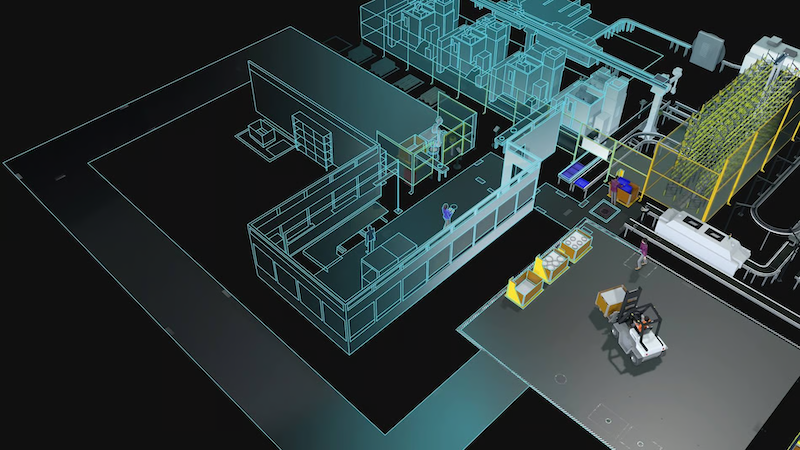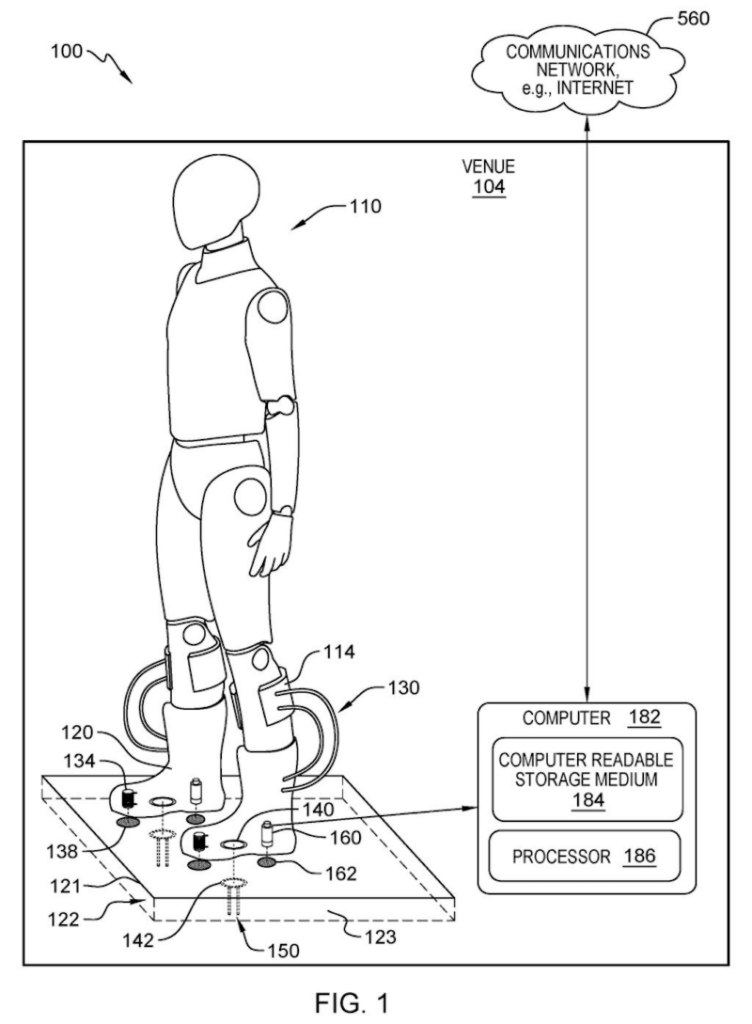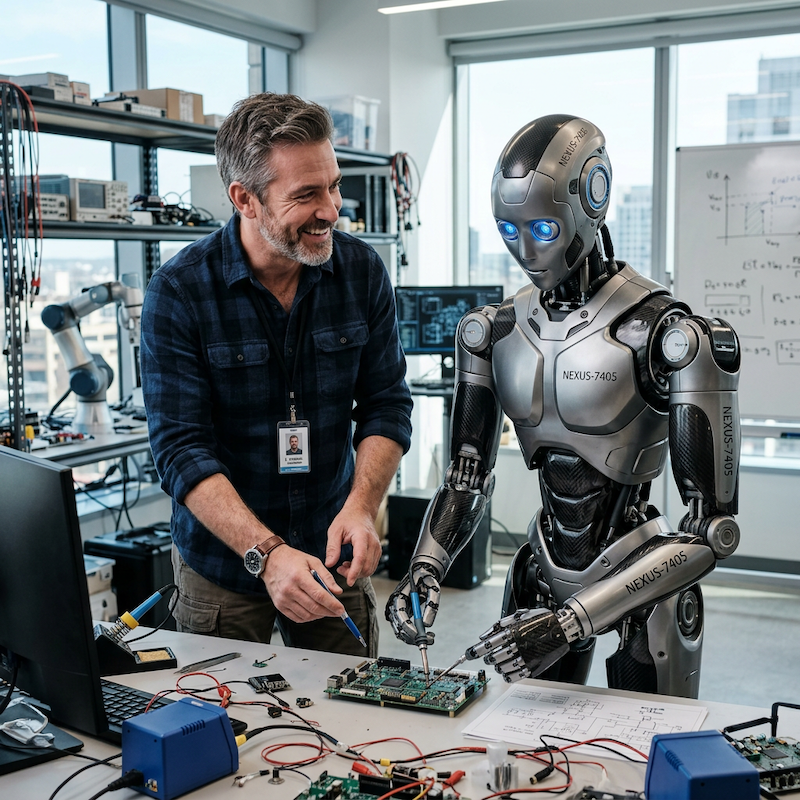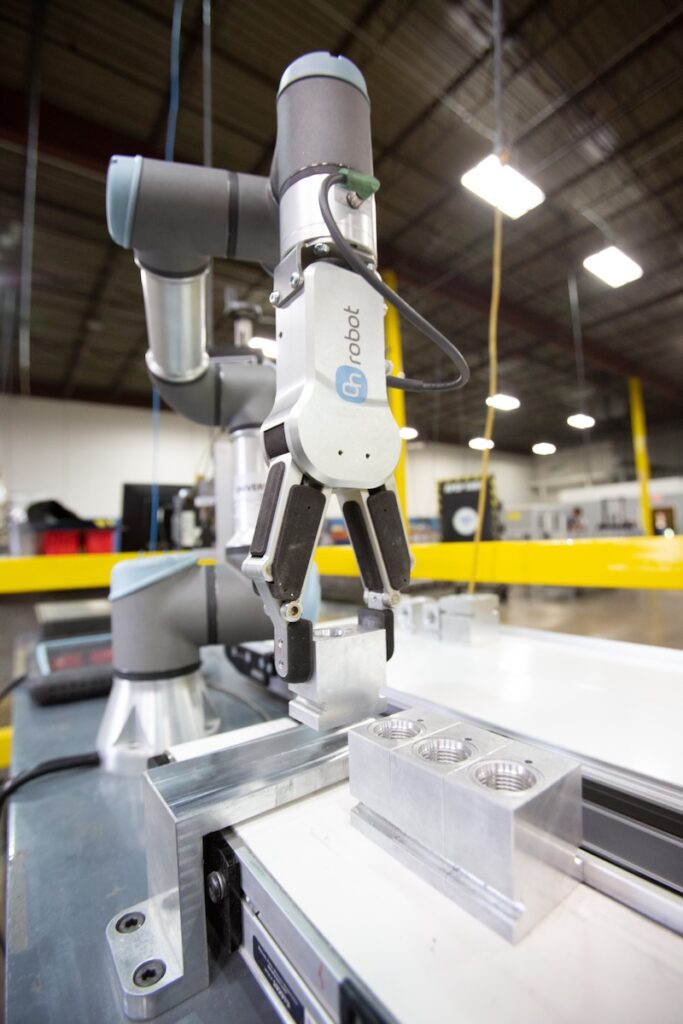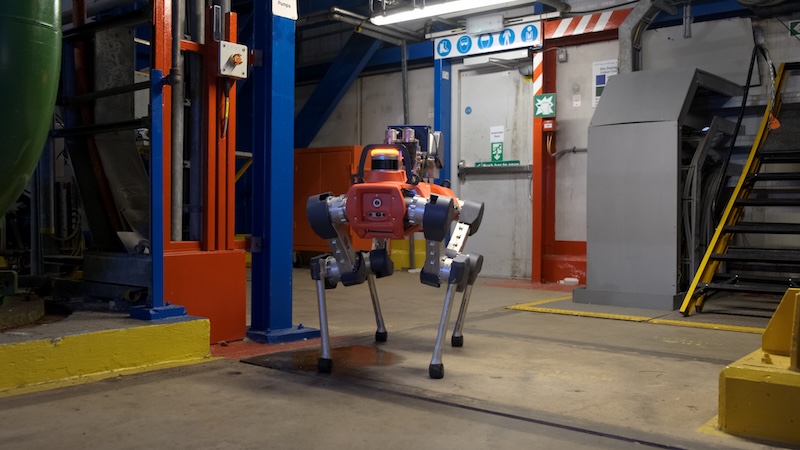
The next leap in robotics won’t come from faster processors or more sophisticated mechanical design. It will come from better data, specifically, from training environments that replicate how the physical world actually behaves. [Read more…] about Why robotics can’t advance without physical AI
physical ai
Interview with CreateMe CEO Campbell Myers: From stitching to bonding – physical AI could transform the way clothes are made
For decades, apparel manufacturing has remained one of the most labor-intensive sectors in global industry. While robots have transformed automotive production, electronics assembly, and warehouse operations, handling soft, deformable materials such as fabric has proven far more difficult to automate.
Textiles stretch, wrinkle, drape, and shift unpredictably, creating challenges that traditional industrial automation systems were never designed to solve.
As interest in embodied AI and physical AI continues to grow, many researchers and technology companies see deformable-material manipulation as one of the most important remaining frontiers in robotics. [Read more…] about Interview with CreateMe CEO Campbell Myers: From stitching to bonding – physical AI could transform the way clothes are made
Interview with Workr Robotics CEO Ken Macken: ‘Paying for automation by the hour’
Industrial robotics is entering a new phase. Advances in artificial intelligence, large language models, and so-called embodied AI have sparked renewed excitement about robots that can understand, reason about, and interact with the physical world.
High-profile collaborations between companies such as Google DeepMind and Boston Dynamics have fueled speculation that increasingly capable general-purpose robots may soon find their way onto factory floors.
But not everyone in the industry is convinced that these developments represent an immediate breakthrough for manufacturing. [Read more…] about Interview with Workr Robotics CEO Ken Macken: ‘Paying for automation by the hour’
Genesis AI launches simulation platform to accelerate robotics development
Genesis AI has launched Genesis World 1.0, a new robotics simulation platform designed to dramatically reduce the time required to develop, test, and evaluate robotic AI systems.
The company says the platform can compress robotics evaluation cycles from days to minutes by enabling large-scale testing in photorealistic virtual environments rather than relying solely on physical robots.
According to Genesis AI, a robotics foundation model evaluation that would typically require nearly a week of continuous testing on real hardware can be completed in approximately 30 minutes using Genesis World 1.0 running on GPU infrastructure. [Read more…] about Genesis AI launches simulation platform to accelerate robotics development
Inbolt to launch vision-enabled robot programming at Automate event
Inbolt, the robot intelligence company that turns digital twins into live robot control, is launching two new capabilities that complete the company’s AI vision model for robot guidance: Inbolt Robot Programming and an expanded Inbolt Robot Control. The launch pad is booth #1675 at Automate 2026 in Chicago, June 22-25.
Rudy Cohen, CEO and co-founder of Inbolt, says: “Robot deployment still takes weeks because the digital twin never matches the real factory floor, engineers hand-tune every trajectory during commissioning.
“With Robot Programming, the Vision Model, and Robot Control on a single platform, that gap closes; Engineers build the program from the CAD, our vision model locates the real part, and the robot executes the planned path. [Read more…] about Inbolt to launch vision-enabled robot programming at Automate event
Physical AI’s looming data rights battle: Interview with Kate Shen of Anaxi Labs
As artificial intelligence continues its rapid expansion into the physical world, much of the industry’s attention has focused on increasingly capable robots, larger AI models, and the vast datasets required to train them.
But a growing number of observers are asking a different question: who owns the data that makes physical AI possible, and who should benefit from it?
Kate Shen, co-founder of Anaxi Labs, is among those pushing the debate into the spotlight. Her company is developing infrastructure for what it describes as a global AI and robotics data supply chain, with a particular emphasis on worker consent, data ownership, compensation, and regulatory compliance. [Read more…] about Physical AI’s looming data rights battle: Interview with Kate Shen of Anaxi Labs
Software is ‘the biggest bottleneck to robotics innovation’, says BlackBerry QNX report
QNX, a division of BlackBerry, has released a new research study, the Inside the Robot: Architecture Benchmark Report, examining how robotics development is changing as systems become more software‑driven, AI‑enabled, and increasingly deployed alongside humans at work and in daily life.
Based on a survey of 1,000 developers from around the world, the research reveals the most significant inhibitors to progress, the gap between system ambitions and current capabilities, and developers’ views on the industry’s future.
A new episode of QNX’s Code the Future podcast featuring Omdia chief analyst Lian Jye Su explores the themes and results in more detail. [Read more…] about Software is ‘the biggest bottleneck to robotics innovation’, says BlackBerry QNX report
Scaling automation in contract manufacturing: Interview with Rodrigo DallOglio of Flex
As manufacturers face increasing pressure to improve productivity, quality, and resilience while managing growing product complexity, automation is becoming a central part of modern factory operations.
Technologies such as collaborative robots, autonomous mobile robots (AMRs), and emerging forms of physical AI are moving beyond pilot projects and into large-scale production environments.
One company at the forefront of this trend is Flex, one of the world’s largest contract manufacturers, which serves customers across industries including automotive, healthcare, industrial equipment, communications, and consumer electronics. [Read more…] about Scaling automation in contract manufacturing: Interview with Rodrigo DallOglio of Flex
Open source hardware for robotics: Democratizing robot building
Most discussions about open-source robotics focus on software. The Robot Operating System (ROS) has become the best-known example, providing developers with a common framework for building and operating robots.
Yet software is only part of the story.
Over the past two decades, a growing ecosystem of open-source hardware platforms has dramatically lowered the barriers to robotics development. [Read more…] about Open source hardware for robotics: Democratizing robot building
Fort Robotics acquires Mapless AI to expand supervised autonomy and physical AI safety platform
Fort Robotics, the trust layer for physical AI, has announced the acquisition of Mapless AI, a Boston- and Pittsburgh-based leader in vehicle teleoperation and autonomy supervision.
The acquisition represents a significant commercial expansion of Fort’s Trust Platform, adding two critical new capabilities: remote human-in-the-loop teleoperation and onboard active safety.
By integrating these technologies, Fort expands its market offering from safety-certified machine control to a comprehensive architecture for supervised autonomy. [Read more…] about Fort Robotics acquires Mapless AI to expand supervised autonomy and physical AI safety platform