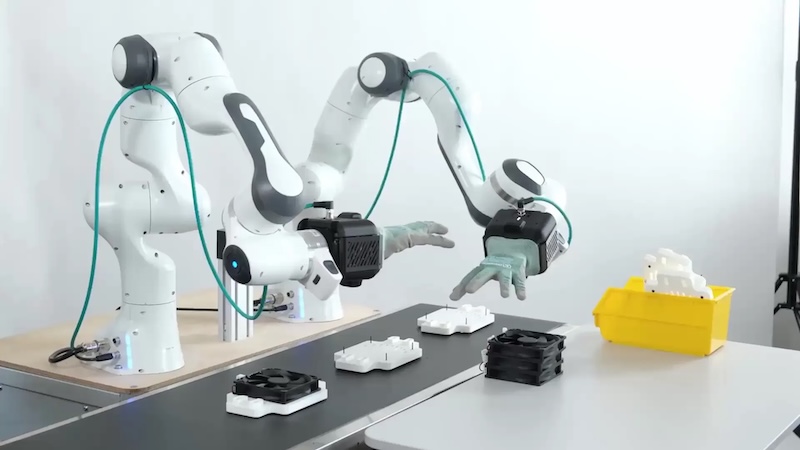
mimic Robotics has introduced a new robotic hand, wearable exoskeleton and software platform that it says are designed to advance general-purpose dexterous manipulation for industrial robots.
The Swiss company unveiled the mimic hand M1, a tendon-driven robotic hand, alongside the mimic wearable U1 exoskeleton and an in-house software infrastructure that together form what it describes as a “vertically integrated physical AI platform”.
The company says the platform has been developed to address one of robotics’ biggest challenges: collecting high-quality training data for AI models capable of performing human-like manipulation tasks.
Unlike many robotic systems that rely on two-finger grippers, mimic Robotics has designed both its hardware and data collection process around a human hand morphology.
“We never introduce this cross-embodiment gap in the first place,” the company says. “We hold morphology constant across every phase of learning by running the entire pipeline on hands.”
The mimic hand M1 features 15 actuated degrees of freedom across 21 joints and uses tendon-driven actuation with motors located in the forearm rather than the hand itself.
According to the company, the design provides high backdrivability, force sensing and durability while supporting payloads exceeding 25 kg in a cylindrical power grasp.
The system also incorporates fingertip tactile sensors and synchronized wrist-mounted cameras to provide detailed sensory data for AI models.
Complementing the robotic hand is the mimic wearable U1, a passive exoskeleton that enables human operators to demonstrate manipulation tasks while matching the robotic hand’s kinematics.
The wearable reproduces the robot’s sensing configuration, allowing demonstration data to be collected without conventional teleoperation latency or retargeting errors.
Beyond the hardware, mimic Robotics has developed its own real-time middleware, teleoperation software and telemetry system.
The company says its custom “mimic-ipc” communication layer significantly reduces latency and jitter compared with conventional robotics middleware, enabling faster AI inference and more reliable robot control.
According to mimic Robotics, the platform reflects its strategy of developing hardware, software and AI infrastructure together rather than integrating third-party components.
“Our mimic hand M1, the wearable U1, and the infrastructure that connects them are three parts of one bet: keep the human hand as a fixed morphology spec across hardware, data collection, and model training, in order to build a true general-purpose robotics foundation model and deployment platform,” the company says.
The company adds that it plans to build on the platform through further development of its Video Action Models for physical AI, arguing that solving dexterous manipulation will enable robots to automate a much broader range of physical work than has previously been possible.
