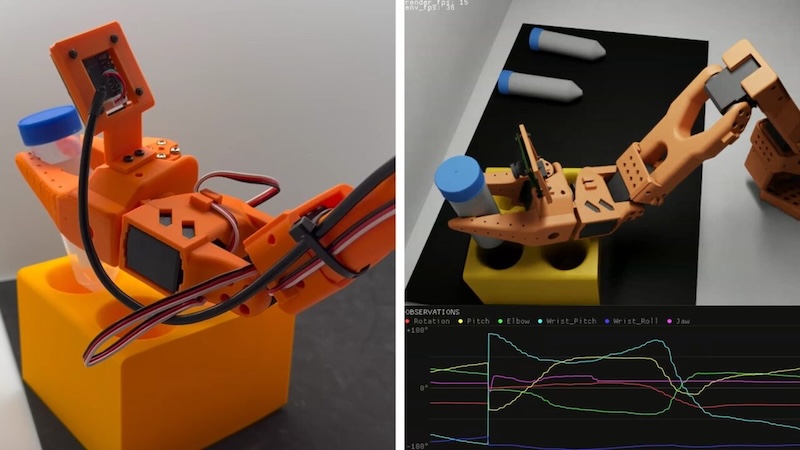
Nvidia and Hugging Face have expanded their collaboration to bring new AI models, robotics frameworks and development tools to the open-source LeRobot platform, aiming to make robot development more accessible for the wider robotics community.
The companies announced that Nvidia Isaac GR00T 1.7, an open vision-language-action (VLA) foundation model for humanoid robots, and the Nvidia Isaac Teleop framework are now integrated into LeRobot. Support for Nvidia Cosmos 3, a world foundation model for physical AI, is also planned.
Together, the additions are intended to provide developers with a standardized workflow for collecting data, training robot models, evaluating performance and deploying AI-powered robots.
“Open source is how a field turns advanced research into something people can study, adapt and build on,” said Thomas Wolf, cofounder and chief science officer at Hugging Face.
“With Nvidia Isaac GR00T 1.7 and Isaac TeleOp in LeRobot today, robotics developers can use shared models, data and workflows to train and evaluate robots in the open. And with Nvidia Cosmos 3 planned next, the community will have a path to bring frontier world models into that same collaborative loop.”
LeRobot is Hugging Face’s open-source robotics library for developing, training and sharing robot datasets, models and workflows.
Nvidia says the expanded partnership combines its community of more than three million robotics developers with Hugging Face’s 16 million AI developers, broadening access to physical AI technologies.
The Isaac Teleop framework enables developers to collect human demonstrations from external devices using standardized formats, while Isaac GR00T 1.7 is designed to simplify post-training and deployment of robot foundation models across different robot types and applications.
Future integration of Nvidia Cosmos 3 will allow developers to generate synthetic robotics data, simulate environments and develop robot policies when real-world data is unavailable or too costly to collect.
The new integrations build on existing Nvidia technologies already available through LeRobot, including open-source physical AI datasets containing more than 350,000 real and simulated robot trajectories and 57 million grasp samples, as well as simulation environments based on Nvidia Isaac Sim and Isaac Lab.
The collaboration also extends to deployment, with support for Nvidia Jetson Thor on Hugging Face’s Reachy 2 humanoid robot, enabling developers to run vision-language-action models on open-source humanoid robotics platforms.
