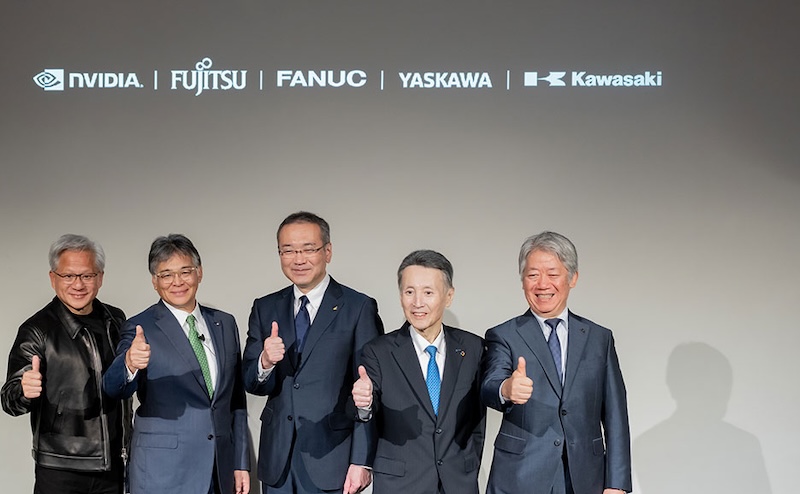
Fujitsu has begun working with Japanese robotics manufacturers Fanuc, Yaskawa Electric and Kawasaki Heavy Industries to explore the development and deployment of physical AI across manufacturing, logistics and healthcare.
The initiative will also incorporate Nvidia’s physical AI technologies as the companies seek to develop a collaborative control platform capable of connecting digital systems with robots and other physical equipment.
Fujitsu says the collaboration is intended to accelerate the adoption of physical AI while helping address challenges including labor shortages, an aging workforce and increasing global competition.
The companies plan to explore applications across several industries.
In manufacturing, the platform will be used to optimize production planning and enable autonomous adaptation to changing factory conditions. In logistics and retail, Fujitsu aims to automate material handling by combining logistics planning with real-time sales and inventory data.
The partners are also targeting healthcare, where robots could automate the transport of pharmaceuticals and medical specimens as well as assist with patient reception and guidance.
Alongside these applications, Fujitsu plans to develop an open, sovereign collaborative control platform that integrates AI, robotics, simulation and data analysis technologies from the participating companies.
The company says the platform is intended to facilitate interoperability between different robots and equipment while addressing cybersecurity, operational resilience and data protection.
As part of the collaboration, Fujitsu will use Nvidia Cosmos foundation models to enhance simulations of real-world environments and employ Nvidia Omniverse libraries, the Nvidia Isaac robotics platform and the Newton physics engine to accelerate robot learning, simulation and Sim2Real workflows.
Jensen Huang, founder and CEO of Nvidia, said: “Physical AI is the next industrial revolution – and it will be made in Japan.
“Fujitsu, Fanuc, Yaskawa and Kawasaki are the companies that taught the world how to manufacture. Together with Nvidia’s full-stack physical AI platform, they will teach the world’s machines to think, move and work alongside people – across factories, hospitals and cities.”
Takahito Tokita, CEO of Fujitsu, said the collaboration combines the robotics expertise of the three manufacturers with Fujitsu’s digital technologies to create “a new social infrastructure in which people and robots work collaboratively across a wide range of industries”.
Fujitsu says the companies will now develop a roadmap for technology development and commercialization, with the longer-term goal of expanding physical AI deployment globally and strengthening Japan’s position in the robotics industry.
