• Skip to primary navigation
  • Skip to main content
  • Skip to primary sidebar
  • Skip to secondary sidebar
  • About
    • Contact
    • Privacy
    • Terms of use
  • Shop
    • Cart
    • Checkout
    • My Account
  • Advertise
    • Advertising
      • Buy ad space
    • Case studies
    • Design
    • Email marketing
    • Features list
    • Lead generation
    • Magazine
    • Press releases
    • Publishing
    • Sponsor an article
    • Webcasting
    • Webinars
    • White papers
    • Writing
  • Subscribe to Newsletter

Robotics & Automation News

Where Innovation Meets Imagination

  • Home
  • News
  • Features
  • Editorial Sections A-Z
    • Agriculture
    • Aircraft
    • Artificial Intelligence
    • Automation
    • Autonomous Vehicles
    • Business
    • Computing
    • Construction
    • Culture
    • Design
    • Drones
    • Economy
    • Energy
    • Engineering
    • Environment
    • Health
    • Humanoids
    • Industrial robots
    • Industry
    • Infrastructure
    • Investments
    • Logistics
    • Manufacturing
    • Marine
    • Material handling
    • Materials
    • Mining
    • Promoted
    • Research
    • Robotics
    • Science
    • Sensors
    • Service robots
    • Software
    • Space
    • Technology
    • Transportation
    • Warehouse robots
    • Wearables
  • Press releases
  • Events

Energy

Maximo completes 100 MW of robotic solar installation in California

March 26, 2026 by Sam Francis

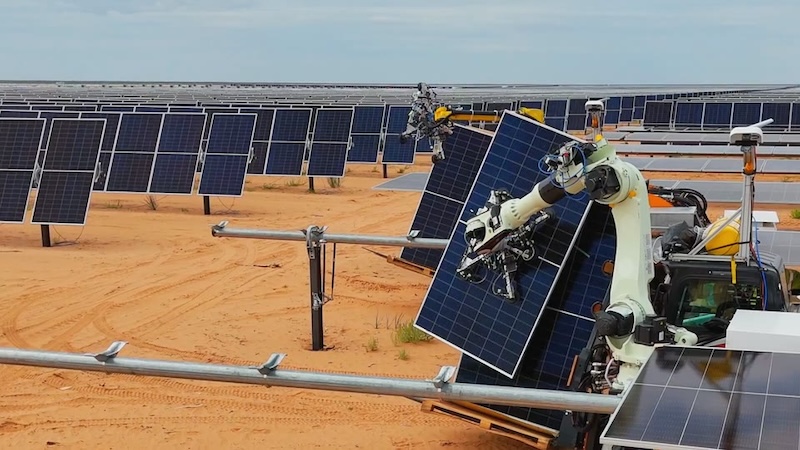
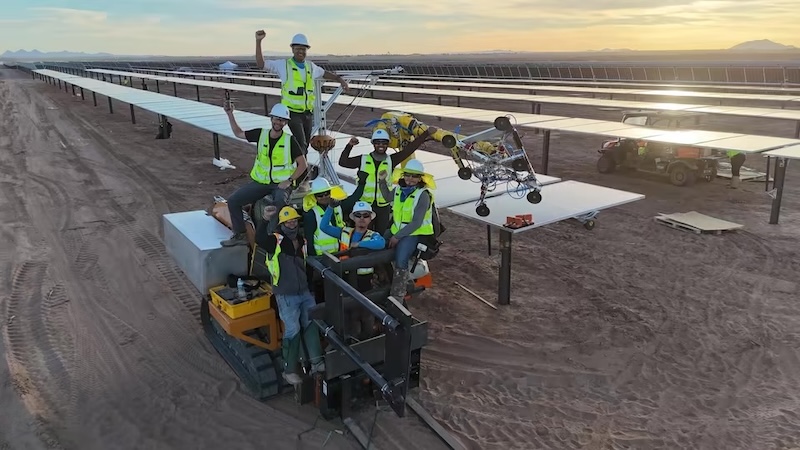
Maximo, the solar robotics company incubated by the AES Corporation, has announced the successful installation of 100 megawatts (MW) of utility-scale solar capacity at AES’ Bellefield complex, located on former agricultural land near California City in Kern County.

Demand for electricity continues to grow rapidly, driven by data center expansion, electrification and industrial manufacturing. Solar construction faces increasing pressure from labor constraints, compressed project timelines and cost volatility.

Maximo’s robotic solar installation solution is helping close the gap between the need for faster time to power and construction capacity. The 100 MW achievement marks the transition of robotic module installation from early deployment validation to sustained commercial production. [Read more…] about Maximo completes 100 MW of robotic solar installation in California

Filed Under: Energy, Environment, News Tagged With: AI in construction, automation news, aws robotics, clean energy infrastructure, energy robotics, EPC construction technology, industrial robotics applications, Maximo robotics, nvidia isaac sim, nvidia omniverse, physical ai, renewable energy automation, robotic construction, robotics and automation, robotics and automation news, robotics news, solar deployment, solar farm automation, solar installation robots, utility scale solar

Smart Battery Camera: Flexibility and Power for Your Security Needs

March 19, 2026 by Sam Francis

A smart battery camera offers incredible security along with flexibility. It has improved object detection that takes security to the next level and keeps the user updated about every activity. Its easy installation, flexible storage, and other features attract users.

In this article, we will discuss what a smart battery camera is. We will explain its features, limitations, and use cases to help you select the right camera for your security needs. [Read more…] about Smart Battery Camera: Flexibility and Power for Your Security Needs

Filed Under: Components, Energy Tagged With: AI security camera, automation news, battery powered camera, consumer electronics, home automation, Home security systems, iot security, night vision camera, outdoor security camera, remote monitoring, robotics and automation, robotics and automation news, robotics news, security technology, smart battery camera, smart home devices, solar security camera, surveillance technology, WiFi camera, wireless security camera

How to Select a DC-DC Converter for Solar Energy Storage Systems

March 11, 2026 by David Edwards

There is a particular kind of system failure that installers and engineers tend to miss until it has already happened multiple times.

The solar array is producing. The batteries are cycling. The BMS shows normal readings. Then, on a hot afternoon in July, or during a stretch of cloudy days in winter, something resets that should not have reset – and nobody can immediately explain why.

A significant number of these incidents trace back to the auxiliary DC-DC converter – the component responsible for stepping down bus voltage to the stable 12V or 24V that the BMS, control boards, and monitoring electronics require.

Not because the converter is a bad product, but because it was specified against a datasheet rather than against the real conditions of the installation.

What DC-DC Converters Actually Do in a Solar Storage System

In a solar storage system, the DC-DC converter serves a critical but often overlooked role: converting the high-voltage DC bus down to the stable 12V or 24V that the BMS, inverter control boards, and monitoring electronics require to operate reliably.

This is a fundamentally different role from a simple point-of-load regulator. The converter must handle a wide and constantly varying input voltage – from the PV bus, from the battery bank at varying states of charge, or from both – while maintaining stable output to sensitive downstream electronics simultaneously, across a wide range of ambient conditions.

A galvanically isolated DC-DC converter adds a further layer of protection: it separates the high-voltage input side from the sensitive 12V/24V output side, so transients from the PV array cannot reach the control electronics. PowerHome’s isolated converter series is built for exactly this role.

How Real-World Solar Conditions Impact DC-DC Converter Specification

Converter datasheets report performance at 25°C, at rated load, with a stable input. None of those conditions reliably describe a solar storage system in operation.

Thermal derating in outdoor enclosures

Residential off-grid systems and agricultural solar setups share a common challenge: the power electronics live in enclosures that absorb heat from the sun and generate heat internally, with limited active cooling.

In summer conditions, enclosure temperatures routinely reach 50-60°C. At those temperatures, a converter rated for 100W at 25°C may reliably deliver only 60-70% of that figure.

The failure mode is not immediate. The converter runs progressively hotter across operating cycles until its thermal protection activates – presenting, from the outside, as an unexplained system reset or a BMS fault that points nowhere useful.

Specifying a converter with adequate thermal headroom, and verifying its derating curve at realistic ambient temperatures, is the difference between a system that performs and one that requires repeated field visits.

Input voltage transients from PV arrays

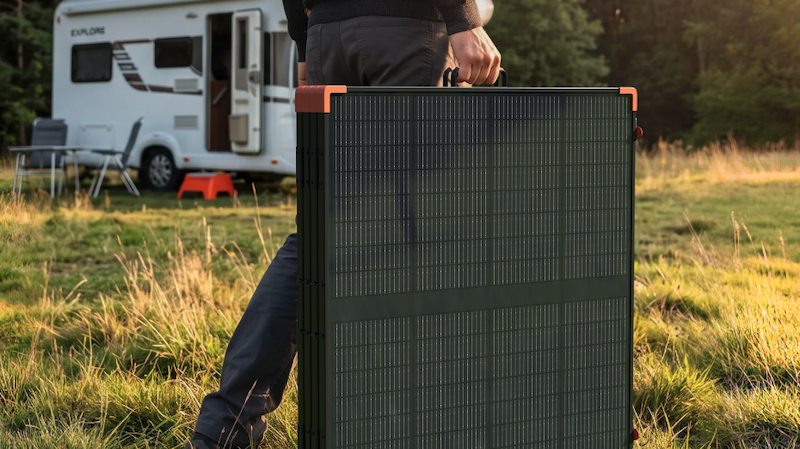
Solar arrays do not produce stable input voltage. Cloud coverage, shading events, and the morning and evening edges of the solar day all cause rapid voltage fluctuations on the DC bus. For smaller residential and RV systems, a converter that cannot handle the input range of a partially shaded or low-angle array will clip energy at exactly the moments when every watt counts.

Isolation and the BMS protection question

A non-isolated DC-DC converter passes voltage transients directly between its input and output. In a solar storage system, this means a spike from the PV array – from a lightning strike, a switching transient, or a sudden load disconnect – can reach the BMS, the inverter control board, or the monitoring electronics without attenuation.

An isolated converter interposes a transformer between the high-voltage input and the sensitive electronics on the output side, creating a galvanic barrier.

For systems where the BMS or inverter controller represents a significant portion of the installation cost, isolation is not a premium option – it is protection against a failure mode that is expensive to diagnose and more expensive to replace.

PowerHome’s isolated DC-DC converter series addresses this directly: galvanic separation between the input and output side means transients from the PV bus don’t reach the BMS or inverter control board.

Why Boost-Buck Topology is Essential for Off-Grid Stability

Off-grid and mobile applications – RV solar systems, marine installations, agricultural irrigation setups – face a wider input voltage range than fixed grid-tied systems. Battery voltage varies with state of charge; PV array output varies with conditions; load demand is unpredictable.

A boost-buck converter handles this range without manual intervention. It maintains stable output whether the input is above or below the target voltage, which matters most during the early morning charge cycle, when battery voltage is low and array voltage is still climbing, and during periods when the converter must supply loads from a partially depleted battery.

For these applications, specifying a standard buck converter is a false economy. The efficiency advantage disappears in any operating condition where the input voltage falls below the output requirement – and in off-grid solar, that condition occurs every day.

For off-grid and mobile installations in this power range, PowerHome Boost-Buck converter series – supporting input ranges from 5V-40V with stable 12V or 24V output – handles exactly this operating profile without manual voltage adjustment.

The Scale Problem: Small Failures in Large Fleets

A failure mode that surfaces once in thirty operating days is easy to attribute to coincidence. For a residential system, that means one unexplained incident per month. For an agricultural operation running multiple storage units, that same failure rate becomes a recurring maintenance issue that the datasheet never warned about.

The converters that create these problems are often not defective. They are correctly specified against the conditions on the datasheet. The issue is that the datasheet conditions do not represent the installation – and the gap between the two only becomes visible at operational scale, after the commissioning team has left.

What to Actually Check Before Specifying a Converter

Input voltage range vs. real array behavior – Map the converter’s minimum input voltage against the array’s voltage at low-angle irradiance, not at STC. If the converter drops out before the array reaches its operating range, you lose energy at both ends of the solar day.

Topology for the application – For fixed installations with a stable voltage differential: a standard buck or boost converter is appropriate. For off-grid, mobile, or variable-load applications: specify a boost-buck topology. For any installation where the BMS or inverter controller represents significant replacement cost: specify isolated.

Thermal derating at enclosure temperature – Size for enclosure temperature in peak summer conditions, not ambient air temperature. An outdoor enclosure in direct sun can run 15-20°C above ambient. A converter rated for your load at 25°C may deliver 60-70% of that figure inside a sealed outdoor cabinet in August.

Efficiency at partial load – Solar storage systems rarely run at full rated load. Locate the converter’s efficiency figure at 40-60% load – that is where the system operates most of the time.

Protection features matched to the environment – Outdoor and agricultural installations need converters rated for the environment: waterproofing (IP67 or IP68 for exposed locations), overvoltage protection capable of handling PV transients, and overtemperature protection with a defined recovery behavior rather than a latching fault.

The Converter is a System Decision, Not a Component Selection

The solar storage installations that avoid these failure modes share one characteristic: the converter was treated as a systems engineering decision rather than a procurement line item.

The question was not which converter meets the voltage and current numbers on the schematic – it was what the converter will actually see across the full operating profile of the installation, from a July afternoon at full load to a February morning with partial cloud cover and a half-charged battery.

That question has a specific answer for every installation. The answer determines the topology, the thermal specification, the isolation requirement, and the input voltage range.

Getting those four things right, early in the design process, is what separates a system that runs reliably for a decade from one that generates field calls on a schedule you cannot predict.

Filed Under: Energy Tagged With: automation news, boost buck converter solar, DC-DC converter solar systems, isolated DC-DC converter, off grid solar power systems, photovoltaic power converters, renewable energy power conversion, robotics and automation, robotics and automation news, robotics news, solar battery storage systems, solar energy storage electronics, solar energy system design, solar inverter electronics, solar power electronics

Oil and gas robotics deployment expands as global market heads toward $205 billion in 2030, says GlobalData

February 6, 2026 by Sam Francis

Robotics is rapidly transforming oil and gas operations as advances in artificial intelligence (AI) and cloud computing unlock the next phase of industrial automation. AI enables advanced decision-making, navigation in complex environments, and reduced reliance on human intervention.

Against this backdrop, the global robotics market is projected to grow from $90.2 billion in 2024 to $205.5 billion in 2030, forecasts GlobalData, an intelligence and productivity platform.

GlobalData’s Strategic Intelligence report, Robotics in Oil and Gas, highlights how robotics is increasingly being adopted across the oil and gas value chain to improve safety, efficiency, and asset integrity. [Read more…] about Oil and gas robotics deployment expands as global market heads toward $205 billion in 2030, says GlobalData

Filed Under: Energy, Features Tagged With: AI industrial automation, automation news, autonomous underwater vehicles, digital twin robotics, energy sector robotics, globaldata robotics report, industrial AI robotics, industrial robotics market, inspection drones energy sector, inspection robots oil and gas, offshore robotics, oil and gas robotics, predictive maintenance robotics, robotics adoption energy industry, robotics and automation, robotics and automation news, robotics investment trends, robotics market forecast, robotics market growth, robotics news, Spot robot oil and gas, subsea robots

ABB Robotics leads global effort to standardize measurement of industrial robot energy consumption

February 3, 2026 by Sam Francis

ABB Robotics is spearheading an initiative to develop the first global, standardized method for measuring the energy consumption and efficiency of industrial robots.

ABB says this effort marks a “critical step” toward improving transparency and supporting the global transition to more sustainable manufacturing.

Gianluca Brotto, head of sustainability, ABB Robotics, says: “With no global standard currently in place, it’s a challenge for customers to compare the energy consumption of different robots and choose the most energy efficient solution. [Read more…] about ABB Robotics leads global effort to standardize measurement of industrial robot energy consumption

Filed Under: Energy, News Tagged With: abb robotics, automation news, carbon footprint reduction, energy efficiency in automation, factory sustainability, industrial automation, industrial robots, ISO standards robotics, manufacturing emissions, robot energy consumption, robot energy efficiency, robotics and automation, robotics and automation news, robotics news, robotics standards, robotics sustainability, sustainable manufacturing

How Big Industries Are Losing Money: The Hidden Cost of Energy Waste

January 13, 2026 by Sam Francis

In the competitive landscape of Florida’s commercial infrastructure, efficiency is not just a goal – it is a requirement for survival.

For many facility managers and developers, the most significant drain on their bottom line isn’t visible on a balance sheet; it is escaping through uninsulated pipes and mechanical systems. [Read more…] about How Big Industries Are Losing Money: The Hidden Cost of Energy Waste

Filed Under: Energy, Environment Tagged With: automation news, building infrastructure, chilled water systems, commercial energy management, facility management, HVAC efficiency, industrial energy efficiency, industrial energy waste, mechanical insulation, robotics and automation, robotics and automation news, robotics news, thermal insulation

9 Ways to Increase the Energy Efficiency of Your Compressed Air System

January 13, 2026 by Sam Francis

Compressed air mechanisms utilize enormous quantities of power in manufacturing operations frequently representing a considerable share of monthly service expenses.

The truth is that most operations squander somewhere between twenty and thirty percent of their compressed air through avoidable deficiencies.

Grasping how to enhance these mechanisms can substantially diminish operating expenses while boosting dependability and prolonging equipment longevity. [Read more…] about 9 Ways to Increase the Energy Efficiency of Your Compressed Air System

Filed Under: Energy, Engineering, Environment Tagged With: air compressor efficiency, automation news, compressed air efficiency, compressed air leaks, energy efficient manufacturing, factory energy management, industrial compressed air, industrial energy savings, manufacturing cost reduction, robotics and automation, robotics and automation news, robotics news, variable speed compressor

SMD strengthens position in emerging Asian offshore wind market

January 9, 2026 by Sam Francis

Subsea technology and services company SMD has strengthened its position as a key player in the emerging Asian offshore wind market, following a multi-vehicle contract win.

The agreement includes the delivery of one of SMD’s bespoke multi-tool hard ground trenchers and work-class ROV, the Quantum EV. This is the first electric work-class ROV purchased in this region, representing a milestone investment in the emerging market.

Matthew Woodward, business development manager at SMD, says: “SMD has operated in the offshore wind industry from the first commercial projects, and supported the construction of countless wind farms around the UK and Europe. [Read more…] about SMD strengthens position in emerging Asian offshore wind market

Filed Under: Energy, Marine, News Tagged With: Asian offshore wind market, automation news, clean energy infrastructure, electric ROV, offshore wind, offshore wind Asia, offshore wind automation, offshore wind trenching, renewable energy automation, robotics and automation, robotics and automation news, robotics news, subsea robotics, work-class ROV

Borouge boosts performance and competitiveness’ with ‘industry-first’ AI autonomous operations at Ruwais facility

January 9, 2026 by Sam Francis

Borouge has announced the successful completion of a proof of concept for AI-powered autonomous operations at its Ruwais facility, delivered in collaboration with Honeywell.

The milestone supports Borouge’s strategy to enhance operational performance, strengthen long-term competitiveness, and contribute to ADNOC’s ambition to become the world’s most AI-enabled energy company.

Building on trials conducted in 2025, the proof of concept marks tangible progress toward developing the petrochemical industry’s first AI-driven control room for full-scale, real-time operations. [Read more…] about Borouge boosts performance and competitiveness’ with ‘industry-first’ AI autonomous operations at Ruwais facility

Filed Under: Energy, Manufacturing, News Tagged With: AI autonomous operations, ai control room, automation news, autonomous operations, borouge, honeywell, Honeywell process automation, industrial ai, petrochemical automation, petrochemical industry, Process automation, robotics and automation, robotics and automation news, robotics news

The Hidden Energy Challenges Behind Autonomous and Automated Operations

January 8, 2026 by Sam Francis

Industries across manufacturing, logistics, and digital services are continuing to adopt automation and autonomous systems as part of day-to-day operations.

These technologies now sit at the core of many workflows, supporting tasks that once required constant human oversight. While much attention focuses on efficiency and reliability, far less discussion centres on the energy demands that underpin these systems.

Automation does not operate in isolation. Every automated process depends on a continuous supply of electricity, often at a scale that organisations did not previously require. As automation expands, energy use increases in parallel, placing new pressure on infrastructure, budgets, and long-term planning. [Read more…] about The Hidden Energy Challenges Behind Autonomous and Automated Operations

Filed Under: Energy Tagged With: automation news, autonomous systems, electricity costs, energy consumption, industrial automation, power purchase agreements, robotics and automation, robotics and automation news, robotics news, sustainable automation

  • « Go to Previous Page
  • Page 1
  • Page 2
  • Page 3
  • Page 4
  • Interim pages omitted …
  • Page 11
  • Go to Next Page »

Primary Sidebar

Search this website

Latest articles

  • The Role of Risk Calculations in Building More Reliable Automated Trading Systems
  • What to Look for When Buying an Oceanfront Condo in Myrtle Beach
  • Top 7 AI Agent Platforms for Industrial Manufacturing in 2026
  • How Motor Controllers Influence Robot Accuracy and Energy Efficiency
  • World of Warcraft Raids: A Complete Guide for Beginners
  • Why Route Planning Sits at the Heart of Last-mile Transformation
  • Why Mobile-First Banking is Becoming the New Standard for Financial Services
  • AI Music Video Generation: 10 Tools That Automate Your Creative Workflow in 2026
  • How to build a WordPress website for an industrial business
  • Dürr implementing a CO2-efficient paint shop with cross-plant system integration

Secondary Sidebar

Latest news

  • The Role of Risk Calculations in Building More Reliable Automated Trading Systems
  • What to Look for When Buying an Oceanfront Condo in Myrtle Beach
  • Top 7 AI Agent Platforms for Industrial Manufacturing in 2026
  • How Motor Controllers Influence Robot Accuracy and Energy Efficiency
  • World of Warcraft Raids: A Complete Guide for Beginners
  • Why Route Planning Sits at the Heart of Last-mile Transformation
  • Why Mobile-First Banking is Becoming the New Standard for Financial Services
  • AI Music Video Generation: 10 Tools That Automate Your Creative Workflow in 2026
  • How to build a WordPress website for an industrial business
  • Dürr implementing a CO2-efficient paint shop with cross-plant system integration

Copyright © 2026 · News Pro on Genesis Framework · WordPress · Log in

We use cookies on our website to give you the most relevant experience by remembering your preferences and repeat visits. By clicking “Accept”, you consent to the use of ALL the cookies.
Do not sell my personal information.
Cookie SettingsAccept
Manage consent

Privacy Overview

This website uses cookies to improve your experience while you navigate through the website. Out of these, the cookies that are categorized as necessary are stored on your browser as they are essential for the working of basic functionalities of the website. We also use third-party cookies that help us analyze and understand how you use this website. These cookies will be stored in your browser only with your consent. You also have the option to opt-out of these cookies. But opting out of some of these cookies may affect your browsing experience.
Necessary
Always Enabled
Necessary cookies are absolutely essential for the website to function properly. These cookies ensure basic functionalities and security features of the website, anonymously.
CookieDurationDescription
cookielawinfo-checkbox-analytics11 monthsThis cookie is set by GDPR Cookie Consent plugin. The cookie is used to store the user consent for the cookies in the category "Analytics".
cookielawinfo-checkbox-functional11 monthsThe cookie is set by GDPR cookie consent to record the user consent for the cookies in the category "Functional".
cookielawinfo-checkbox-necessary11 monthsThis cookie is set by GDPR Cookie Consent plugin. The cookies is used to store the user consent for the cookies in the category "Necessary".
cookielawinfo-checkbox-others11 monthsThis cookie is set by GDPR Cookie Consent plugin. The cookie is used to store the user consent for the cookies in the category "Other.
cookielawinfo-checkbox-performance11 monthsThis cookie is set by GDPR Cookie Consent plugin. The cookie is used to store the user consent for the cookies in the category "Performance".
viewed_cookie_policy11 monthsThe cookie is set by the GDPR Cookie Consent plugin and is used to store whether or not user has consented to the use of cookies. It does not store any personal data.
Functional
Functional cookies help to perform certain functionalities like sharing the content of the website on social media platforms, collect feedbacks, and other third-party features.
Performance
Performance cookies are used to understand and analyze the key performance indexes of the website which helps in delivering a better user experience for the visitors.
Analytics
Analytical cookies are used to understand how visitors interact with the website. These cookies help provide information on metrics the number of visitors, bounce rate, traffic source, etc.
Advertisement
Advertisement cookies are used to provide visitors with relevant ads and marketing campaigns. These cookies track visitors across websites and collect information to provide customized ads.
Others
Other uncategorized cookies are those that are being analyzed and have not been classified into a category as yet.
SAVE & ACCEPT