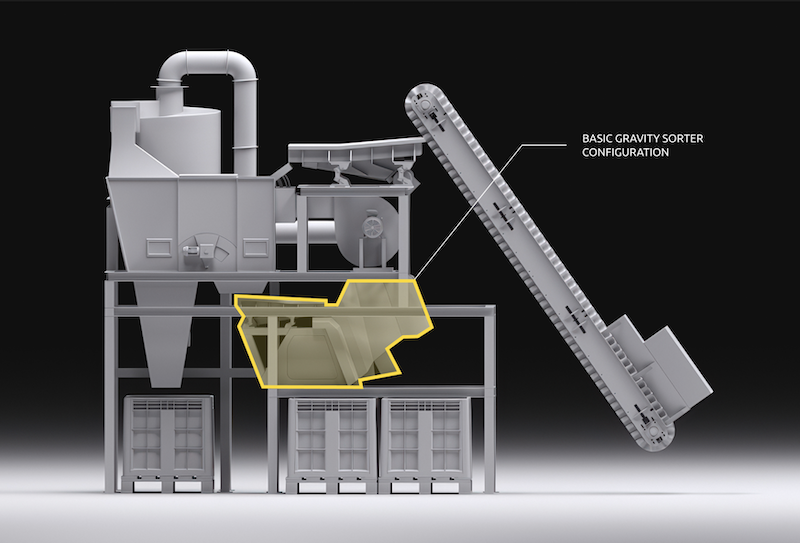
A Dutch recycling automation startup says it has developed a new AI-powered sorting system capable of removing discarded batteries from municipal waste streams at industrial scale – addressing a problem that recycling facilities have struggled with for decades.
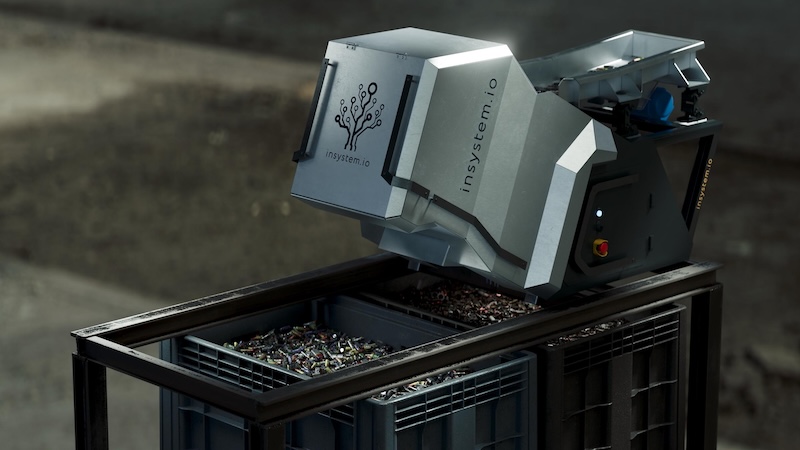
The company, inSystem.io, says its new “Gravity Sorter” can remove up to 50 batteries per second from mixed waste streams while achieving purity rates above 96 percent during recent facility trials.
The announcement highlights a growing problem for recycling operators worldwide. Despite widespread public awareness around battery recycling, large numbers of portable batteries continue to end up in household rubbish.
According to information provided by the company, only around 50 percent of portable batteries are recycled in the Netherlands, while global recycling rates are estimated at roughly 15 percent.
The company says recent research suggests a single fully loaded municipal waste collection vehicle contains an average of 252 portable batteries.
Once inside municipal solid waste streams, batteries become difficult to separate from metal fractions after shredding, screening, and magnetic sorting processes.
That creates both economic and operational problems for recycling facilities because batteries contain recoverable materials while also posing contamination and fire risks.
inSystem.io said: “For MSW battery streams, the only available approach has been hand-picking, which brings safety, accuracy, and labor costs while batteries that escape contaminate the ferrous scrap output or cause fires downstream.”
The company’s Gravity Sorter is designed specifically for the difficult 5 mm to 70 mm material range – a category where traditional optical sorting systems often struggle because materials are small, dense, irregularly shaped, and aerodynamically unpredictable.
Instead of using conveyor-based sorting, the Gravity Sorter processes materials in free fall.
According to the company, an AI vision system operating at up to 400 frames per second tracks each object individually during its descent, analysing movement, rotation, and trajectory in real time.
Compressed-air nozzles then eject targeted materials at precisely timed intervals.
Evgeny Gudov, CEO of inSystem B.V., said: “We built the Gravity Sorter for the fractions that have historically been difficult to sort at scale.
“Through developing a new approach, we eliminated the belt and delay-based ejection. The unit works in free fall, and the AI camera tracks each object individually with its speed, acceleration, rotation during the fall to time the ejection precisely. That saves energy and improves accuracy.”
Gudov also argued that the system’s free-fall approach reduces energy consumption compared to traditional conveyor-based sorting systems.
He said: “Why spend energy accelerating an object to 3 m/s on a conveyor if it is going to hit a wall anyway? If you simply drop it from the height of an ordinary chair, gravity will accelerate it to the same speed.
“The same logic applies to the air. The nozzles open only at the calculated ejection moment and only according to the shape of the object. With up to 500 on/off cycles per second, no air is wasted on the gaps between objects. That alone saves a lot of compressed air compared to older systems. In some cases, the energy savings are enough to pay for the unit on their own.”
The company says the system can process up to six tons of material per hour and is designed to integrate into existing recycling lines without major redesign work.
Beyond batteries, the technology is also intended for e-waste fragments, plastics, non-ferrous metals, construction waste, and incinerator bottom ash recovery.
The company says the system can be upgraded with additional sensing technologies including NIR, SWIR, LWIR, and X-ray imaging to identify different plastic polymers and material types.
According to inSystem.io, the Gravity Sorter generated strong interest during IFAT Munich 2026, with recycling operators and plant engineers from Europe, Canada, Australia, and Latin America requesting pilot evaluations.
The company is now accepting pilot projects and early commercial orders for the system.
