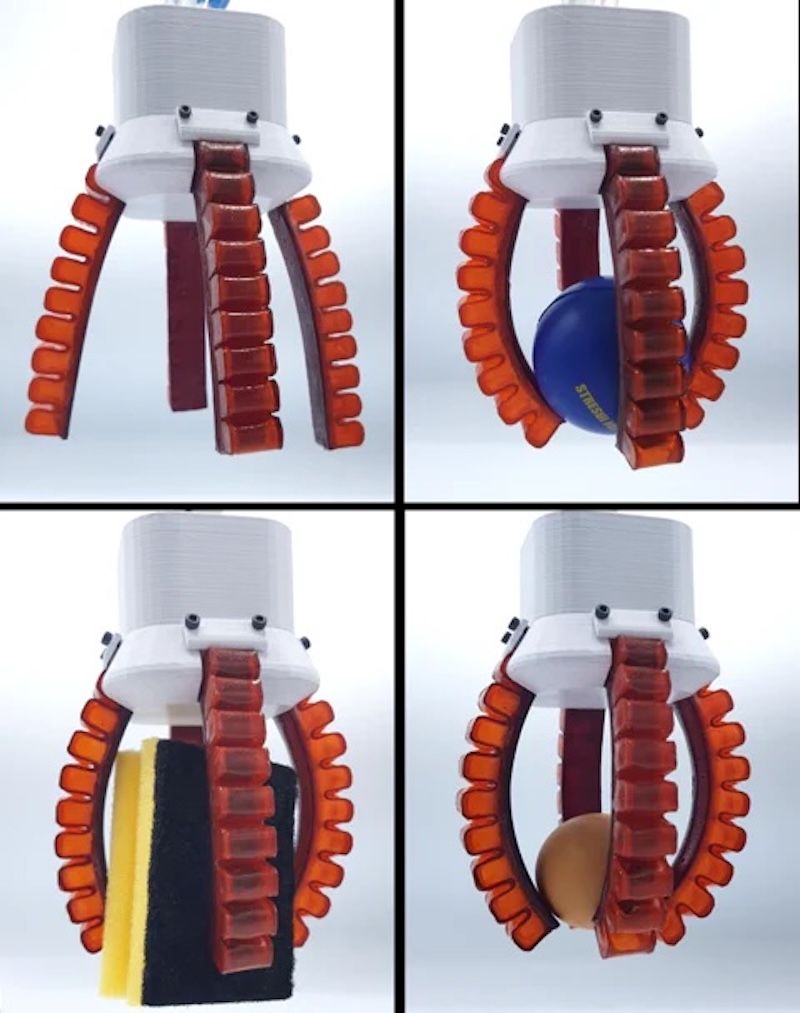
Soft robots that provide patients with tailored support during rehabilitation, gain a sense of touch to safely handle delicate objects, and switch between soft and rigid states depending on the task: these are among the ambitions of RESSORT, a new European research project led by Vrije Universiteit Brussel (VUB).
Funded by the European Union’s Horizon Europe research and innovation programme, the four-year project brings together 14 partners from Belgium, Denmark, Germany, Greece, Norway, Sweden and Switzerland to make soft robots more sustainable, intelligent and reliable, paving the way for applications in healthcare, the food industry and industrial inspection.
Unlike conventional rigid robots, soft robots are made from flexible materials that enable them to adapt more easily to their surroundings. This allows them to interact more safely with people and handle delicate objects without causing damage.
Despite their enormous potential, however, soft robots are still largely confined to laboratory settings due to challenges related to durability, sensing, manufacturing and reliability.
Led by Professor Bram Vanderborght, RESSORT (Resilient Efficient Soft and Sustainable Optimized Robotics Technology) aims to overcome these barriers by combining several breakthrough technologies.
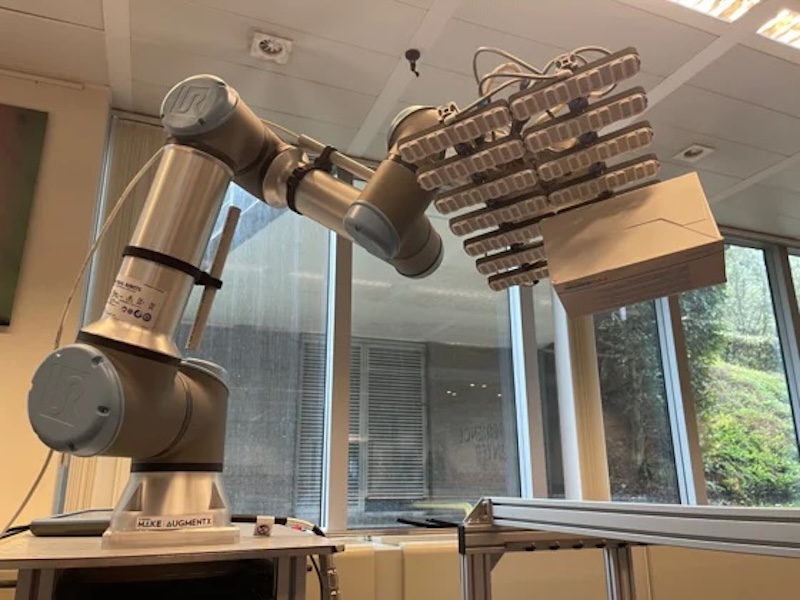
Researchers will develop self-healing materials, variable-stiffness structures that can switch between soft and rigid states, affordable three-dimensional tactile sensors that give robots a sense of touch, artificial intelligence capable of adapting to changing environments, and advanced multi-material 3D printing techniques.
Project lead Professor Bram Vanderborght (Brubotics, VUB and imec), says: “Soft robotics has the potential to fundamentally change the way robots interact with people and their environment.
“With RESSORT, we are bringing together a range of innovative technologies to make soft robots not only smarter, but also more sustainable, reliable and ready for real-world applications.”
From the laboratory to real-world applications
To validate the new technologies under realistic conditions, RESSORT will develop three demonstrators, each addressing an important societal challenge.
In healthcare, researchers will create a personalised soft exosuit: a wearable device that provides patients with tailored, comfortable and safe support during rehabilitation or everyday movement.
Thanks to its flexible materials and intelligent control system, the exosuit can adapt to the movements and individual needs of each user.
For the food industry, the consortium will develop an adaptive robotic system capable of grasping and handling fragile products of widely varying shapes and sizes. New three-dimensional tactile sensors will effectively give the robot a sense of touch, helping it adapt its grip to delicate objects.
While conventional robots often struggle with delicate or irregularly shaped food items, the soft robotic system will be able to safely handle products such as fruit, vegetables and bread without damaging them. This opens up new opportunities for industrial kitchens, food processing companies and logistics environments.
The third demonstrator focuses on inspection tasks in confined or vulnerable environments. Researchers will develop a deformable drone incorporating soft robotic technologies and variable-stiffness structures. These will allow the drone to deform to navigate narrow passages and then become more rigid when required.
This will enable safer inspections in locations where conventional drones or robots face significant limitations, such as industrial facilities or damaged infrastructure.
Strong Belgian contribution
Belgium plays a central role in the project. In addition to leading the consortium, VUB – through Brubotics and imec – contributes to several key research areas.
Together with J. Schmalz GmbH, the university is developing self-sealing suction cups and integrating self-healing materials into robotic systems. In collaboration with Melexis, it is also designing new three-dimensional tactile sensors.
VUB spin-off Valence Technologies will contribute its patented HEALANT self-healing technology, making the robots more durable and resilient.
A European consortium funded by Horizon Europe
RESSORT is funded by the European Union’s Horizon Europe research and innovation programme. The four-year project brings together 14 complementary partners, including VUB, imec, Valence Technologies, Melexis and J. Schmalz GmbH, as well as research institutes, universities and companies from Denmark, Germany, Greece, Norway, Sweden and Switzerland.
By combining expertise in robotics, artificial intelligence, soft materials, advanced manufacturing, sustainability and technology transfer, the consortium aims to strengthen Europe’s leadership in human-centred and sustainable robotics.
