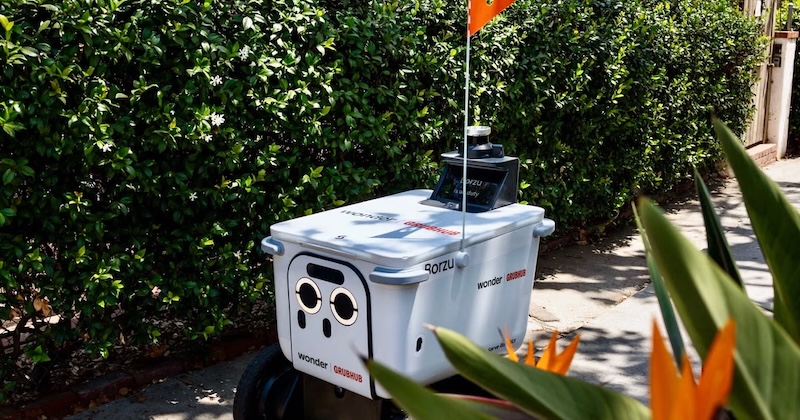
Serve Robotics is expanding its autonomous delivery network through a new partnership with Grubhub, while its Diligent Robotics subsidiary begins rolling out the next generation of its Moxi hospital robot across the United States.
The Grubhub agreement adds a third major delivery platform to Serve’s network alongside Uber Eats and DoorDash, increasing the number of restaurants and orders available to its autonomous sidewalk delivery fleet.
Robot delivery through Grubhub is beginning in Chicago, Los Angeles and Alexandria, Virginia. More than 100 participating Grubhub merchants in Chicago and nearly 200 in Los Angeles are included initially, with additional restaurants expected to join over time.
Wonder, the food technology company that owns Grubhub, is also introducing Serve robot delivery from its Alexandria location.
Ali Kashani, co-founder and CEO of Serve Robotics, says: “Not long ago, our robots were delivering dinner in a handful of neighborhoods. Today, they’re rolling into new cities from San Jose, California’s third largest city, to Washington, DC, the nation’s capital. Their hospital cousins, our new Moxi robots, are showing up in health systems across the country.
“Welcoming Wonder and Grubhub to our network is the clearest signal yet of where we are headed. Every new partner puts more robots to work, and every delivery makes the whole fleet smarter.”
PJ Poykayil, EVP of customer delivery operations at Wonder, says: “At Wonder, we’re constantly looking for ways to make the customer experience more convenient and reliable.
“Our partnership with Serve brings autonomous delivery to Grubhub customers in Chicago, Los Angeles, and Alexandria, while also enabling robot delivery from Wonder’s Alexandria location.
“As we continue to grow, partnerships like this help us expand delivery options, improve efficiency and create a more seamless mealtime experience.”
Serve expands to Washington and San Jose
Alongside the Grubhub agreement, Serve is expanding its geographical footprint with launches in Washington, DC and San Jose, California, both in partnership with DoorDash.
The two additions become Serve’s seventh and eighth major US markets and join Los Angeles, Chicago, Atlanta, Dallas and Miami.
Serve says its robots have already completed their first month of deliveries in San Jose, its first Bay Area market. In Washington, robots are operating in Dupont Circle and parts of downtown, with Talkin’ Tacos among the early restaurant partners.
The company is also introducing its first “micro depots” in Miami. The smaller facilities are designed to handle robot staging, charging, dispatch and maintenance without the build-out required for a full-scale operating site.
Serve says the model should allow it to enter high-demand neighborhoods more quickly and at lower cost.
Another new product, Beacon, is intended to simplify connections between restaurants and Serve’s delivery robots.
The standalone countertop device uses built-in cellular connectivity to alert restaurant staff when a robot arrives for a pickup. It requires only a power connection and does not require restaurants to install another tablet or make changes to their existing back-of-house systems.
Serve says Beacon could extend autonomous delivery to restaurants whose existing systems cannot easily integrate with its platform.
Diligent begins Moxi 2.0 rollout
At the same time, Diligent Robotics, which Serve acquired in 2026, is beginning deployments of its Moxi 2.0 mobile manipulation robot to hospitals across the US.
Initial deployments include Endeavor Health Edward Hospital in the Chicago area, Providence Saint John’s Health Center in Los Angeles and Children’s Hospital Los Angeles.
The new platform incorporates five years of operational experience from Moxi deployments at more than 25 US hospitals.
Moxi 2.0 includes 10 times more onboard computing capacity and perception processing that Diligent says is 10 to 15 times faster than the previous generation.
The robot also gains upgraded cameras, sensors and storage, improved autonomy and edge-case recovery, redesigned handles and ergonomics, and up to 18 hours of daily operating time. It can operate for up to nine hours at a time and charges 30 percent faster.
The compute platform uses Nvidia A2000 hardware. Development also uses the Nvidia Isaac Sim open simulation framework and elements of Nvidia Cosmos open world models, including its 3D lidar tokenizer.
Andrea Thomaz, founder and CEO of Diligent Robotics, says: “Today we’re deploying our most sophisticated physical AI platform yet.
“Hospital hallways are some of the most dynamic environments a robot can operate in, full of fast-moving people, doors, and carts, all in tight spaces. To operate safely in that world, our first-generation platform often had to move conservatively.
“Moxi 2.0 is built with the compute, sensors and models to reason about that complexity in real time, so Moxi can move with more confidence without compromising safety.”
Diligent introduces robotic world model
Moxi 2.0 also introduces what Diligent describes as a robotic world model, which forms part of a learning system designed to improve robots using experience collected across the deployed fleet.
Data gathered by robots operating in hospitals feeds into Diligent’s cloud training infrastructure, allowing the company to refine models for navigation, task execution and recovery from unusual situations.
The cloud infrastructure is developed with Amazon Web Services, with Diligent training the World Model using Amazon SageMaker HyperPod.
T-Mobile for Business is also working with Diligent on network access in hospitals and planning for future private 5G deployments.
Safety and autonomy functions continue to run onboard the robot, allowing Moxi to complete tasks without Wi-Fi. Cellular connectivity provides a fallback in areas where hospital networks have limited coverage.
Diligent says the next-generation platform requires no changes to existing hospital infrastructure.
Omkar Kulkarni, chief innovation and transformation officer at Children’s Hospital Los Angeles, says: “Moxi has become an integral team member at Children’s Hospital Los Angeles.
“Since Moxi joined our team, it has completed more than 40,000 deliveries, representing over 16,000 hours of work that our staff didn’t have to spend transporting supplies and medications across the hospital.
“We expanded our Moxi fleet from two to three robots over time, and utilization continues to grow, increasing more than 10 percent in the second quarter alone. Our nursing leaders and pharmacy team appreciate that we’re investing in technology that allows team members to work at the top of their skill set.”
Serve says it has deployed more than 2,000 robots across the US and supports deliveries from more than 4,000 restaurants. Its acquisition of Diligent extends the company’s operations from outdoor autonomous delivery into indoor hospital service robotics.
