
From shelf-scanning robots to warehouse automation and AI-powered checkout systems, robots are transforming retail operations both in stores and behind the scenes. [Read more…] about Retail automation: Robots on the shop floor and behind the scenes
Retail
Walmart reportedly selling Unitree humanoid robots on its website: Retail reality or PR stunt?
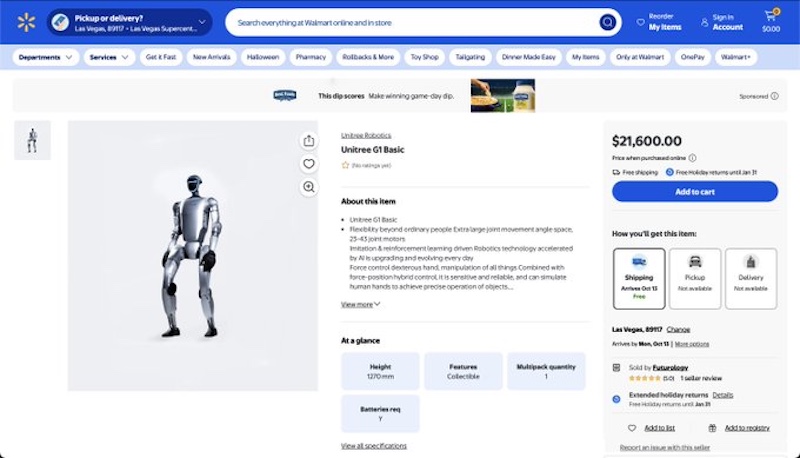
A photograph (main image) has been circulating online this week showing a Walmart product listing for the Unitree G1 humanoid robot, priced at $21,600.
TechNode first reported the story in English, after having apparently discovered it on IThome. Technode noted that Walmart’s website briefly carried a page offering the robot for sale with free shipping and a six-unit limit per customer.
But we checked that Walmart page and the listing can no longer be found. Walmart’s website now returns the message “We couldn’t find this page” when the supposed link is accessed.
However, if you look at the URL for the page, it does mention the “Unitree G1 Basic” (the official company image which we have displayed for you below). This lends credibility to the story – what else could have been on that Walmart page and be described as a “Unitree G1 Basic”? [Read more…] about Walmart reportedly selling Unitree humanoid robots on its website: Retail reality or PR stunt?
Brain Corp partners with Driveline to launch ‘first fully managed, robot-powered shelf intelligence service’
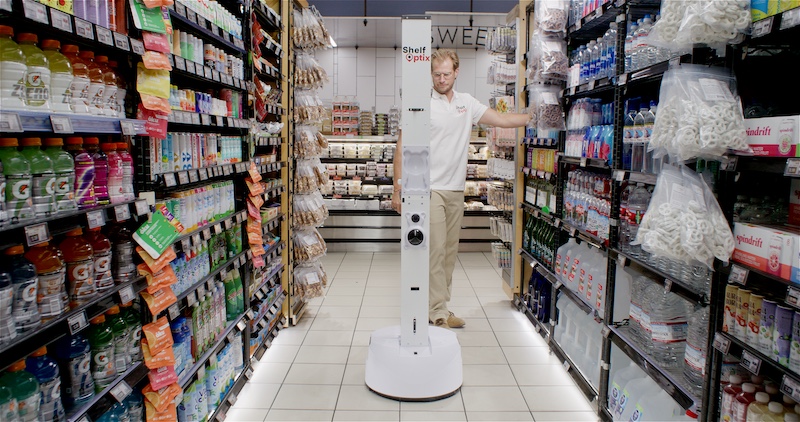
Brain Corp, a provider of operating systems and software for robots, has partnered with Driveline, which has more than 15,000 retail outlets across the US, to launch ShelfOptix, a fully managed inventory management service for stores.
Brain Corp says the ShelfOptix service provides “robot-powered shelf intelligence at scale without the cost or complexity of technology ownership”.
Retailers and brands alike struggle to understand where in-store execution is impacting sales because they lack clear and consistent visibility at the shelf. [Read more…] about Brain Corp partners with Driveline to launch ‘first fully managed, robot-powered shelf intelligence service’
Automation in Retail: How Real-Time Integrations Between POS and eCommerce Prevent Lost Sales

The Problem of Stock Mismatch
Few things frustrate customers more than ordering an item online only to discover it’s out of stock. This issue is common when a retailer runs separate systems for point-of-sale (POS) and eCommerce.
Stores may sell an item in person, but the online system doesn’t register that sale until hours later. By then, an online order could already be placed for a product that no longer exists on the shelf.
For retailers, this mismatch means canceled orders, customer disappointment, and sometimes lost loyalty. Preventing these situations requires real-time synchronization across channels.
Why Real-Time Matters
Retail no longer lives in silos. Customers browse online, buy in store, and expect to return items across channels. If data moves slowly between systems, it creates blind spots:
- Delayed stock updates – overselling and refunds
- Inaccurate pricing – checkout conflicts and unhappy customers
- Disconnected promotions – coupons valid online but not in store
Real-time integration is about closing these gaps. When POS and eCommerce platforms update each other instantly, both staff and shoppers see the same picture of products, pricing, and availability.
How Integrations Reduce Lost Sales
1. Centralized Inventory Visibility
When POS and eCommerce share one source of truth, staff can tell customers with confidence whether an item is available. Online shoppers see real-time stock numbers, reducing the chance of placing impossible orders.
2. Instant Price Updates
Promotions launched in-store should appear online immediately. Real-time sync ensures consistent pricing across all channels, preventing disputes at checkout.
3. Faster Fulfillment
With connected systems, online orders can automatically trigger in-store picking or warehouse dispatch. This shortens fulfillment cycles and improves delivery times.
4. Unified Customer Experience
Customers no longer have to wonder if inventory shown online is accurate. Trust builds when what they see is what they get, regardless of channel.
The Role of Middleware
Many retailers don’t replace their POS or eCommerce systems entirely. Instead, they use a middleware layer that acts as the bridge between them. Middleware synchronizes product data, inventory levels, orders, and customer profiles across multiple platforms.
One example is Helix Solutions, which integrates POS systems with eCommerce stores and ERPs. By updating stock and orders in near real time, it helps retailers avoid overselling and keeps all channels consistent.
Similar middleware approaches exist in the market, but the core idea is the same: automate the data flow to reduce manual intervention.
Retailers who move to integrations often see:
- Fewer cancellations because items sold in-store disappear from online catalogs immediately.
- Reduced refunds thanks to accurate pricing and promotions.
- Higher customer satisfaction since shoppers can rely on availability data.
- Improved staff efficiency as employees spend less time reconciling mismatched records.
For businesses handling hundreds or thousands of SKUs, even a small drop in cancellation rates can mean significant savings and stronger brand reputation.
Challenges to Overcome
Not all integrations are straightforward. Retailers face obstacles such as:
- Legacy POS Systems: Older software may not have APIs for real-time communication.
- Data Formatting Issues: Different platforms may track SKUs or product variations in unique ways.
- Network Reliability: Real-time sync requires stable internet and system uptime.
To overcome these challenges, retailers often start with the most critical processes – such as inventory updates – before expanding to orders, promotions, and customer data.
The Future of Retail Integrations
The next stage of retail automation involves more than just POS and eCommerce:
- Connected Warehouses: Warehouse management systems (WMS) will sync instantly with sales channels to optimize picking and packing.
- Omnichannel Loyalty Programs: Points earned in-store will be reflected online right away, and vice versa.
- AI Forecasting: With unified data, machine learning models can better predict demand and adjust stock distribution.
All of these advancements depend on a solid integration layer that ensures information flows without delay.
Final Thoughts
Lost sales due to mismatched systems are preventable. Real-time integrations between POS and eCommerce give retailers a unified view of inventory and customers, ensuring shoppers always get accurate information.
As retail continues to blend physical and digital experiences, automation is no longer optional – it’s a requirement.
Companies that invest in robust integrations now will not only prevent losses but also build the trust and efficiency needed to thrive in the years ahead.
HomeBase USA pilots Simbe’s shelf-scanning robot at two stores
HomeBase USA, one of America’s largest home improvement retailers, has introduced Simbe Robotics’s Store Intelligence platform – powered by the world’s first autonomous shelf-scanning robot, Tally – to two locations in Copperas Cove, Texas and Laramie, Wyoming.
The Laramie store introduction marks the first Tally deployment in Wyoming.
Stores like HomeBase have expansive footprints and tens of thousands of SKUs across lumber, building supply, hardware, farm, ranch, and lawn and garden categories. [Read more…] about HomeBase USA pilots Simbe’s shelf-scanning robot at two stores
Amazon’s relentless march towards total global roboticization

Amazon has quietly passed a stunning milestone: the deployment of 1 million robots across its global operations.
While not all are fully autonomous, the scale and speed of the company’s automation push have sparked a bigger question – how soon will robots outnumber human workers inside Amazon’s warehouses?
With the announcement of a new generative AI foundation model powering its fleet, Amazon is transforming its fulfillment network into one of the most advanced robotic ecosystems in the world. The implications – on efficiency, employment, and the future of logistics – are significant. [Read more…] about Amazon’s relentless march towards total global roboticization
VenHub launches robot-operated store at Los Angeles airport

VenHub Global, a developer of fully autonomous, AI-powered, robot-operated retail, has unveiled its flagship Smart Store at the LAX/Metro Transit Center at Los Angeles International Airport.
The Smart Store brings secure, frictionless, and fully automated retail convenience to millions of travelers and transit riders moving through Los Angeles each year.
Launched in anticipation of the 2026 FIFA World Cup and 2028 Olympic and Paralympic Games, the installation places VenHub at the forefront of smart retail infrastructure as Los Angeles prepares to welcome the world. [Read more…] about VenHub launches robot-operated store at Los Angeles airport
Amazon marks deployment of 1 millionth robot and unveils new AI foundation model for its robots

Amazon Robotics has reached two major milestones in its robotics and AI operations: the deployment of its one millionth robot and the launch of a new generative AI foundation model designed to optimize its global fleet of warehouse robots.
The new AI model, called DeepFleet, is expected to improve robot travel efficiency by 10 percent across Amazon’s fulfillment network, which spans more than 300 facilities worldwide. The company says the technology will support faster customer deliveries and reduce operational costs.
“Think of DeepFleet as an intelligent traffic system for our robotic fleet,” writes Scott Dresser, vice president of Amazon Robotics, in a blog post on one of the company’s websites. “It optimizes how robots move within our facilities, reducing congestion and improving efficiency.” [Read more…] about Amazon marks deployment of 1 millionth robot and unveils new AI foundation model for its robots
Simbe Robotics and DeCicco & Sons launch strategic partnership at new flagship store

Simbe Robotics, a specialist in retail shelf digitization, has agreed a strategic partnership with DeCicco & Sons, one of New York’s most respected family-owned grocery chains.
The partnership brings Simbe’s Store Intelligence platform to DeCicco’s flagship Sleepy Hollow location, and additional stores in Eastchester and Larchmont.
Simbe’s platform delivers real-time, storewide visibility into pricing accuracy, product availability, and inventory placement – supporting greater operational precision and in-store execution. [Read more…] about Simbe Robotics and DeCicco & Sons launch strategic partnership at new flagship store
Why Every Modern Restaurant Needs a Smart POS System

Running a successful restaurant in today’s digital age is about much more than delicious food and friendly service.
Behind every seamless dining experience is a system that ensures orders are processed quickly, payments are accurate, and inventory is always under control. This backbone of restaurant efficiency is known as the restaurant POS system.
Whether it’s a bustling café, a fine-dining establishment, or a fast-food chain, a POS system tailored for the foodservice industry is no longer optional – it’s essential. Let’s dive into what a restaurant POS system is, why it matters, and how it can revolutionize your operations. [Read more…] about Why Every Modern Restaurant Needs a Smart POS System