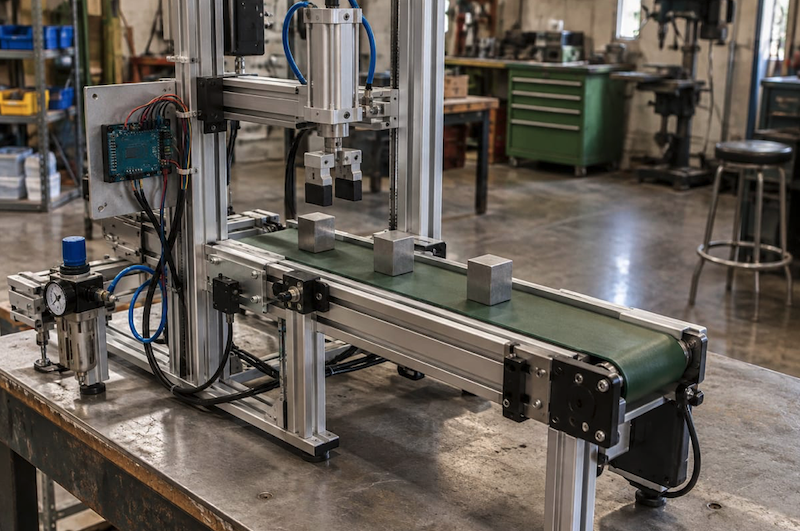
Most teams start a new automation cell by ordering the controller. The PLC or the industrial robot arm shows up, the integrator schedules commissioning time, and only then does anyone sit down to work out what the machine is supposed to do, in what order, with what interlocks.
The logic gets written against hardware that costs thousands per day to keep idle.
That order of operations is backwards, and the cheapest fix is a microcontroller board on a desk.
Sketch the sequence before you buy the controller
A pick-and-place cycle, a conveyor diverter, a torque-limited screwdriving routine: all of these are state machines before they are anything else. The state machine does not care whether the output drives a 24V solenoid or a Fanuc tool-change signal.
Writing that sequence on an Arduino forces the question most specifications skip. What happens when the part sensor fires while the gripper is still closing? What happens if the home switch never trips?
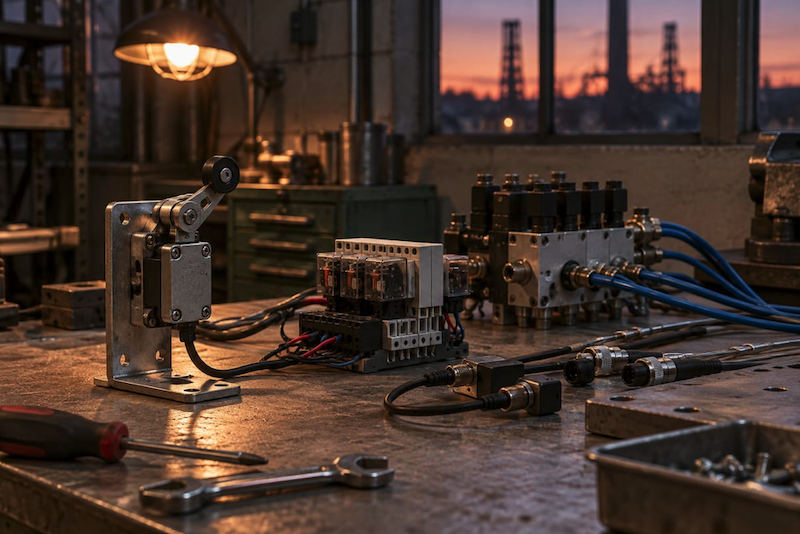
Catching those cases on a breadboard costs an afternoon. Catching them during commissioning costs a shift of line downtime and an angry plant manager.
Timing assumptions are what break on the factory floor
The single most common failure in a transplanted control routine is timing. Code written with a blocking delay works fine when the only thing happening is a servo sweep. Put the same structure on a cell that has to watch an E-stop, a light curtain, and a vision trigger at once, and it falls apart.
Prototyping on a constrained 16MHz board is useful here precisely because it is constrained. If you cannot make the loop non-blocking on an Uno, you have not solved the problem, you have hidden it behind processor headroom.
Measure the cycle time. Write it down. Compare it to what the industrial platform gives you once the scan includes safety I/O.
Pick the board for the signal types, not whatever’s in the drawer
Teams default to whatever board is in the drawer. That is fine for a logic test and a problem for anything touching real actuators.
If the eventual system runs quadrature encoders and three or four axes of coordinated motion, prototype on a Mega 2560 with enough interrupt-capable pins to represent that honestly.
If you are testing a single conveyor index with a photoeye, a Nano is plenty. The point is that pin count and interrupt behaviour are part of the design, not an implementation detail to sort out later.
Motor driver boards matter too. A prototype that drives a hobby servo tells you nothing about the acceleration profile your actual stepper or brushless unit needs.
Where ArduinoDroid fits in the iteration loop
Controller logic is rarely written in one sitting at a desk. Changes get suggested on the shop floor, during a review, or in the truck on the way back from a site visit, and the usual workflow is to scribble them in a notebook and retype them later, which is where transcription errors and half-remembered pin numbers creep in.
ArduinoDroid, published under the developer name Anton Smirnov, bundles the compiler and uploader into a single Android package, so a sketch gets opened, edited and compiled on the spot instead of reconstructed from memory.
Running ArduinoDroid for PC keeps that same editing environment on a Windows machine back in the office, for when the file goes under proper review.
It supports the boards most prototyping work uses, including the Uno, Nano, Mega 2560, Leonardo and the Robot Control and Robot Motor boards, with syntax highlighting and real-time error diagnostics. The practical value is that a compile error surfaces where the change was made, not two days later.
The library and example sketches included are the same ones engineers already know, so nothing has to be relearned to use it.
Write the test cases while you write the code
Software teams have been doing this for decades and automation teams mostly have not. Every state transition in your sequence deserves a test you can run deliberately: force the sensor high, force it low, interrupt mid-motion, cut and restore power.
On a prototype board you can do this with jumper wires and a few minutes. On a live cell you need lockout, a safety observer, and permission.
Keep the list. When the logic moves to the industrial controller, those same cases become your acceptance tests, and you will have them written before the integrator asks.
What does not transfer
Be honest about the boundary. An Arduino prototype proves sequence logic, timing structure and I/O behaviour. It proves nothing at all about safety rating, EMC performance in a cabinet full of VFDs, or deterministic scan time under load.
Safety functions must be implemented on rated hardware. A prototype that happens to stop the motor when the button is pressed is not a safety circuit, and treating it as one is how people get hurt.
Fieldbus behaviour is another gap. EtherCAT and PROFINET timing has no analogue on a serial-connected hobby board, so anything that depends on network determinism needs to be validated on the real stack.
Think of the prototype as a specification that runs: it answers the behavioural questions for the price of a breadboard and a weekend, and it hands the engineering questions, the ones needing rated components and a competent electrical designer, to the people who are supposed to answer them.
