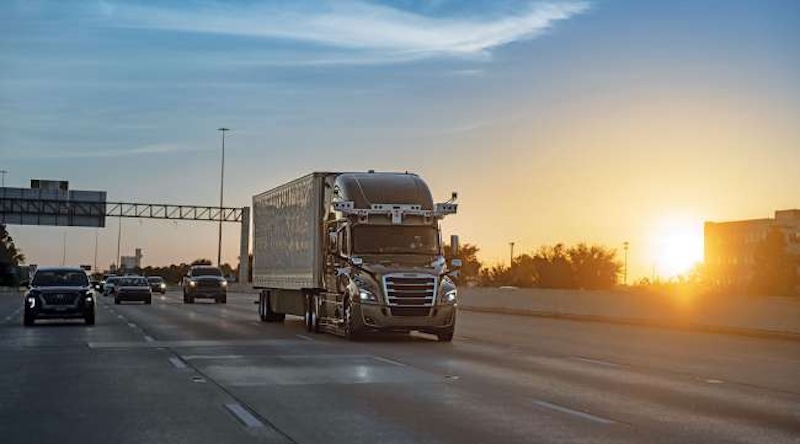
Bot Auto has launched its Capacity Grid, a freight transportation network designed to match customer demand with autonomous trucking capacity, alongside agreements covering 200 million miles of driverless freight operations.
The Houston-based company says the new platform will enable shippers and freight brokers to reserve driverless trucking capacity in advance, with agreed prices, routes and operating schedules.
The agreements include a commitment covering 50 million miles for FreightVana, a Phoenix-based logistics company specializing in power-only freight transportation.
Bot Auto says the Capacity Grid represents a shift from operating individual autonomous trucks toward managing a coordinated freight network capable of serving customers across multiple routes and schedules.
Building a network around customer demand
The Capacity Grid allows customers to purchase autonomous freight transportation by the mile and arrange capacity according to their requirements.
Rather than treating each driverless truck as a standalone vehicle, the system coordinates available trucks, routes, schedules and trailer pools to meet customer demand.
Customers can reserve capacity for specified routes and time windows at agreed prices, allowing Bot Auto to plan its fleet operations around anticipated freight volumes.
The company believes this approach will improve vehicle utilization and reduce operating costs, while giving customers greater predictability when planning their logistics operations.
Unlike autonomous trucking technology providers that sell driving systems to fleet operators, Bot Auto owns and operates its vehicles and provides transportation services directly to customers.
This means customers do not need to purchase autonomous trucks, maintain the vehicles or manage the underlying technology.
Bot Auto says its business model is designed to keep vehicles operating as frequently as possible, spreading fixed costs across more revenue-generating miles.
FreightVana agreement
The agreement with FreightVana covers 50 million miles of autonomous trucking services and is intended to support the logistics company’s power-only freight operations.
In power-only transportation, a carrier provides the truck while the customer or logistics provider supplies the trailer.
The arrangement is particularly suited to operations in which loaded trailers are prepared in advance for collection, allowing trucks to connect to trailers and continue their journeys with limited waiting time.
Brett Suma, president and COO of Bot Auto, says: “I spent years building a power-only business before I came to Bot Auto, so I know exactly what a committed trailer pool is worth.
“Pair that with humanless trucks, and the economics on both sides improve substantially. FreightVana’s trailers and our humanless trucks fit together without either side having to reinvent how they operate. Fifty million miles is a strong place to start.”
Bot Auto has not specified the timetable for completing the full 200 million miles covered by its announced agreements.
Testing the economics of driverless freight
The Capacity Grid announcement follows Bot Auto’s completion of a fully driverless commercial freight journey in Texas in April 2026.
On April 29, a Bot Auto truck transported a commercial load from northeast Houston to Hutchins, near Dallas, without a human driver or in-cab observer.
The vehicle departed at 1:16 a.m. and arrived at 4:57 a.m., completing a 231-mile journey for freight broker Ryan Transportation.
According to figures reported by the company, the driverless journey cost $1.89 per mile, compared with $3.78 per mile for a comparable human-driven operation within its business.
The shipment generated revenue equivalent to $2.70 per mile, suggesting a positive operating margin for the individual journey based on the reported figures.
However, the figures do not by themselves establish the profitability of a larger autonomous trucking fleet, which must also account for vehicle investment, maintenance, insurance, fleet management and supporting infrastructure.
Bot Auto argues that higher vehicle utilization is central to making autonomous trucking commercially viable.
Under US federal hours-of-service regulations, most property-carrying commercial truck drivers are limited to 11 hours of driving after 10 consecutive hours off duty.
Autonomous trucks are not subject to the same driver rest requirements, potentially allowing vehicles to operate for longer periods, subject to maintenance, refueling and other operational constraints.
Expanding commercial operations
Bot Auto says its autonomous trucking services are already being used by customers including J.B. Hunt, Ryan Transportation and Steves & Sons.
At the time of its April commercial journey, the company was operating 12 trucks across two commercial routes and serving more than 25 customers.
The company has also begun a pilot program at Fort Hood in Texas, where its autonomous trucks are being used to transport goods between warehouses.
The program is intended to evaluate civilian autonomous driving technology in a military installation environment.
Bot Auto’s broader strategy comes as the US trucking industry faces continuing pressure from operating costs, driver availability and fluctuating freight capacity.
The company believes autonomous vehicles could help address some of these challenges by enabling more consistent operations, particularly on established highway routes and overnight services.
However, expanding driverless trucking beyond limited commercial routes will require further investment in vehicles, maintenance facilities, operational oversight and supporting infrastructure.
The Capacity Grid is intended to provide the commercial framework for that expansion by securing customer demand before additional fleet capacity is introduced.
For Bot Auto, the objective is to move beyond demonstrating that autonomous trucks can transport freight without drivers and establish a repeatable business model capable of supporting large-scale commercial operations.
