• Skip to primary navigation
  • Skip to main content
  • Skip to primary sidebar
  • Skip to secondary sidebar
  • About
    • Contact
    • Privacy
    • Terms of use
  • Shop
    • Cart
    • Checkout
    • My Account
  • Advertise
    • Advertising
      • Buy ad space
    • Case studies
    • Design
    • Email marketing
    • Features list
    • Lead generation
    • Magazine
    • Press releases
    • Publishing
    • Sponsor an article
    • Webcasting
    • Webinars
    • White papers
    • Writing
  • Subscribe to Newsletter

Robotics & Automation News

Where Innovation Meets Imagination

  • Home
  • News
  • Features
  • Editorial Sections A-Z
    • Agriculture
    • Aircraft
    • Artificial Intelligence
    • Automation
    • Autonomous Vehicles
    • Business
    • Computing
    • Construction
    • Culture
    • Design
    • Drones
    • Economy
    • Energy
    • Engineering
    • Environment
    • Health
    • Humanoids
    • Industrial robots
    • Industry
    • Infrastructure
    • Investments
    • Logistics
    • Manufacturing
    • Marine
    • Material handling
    • Materials
    • Mining
    • Promoted
    • Research
    • Robotics
    • Science
    • Sensors
    • Service robots
    • Software
    • Space
    • Technology
    • Transportation
    • Warehouse robots
    • Wearables
  • Press releases
  • Events

Science

Robots and AI are tackling some of the biggest challenges in construction

March 17, 2026 by Sam Francis

Each year, the construction industry builds $2.1 trillion worth of structures in the US, and more than three-quarters of those projects face delays, according to the Associated General Contractors of America.

One solution could be robots.

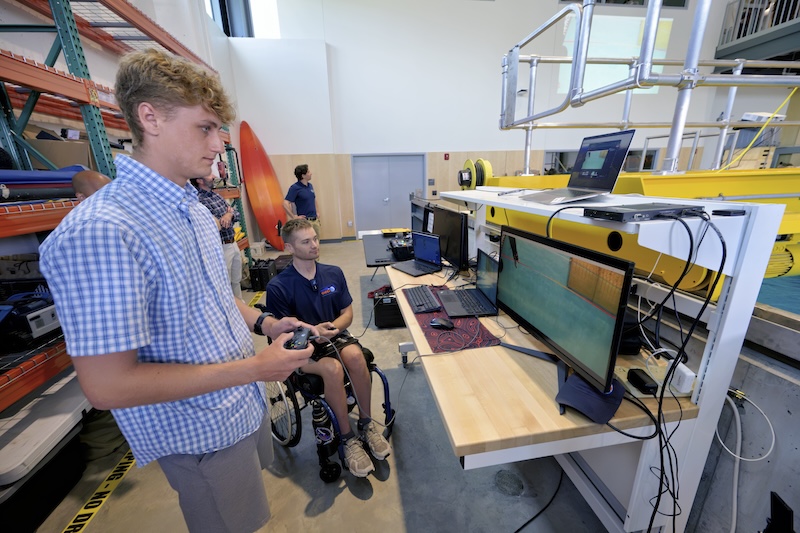
Virginia Tech researchers, in collaboration with Procon Consulting, are developing a coordinated team of robots, drones, and technology such as artificial intelligence (AI) sensing and computer vision designed to enable continuous, remote monitoring of construction sites. [Read more…] about Robots and AI are tackling some of the biggest challenges in construction

Filed Under: Features, Science Tagged With: AI construction monitoring, automation news, construction digital twins, construction site robots, drones in construction, robotic site inspection, robotics and automation, robotics and automation news, robotics news, virginia tech robotics research

Tahoe Therapeutics builds record single-cell atlas using automated pipetting technology

March 13, 2026 by Sam Francis

Tahoe Therapeutics – a biotech start-up based in San Francisco, California – is creating the largest ever atlas of cell-chemical interactions to inform drug discovery.

Combining automated pipetting systems from Integra Biosciences with Parse Biosciences’ Evercode single-cell RNA sequencing (scRNA-seq) products, and its own proprietary AI algorithms, the company already has several drug discovery programs running in parallel across multiple cancer types, and is expanding into other therapeutic areas.

Workflow automation is essential for the Tahoe Therapeutics team’s aim of generating some of the largest scRNA-seq datasets in the world. The company invested in an Assist Plus pipetting robot with Viaflo handheld electronic pipette to automate its research workflows. [Read more…] about Tahoe Therapeutics builds record single-cell atlas using automated pipetting technology

Filed Under: Science Tagged With: automated pipetting systems, automation news, biotech lab automation, drug discovery automation, Integra Biosciences pipetting robots, laboratory automation robotics, robotics and automation, robotics and automation news, robotics news, scRNA seq workflow automation, single cell RNA sequencing

HighRes and Opentrons showcase ‘industry’s first’ AI agent-to-agent lab automation workflow

March 13, 2026 by Sam Francis

HighRes, a laboratory automation and orchestration software provider, and Opentrons Labworks, a laboratory robotics company building the physical infrastructure for AI-driven autonomous science, have agreed a strategic partnership to co-develop “the industry’s first AI agent-to-agent laboratory workflow”.

Together, the companies are introducing a new model for workflow automation that connects intuitive, modular robotics with enterprise-grade orchestration and AI-ready infrastructure. They demonstrated their innovation at the recent Society for Laboratory Automation and Screening event.

This collaboration brings Opentrons’ flexible, high-throughput Opentrons Flex robotic platforms and OpentronsAI, together with the FlexPod Configurable Lab Automation Platform and Cellario, HighRes’ industry-leading scheduling and orchestration software, enabling scientists to adopt automation quickly and scale seamlessly as workflows grow in complexity. [Read more…] about HighRes and Opentrons showcase ‘industry’s first’ AI agent-to-agent lab automation workflow

Filed Under: Health, News, Science Tagged With: agent-to-agent AI workflow, AI lab automation, automation news, autonomous laboratory workflows, HighRes Cellario software, laboratory automation robotics, Opentrons Flex robot, robotic lab automation systems, robotics and automation, robotics and automation news, robotics news

What are Biosafety Cabinets?

March 13, 2026 by Sam Francis

Picture a glass-fronted workstation that behaves a bit like an invisible shield. Air flows in carefully controlled patterns, almost choreographed, to keep hazardous particles from escaping while also protecting whatever sample sits inside.

That airflow matters. A lot.

Air is pulled inward through the cabinet’s front opening, forming a barrier that prevents stray microbes or hazardous aerosols from drifting out toward the operator or the surrounding room.

At the same time, filtered air flows downward over the work surface. Think of it as a gentle sterile “air curtain.” It sweeps contaminants away from samples so the materials you’re working with remain clean.

In short? The cabinet protects three things simultaneously: the person working, the experiment itself, and the wider laboratory environment. A neat trick for a metal box with a fan and filters.

Choosing the right cabinet is not trivial

Labs don’t just grab whichever unit is on sale that month. Selection depends on a few practical questions.

What kind of organisms are involved?
How dangerous are they?
Will chemicals or radioactive compounds be used alongside the biological work?

These questions tie into something called risk groups, which run from relatively harmless microbes to truly nasty pathogens.

Roughly speaking:

  • Risk Group 1-3 organisms: standard biosafety cabinets usually do the job
  • Risk Group 4 agents: that’s the serious territory. Think maximum containment systems
  • Experiments involving volatile chemicals or radionuclides: special airflow designs are needed

Different cabinet classes exist precisely because no single design fits every situation.

The different classes of biosafety cabinets

Not all cabinets are created equal. Some are fairly basic. Others resemble miniature containment vaults.

Class I

This is the simplest design you’ll encounter. Air is pulled inward and then filtered before being exhausted. It protects the person operating the cabinet and the lab environment.

What it doesn’t do particularly well is protect the sample itself from contamination.

Still, for work involving lower risk microorganisms, it’s perfectly adequate.

Class II

Now we’re talking about the workhorse of modern laboratories. If you step into a university research facility or hospital microbiology lab, chances are high you’ll see one of these humming away.

Class II cabinets protect everything: the user, the room, and the sample.

Here’s how they manage that balancing act:

Roughly 70 percent of the air inside the cabinet recirculates as filtered downward airflow. The remaining portion is exhausted after passing through high-efficiency filters. That combination maintains sterile conditions inside while preventing hazardous particles from escaping.

Most labs rely on Type A2 cabinets, the most common configuration.

Occasionally, when toxic chemicals are involved, these cabinets are connected to exhaust ducts to keep fumes moving out of the workspace.

Class II Type B2

This variant takes things a step further. Instead of recirculating air inside the cabinet, all air is exhausted after filtration.

Nothing cycles back through the workspace.

Because of that design, Type B2 cabinets are often used when biological work is combined with toxic chemicals. No recirculation means less chance of hazardous buildup.

Some safety engineers even argue they’re the safest version of Class II cabinets, simply because the full-exhaust system acts like a built-in safety net.

Class III

This is the heavy-duty containment option. The “space suit” of bio safety cabinet.

Everything inside is completely sealed off. Operators manipulate materials through glove ports built into the cabinet wall. Air entering and leaving the system is heavily filtered, often more than once.

These cabinets are typically reserved for work involving the most dangerous pathogens known. The kind of organisms that make epidemiologists lose sleep.

A quick note on biosafety levels

Laboratories themselves are categorized by biosafety levels, which define how dangerous the materials being handled are.

There are four main levels.

  1. BSL-1 is the lowest tier. Harmless microbes used in teaching labs usually fall here. Basic precautions, handwashing sinks, and common sense are generally enough.
  2. BSL-2 involves pathogens that can cause disease but are manageable with standard safety practices. Think organisms like certain hepatitis viruses or Salmonella.
  3. BSL-3 laboratories deal with pathogens capable of causing serious illness, often transmitted through the air. Tuberculosis bacteria, for instance, belong here. Specialized ventilation and strict procedures become essential.
  4. Then there’s BSL-4. Rare facilities. Extreme containment. These labs handle agents such as hemorrhagic fever viruses where vaccines or treatments may not exist. Workers typically wear full-body positive-pressure suits, and Class III cabinets often form part of the containment system.

Filters: the unsung heroes

If the cabinet is the fortress, the filters are the gatekeepers.

There are two types dominate modern biosafety cabinets.

  • HEPA filters, which capture 99.99 percent of particles around 0.3 microns in size.
  • And ULPA filters, which are even finer, trapping about 99.999 percent of particles down to roughly 0.12 microns.

ULPA filters are often described as roughly ten times more efficient than standard HEPA filters. Not that HEPA is weak. It’s already incredibly effective.

But when dealing with biological hazards, “almost perfect” sometimes isn’t quite perfect enough.

Design details matter more than you’d think

You might assume all cabinets look roughly the same. Front window. Steel work surface. Maybe a control panel.

Yet small design choices can make a surprising difference.

For instance, airflow enters through a grille near the front of the cabinet. If a researcher accidentally blocks that grille with their arms or equipment, airflow can become disrupted. That, in turn, weakens the protective barrier.

Manufacturers try to reduce that risk with clever tweaks, like raised armrests or curved air grilles that discourage obstruction.

Controls and alarms

Older cabinets were almost laughably simple. Flip a switch. Fan starts. Light turns on.

Modern units are smarter.

Some now include digital microprocessor systems that monitor airflow velocity, sash position, filter performance, and other parameters. If something drifts out of safe operating range, alarms kick in.

Windows, trays, and ergonomics

Many cabinets use tempered safety glass that stays largely intact if shattered, reducing the chance of hazardous exposure. Some windows tilt forward slightly rather than standing perfectly vertical, which reduces glare and makes long work sessions easier on the eyes.

Inside the cabinet, the work surface can be a single solid tray or multiple removable panels.

Single trays contain spills better. Multi-piece trays are easier to lift out and clean.

Like so many things in lab design, it’s a trade-off.

And yes, ergonomics count

Researchers may spend hours inside a biosafety cabinet. Poor design can quickly turn that into an uncomfortable experience.

Good cabinets consider things like:

  • Control panels placed where both seated and standing operators can reach them
  • Bright but glare-free lighting inside the work area
  • Quiet blowers, ideally under about 67 decibels
  • UV lamps positioned so they don’t shine directly into someone’s eyes

Little details. They matter after the fourth hour of repetitive pipetting.

A few practical safety habits

Owning a biosafety cabinet doesn’t magically make work safe. Proper use still matters.

A few rules that experienced lab workers repeat endlessly:

  • Don’t confuse biosafety cabinets with laminar flow hoods. They serve different purposes.
  • Never ignore alarms. If the cabinet complains, something’s wrong.
  • Avoid using open flames inside the cabinet.
  • Don’t turn it into a storage shelf.
  • Keep airflow unobstructed whenever possible.

Also important: certification. Cabinets should be tested regularly, usually once a year, to confirm that airflow patterns and filters are still performing properly.

Because when containment fails, the consequences can escalate quickly.

Filed Under: Research, Science Tagged With: automation news, biosafety cabinets, biosafety level labs, Class II biosafety cabinet, HEPA filtration laboratories, lab airflow containment, laboratory containment systems, laboratory safety equipment, robotics and automation, robotics and automation news, robotics news

Tekniker unveils robotic metrology system combining collaborative robots and digital measurement at BIEMH 2026

February 21, 2026 by David Edwards

The combination of collaborative robotics and in-process digital metrology represents a strategic convergence for the manufacturing industry and factories of the future.

On the one hand, collaborative robots make it possible to automate handling and assembly tasks flexibly and safely without the need for physical barriers and, on the other hand, digital metrology integrated into the process means that components can be measured and checked directly in the production line with high precision.

In this context, Spain’s Tekniker technology centre, member of the Basque Research and Technology Alliance (BRTA) partnership, with extensive expertise in this set of technologies, will present a solution that brings together automation, high-precision measurement and digitalisation in industrial environments at the next edition of the Biennial International Machine Tool Exhibition (BIEMH). [Read more…] about Tekniker unveils robotic metrology system combining collaborative robots and digital measurement at BIEMH 2026

Filed Under: Features, Science, Technology Tagged With: advanced manufacturing technology, automation news, BIEMH 2026, cobot systems, collaborative robots, digital metrology, factory of the future, industrial automation, industrial robotics Spain, machine vision robotics, quality control automation, robotics and automation, robotics and automation news, robotics news, smart factory technology

Michigan State University scientists use AI to grow gigantic diamond worth trillions in lab

February 20, 2026 by David Edwards

Natural diamonds are ‘actually lower quality than the kind of diamond we grow’, say researchers

Diamond is more than just a gemstone; it is the hardest natural substance on Earth with exceptional qualities for improving semiconductors – the materials used in electronics, electric vehicles and renewable energy technologies.

Michigan State University has received a $3 million National Science Foundation grant as part of the NSF’s Future Manufacturing program in collaboration with teams at the Fraunhofer USA Center Midwest and Fraunhofer USA Center Mid-Atlantic.

The teams are using artificial intelligence to grow high-quality diamond in labs, which could be the key to the future of semiconductor manufacturing and advancing workforce talent in the US. [Read more…] about Michigan State University scientists use AI to grow gigantic diamond worth trillions in lab

Filed Under: Features, Science Tagged With: advanced materials engineering, ai in manufacturing, automation news, Fraunhofer USA, industry 4.0, lab grown diamonds, Michigan State University, microwave plasma technology, NSF grant research, robotics and automation, robotics and automation news, robotics news, semiconductor materials, us semiconductor manufacturing, workforce development

No brain? No problem. University of Southern California scientists show what robots can learn from sea stars

February 10, 2026 by Sam Francis

Ever feel run off your feet? Spare a thought for sea stars, creatures whose movement involves the coordination of hundreds of tiny tube feet to navigate complex environments – despite the lack of a central “brain”.

In other words, it’s as though each foot has a mind of its own. For Kanso Bioinspired Motion Lab, based within the University of Southern California Viterbi Department of Aerospace & Mechanical Engineering, sea stars pose an intriguing phenomenon.

Kanso Lab specializes in decoding the flow physics of living systems, often applying those insights to inform developments in robotics. [Read more…] about No brain? No problem. University of Southern California scientists show what robots can learn from sea stars

Filed Under: Features, Science Tagged With: academic research, automation news, Autonomous robots, bio-inspired robotics, decentralized control, marine biology, resilient robots, robot locomotion, robotics and automation, robotics and automation news, robotics news, soft robotics, usc

ABB showcases the future of lab automation at SLAS 2026

February 9, 2026 by Sam Francis

ABB Robotics is demonstrating what it describes as “the next leap in automated laboratory workflows”, showcasing how AI-powered, Autonomous Versatile Robotics (AVRTM) can deliver higher throughput, improved reproducibility and seamless multi-vendor connectivity.

ABB Robotics is at Booth #2027 at the ongoing Society for Laboratory Automation and Screening (SLAS) 2026 International Conference & Exhibition, February 7-11 at the Thomas Michael Menino Convention & Exhibition Center in Boston.

Jose-Manuel Collados, service robotics product line manager at ABB Robotics, says: “Laboratories worldwide are moving from isolated automation pilots to fully connected, AI-ready operations. [Read more…] about ABB showcases the future of lab automation at SLAS 2026

Filed Under: Health, Science Tagged With: abb robotics, ai robotics, automation news, cobots, collaborative robots, industrial robotics, lab automation systems, laboratory automation, research automation, robotics and automation, robotics and automation news, robotics news, scientific robotics, SLAS 2026

Scientists outline manufacturing roadmap for ultra-thin silicon bioelectronics

February 7, 2026 by Sam Francis

Researchers at Incheon National University, South Korea comprehensively review the latest advances, potential applications, and future prospects of this cutting-edge technology

Ultra-thin crystalline silicon is an exciting material for next-generation bioelectronics, transforming rigid silicon into flexible nanomembranes while preserving superior electrical performance and CMOS compatibility.

A new review paper systematically explores its manufacturing roadmap – from high-temperature on-wafer processes like oxidation and doping, through transfer printing techniques, to diverse applications including wearable health monitors, electrophysiological sensors, personalized neuromodulation, bio-integrated prosthetics, and bioresorbable implants that dissolve post-use.

Silicon has been the foundation of modern electronics for decades, yet it has traditionally been regarded as incompatible with soft, dynamic biological systems due to its rigidity. [Read more…] about Scientists outline manufacturing roadmap for ultra-thin silicon bioelectronics

Filed Under: Features, Science Tagged With: automation news, bioelectronics, flexible electronics, implantable technology, robotics and automation, robotics and automation news, robotics news, semiconductor research, silicon nanomembranes, wearable medical devices

SMART and NUS pioneer neural blueprint for human-like intelligence in soft robots

February 6, 2026 by Sam Francis

Singapore-MIT Alliance for Research and Technology’s (SMART) Mens, Manus & Machina (M3S) interdisciplinary research group, and National University of Singapore (NUS), alongside collaborators from Massachusetts Institute of Technology (MIT) and Nanyang Technological University (NTU Singapore), have developed an AI control system that enables soft robotic arms to learn a wide repertoire of motions and tasks once, then adjust to new scenarios on the fly without needing retraining or sacrificing functionality.

This breakthrough brings soft robotics closer to human-like adaptability for real-world applications, such as in assistive robotics, rehabilitation robots, and wearable or medical soft robots, by making them more intelligent, versatile and safe.

Unlike regular robots that move using rigid motors and joints, soft robots are made from flexible materials such as soft rubber and move using special actuators – components that act like artificial muscles to produce physical motion. [Read more…] about SMART and NUS pioneer neural blueprint for human-like intelligence in soft robots

Filed Under: Science Tagged With: adaptive robots, ai robot control, assistive robotics, automation news, embodied intelligence, intelligent robots, medical robotics, meta-learning robotics, mit robotics, National University of Singapore, neural-inspired AI, next-generation robotics, robot control systems, robotic learning systems, robotics and automation, robotics and automation news, robotics news, SMART research, soft robotics

  • « Go to Previous Page
  • Page 1
  • Page 2
  • Page 3
  • Page 4
  • Interim pages omitted …
  • Page 29
  • Go to Next Page »

Primary Sidebar

Search this website

Latest articles

  • The Hardware Powering the Hybrid Industrial Workforce
  • How to Choose a Robot Vacuum and Mop That Actually Fits Your Home
  • How Modern Software Helps Construction Companies in Qatar Work Smarter and Safer
  • Antivirus vs malware: Why antivirus alone is no longer enough
  • X Square Robot builds a full-stack approach to embodied AI and general-purpose robotics
  • AGIBOT debuts A3 humanoid robot in Europe and launches UK Robot-as-a-Service model
  • What Are the Biggest Challenges in Modern Electronics Manufacturing?
  • What Are the Best AI Tools for Creating Content Faster in 2026?
  • Why Does Quality Wiring Matter More Than Ever in Modern Electronic Devices?
  • Why Are Custom Harness Solutions Essential for Next Generation Technology?

Secondary Sidebar

Latest news

  • The Hardware Powering the Hybrid Industrial Workforce
  • How to Choose a Robot Vacuum and Mop That Actually Fits Your Home
  • How Modern Software Helps Construction Companies in Qatar Work Smarter and Safer
  • Antivirus vs malware: Why antivirus alone is no longer enough
  • X Square Robot builds a full-stack approach to embodied AI and general-purpose robotics
  • AGIBOT debuts A3 humanoid robot in Europe and launches UK Robot-as-a-Service model
  • What Are the Biggest Challenges in Modern Electronics Manufacturing?
  • What Are the Best AI Tools for Creating Content Faster in 2026?
  • Why Does Quality Wiring Matter More Than Ever in Modern Electronic Devices?
  • Why Are Custom Harness Solutions Essential for Next Generation Technology?

Copyright © 2026 · News Pro on Genesis Framework · WordPress · Log in

We use cookies on our website to give you the most relevant experience by remembering your preferences and repeat visits. By clicking “Accept”, you consent to the use of ALL the cookies.
Do not sell my personal information.
Cookie SettingsAccept
Manage consent

Privacy Overview

This website uses cookies to improve your experience while you navigate through the website. Out of these, the cookies that are categorized as necessary are stored on your browser as they are essential for the working of basic functionalities of the website. We also use third-party cookies that help us analyze and understand how you use this website. These cookies will be stored in your browser only with your consent. You also have the option to opt-out of these cookies. But opting out of some of these cookies may affect your browsing experience.
Necessary
Always Enabled
Necessary cookies are absolutely essential for the website to function properly. These cookies ensure basic functionalities and security features of the website, anonymously.
CookieDurationDescription
cookielawinfo-checkbox-analytics11 monthsThis cookie is set by GDPR Cookie Consent plugin. The cookie is used to store the user consent for the cookies in the category "Analytics".
cookielawinfo-checkbox-functional11 monthsThe cookie is set by GDPR cookie consent to record the user consent for the cookies in the category "Functional".
cookielawinfo-checkbox-necessary11 monthsThis cookie is set by GDPR Cookie Consent plugin. The cookies is used to store the user consent for the cookies in the category "Necessary".
cookielawinfo-checkbox-others11 monthsThis cookie is set by GDPR Cookie Consent plugin. The cookie is used to store the user consent for the cookies in the category "Other.
cookielawinfo-checkbox-performance11 monthsThis cookie is set by GDPR Cookie Consent plugin. The cookie is used to store the user consent for the cookies in the category "Performance".
viewed_cookie_policy11 monthsThe cookie is set by the GDPR Cookie Consent plugin and is used to store whether or not user has consented to the use of cookies. It does not store any personal data.
Functional
Functional cookies help to perform certain functionalities like sharing the content of the website on social media platforms, collect feedbacks, and other third-party features.
Performance
Performance cookies are used to understand and analyze the key performance indexes of the website which helps in delivering a better user experience for the visitors.
Analytics
Analytical cookies are used to understand how visitors interact with the website. These cookies help provide information on metrics the number of visitors, bounce rate, traffic source, etc.
Advertisement
Advertisement cookies are used to provide visitors with relevant ads and marketing campaigns. These cookies track visitors across websites and collect information to provide customized ads.
Others
Other uncategorized cookies are those that are being analyzed and have not been classified into a category as yet.
SAVE & ACCEPT