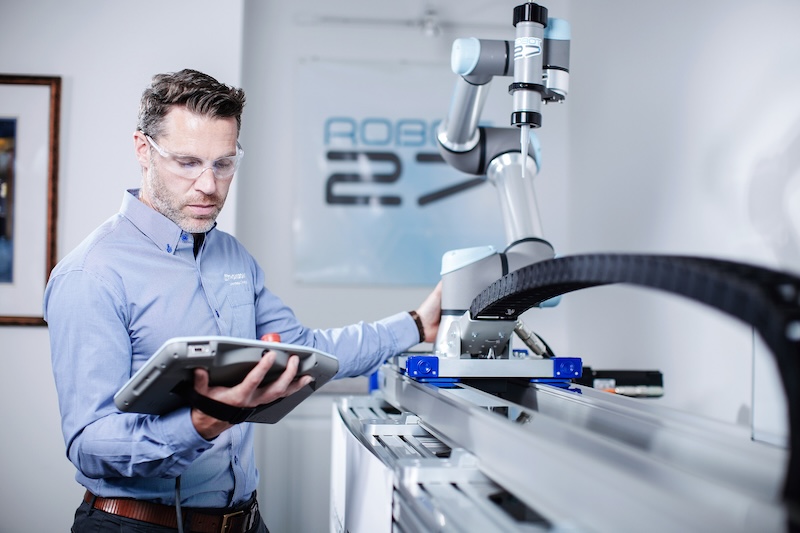
Rodriguez has introduced a collaborative linear transfer system that can move a cobot between multiple workstations and extend its operating range to as much as 10 metres.
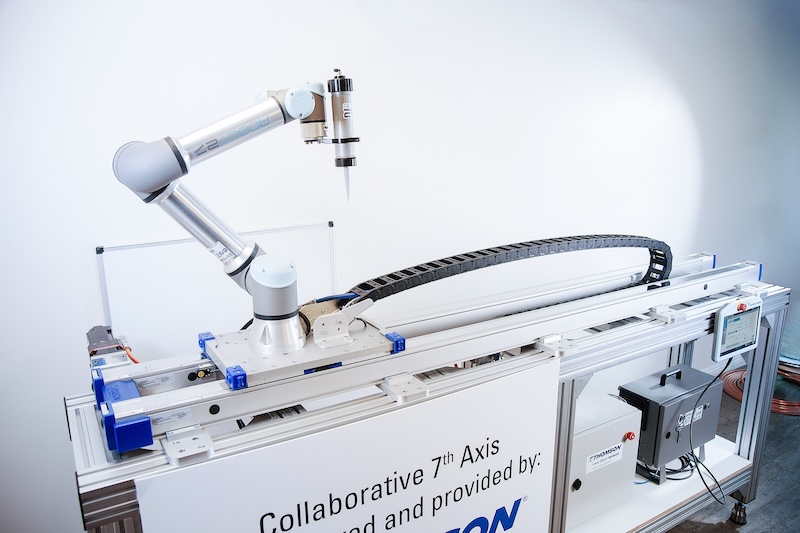
The company is offering Thomson’s Movotrak Cobot Transfer Unit (CTU), which it describes as “a movable seventh axis” designed to allow a single cobot to perform tasks at different positions along a production line rather than remaining fixed at one workstation.
Rodriguez says the system could help manufacturers increase robot utilisation while reducing the need to reposition or reconfigure automation equipment when production requirements change.
A key feature of the Movotrak CTU is integrated collision detection. According to Rodriguez, it is “the only 7th axis available on the market to be equipped with collision detection”, enabling the system to detect a collision while the carriage is moving and automatically stop its motion.
The company says the capability is intended to make the transfer unit more suitable for production environments where people and automated equipment operate in close proximity.
However, Rodriguez stresses that the collision detection capability “complements the safety architecture but does not replace safety functions required by standards”.
One cobot, multiple workstations
Adding a linear seventh axis effectively turns a stationary cobot into a mobile automation system within a defined production area.
Instead of installing separate cobots at individual machines or workstations, manufacturers can potentially use one robot to serve several locations along the Movotrak axis.
Depending on its configuration, the system can provide an operating range of up to 10 metres, making it suitable for applications such as tending several machines, inspecting large components or moving materials between different production stages.
The transfer unit can be installed horizontally or mounted on a wall or ceiling, giving system integrators more freedom when designing production cells where floor space is limited.
Rodriguez says the modular mounting system makes the CTU compatible with many standard cobots currently available on the market.
The system also includes a Freedrive function that allows an operator to guide the robot manually along the axis and save positions directly. This can simplify the process of teaching the system where the cobot needs to stop and work.
Designed for extended robot loads
The Movotrak CTU uses two linear units designed to provide torque capacity and rigidity when a cobot is operating with its arm fully extended.
Rodriguez supplies the technology as a complete system incorporating the linear units, motor, gearbox and control cabinet, with configurations adapted to individual applications.
The company sees the technology being used particularly in production environments where the same robot needs to perform tasks across a relatively large working area.
Potential applications include machine tending, order picking, palletising and packaging, as well as inspection and quality assurance of large components.
The extended working range could also be used for processes such as welding, soldering, grinding and dispensing, where a conventional fixed cobot installation may not be able to cover the complete workpiece.
By allowing a single cobot to travel between different working positions, Rodriguez says the system can reduce changeover requirements, make production layouts easier to adapt and increase overall utilisation of robotic equipment.
