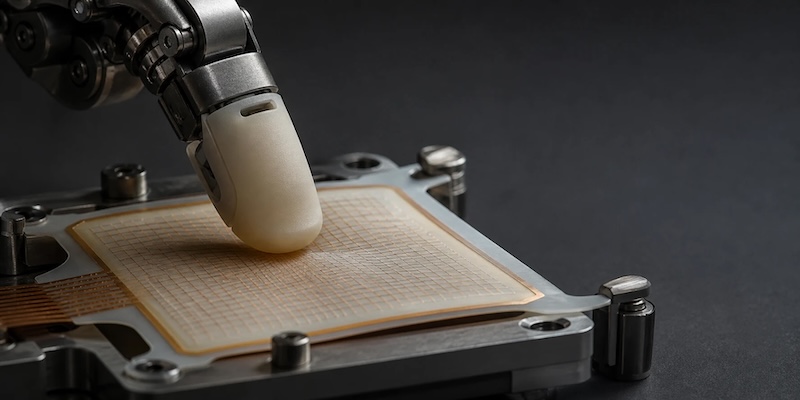
Scientists have developed a hybrid robotic skin that combines electrical impedance tomography with pneumatic pressure sensing in an effort to improve force detection across large areas of a humanoid robot, as highlighted by RoboSkin.
Described in a preprint published in May 2026, the system uses electrical impedance tomography (EIT) to determine where contact occurs, while four sealed pneumatic pads provide an estimate of the force being applied.
Combining the two sensing methods is intended to address a limitation of large-area EIT-based tactile sensors, where sensitivity can vary depending on the location of contact.
In load-cell indentation experiments, the researchers report that the coefficient of variation for sensitivity non-uniformity fell from 0.31 using EIT alone to 0.14 with the hybrid sensing method.
The result represents a reduction in sensitivity variation under the researchers’ test conditions rather than a general measure of the system’s accuracy.
Large-area tactile sensing
The prototype consists of a rigid base, four soft air-tight pads, a continuous piezoresistive layer and 32 boundary electrodes, with components manufactured using 3D printing and spray coating.
A version installed on the chest of a humanoid robot measures 280 × 280 mm, demonstrating the approach over a substantially larger surface than fingertip-scale tactile sensors.
The system reconstructs EIT images at 100 Hz using a precomputed matrix.
Its processing system uses a Tikhonov-regularized inverse reconstruction to produce a spatial EIT map. Each of the four pneumatic pads is separately calibrated against ground-truth force measurements.
Data from the pneumatic pads is then used to rescale the reconstructed conductivity image. The approach allows the EIT system to retain information about the location of contact while using pneumatic measurements to improve the estimate of force magnitude.
The researchers’ approach takes advantage of the different strengths of the two technologies.
EIT can determine where conductivity has changed across a flexible surface, but its inverse reconstruction can be affected by factors including nonlinearity, manufacturing variations and differences between simulated and physical sensor behavior.
Pneumatic sensing provides a comparatively simple way of measuring total load but cannot independently determine where within an individual air chamber the contact occurred.
Combining them therefore allows EIT to provide the spatial information while air pressure provides the net-force measurement.
Detecting multiple contacts
The researchers also tested the skin by applying pressure sequentially at two locations on the same pneumatic pad.
In those experiments, the pressure signal tracked the combined force of the contacts while the EIT reconstruction retained information about their spatial locations.
The result suggests that an individual pneumatic pad can continue to estimate aggregate load when more than one contact occurs. However, the pneumatic sensing system itself cannot determine the individual force applied at each contact point.
Such capabilities could eventually be important for humanoid robots and other machines designed to operate in close physical proximity to people.
Large-area robot skin needs to provide useful contact information across curved and extensive body surfaces while accommodating practical constraints including wiring, fabrication and real-time processing.
The hybrid approach attempts to divide those requirements between two complementary sensing technologies rather than relying on a single sensor type to provide coverage, localization and accurate force measurement simultaneously.
Further testing required
The research remains at the preprint and prototype stage, and several limitations have yet to be addressed.
The paper identifies reduced sensitivity near areas where the pneumatic pads overlap. Because the current sensor-fusion method relies heavily on pneumatic measurements for its force estimate, errors in those areas can affect the reconstructed result.
The humanoid demonstration also does not test the skin as part of a closed-loop robot safety system.
Other practical requirements for commercial deployment, including long-term abrasion resistance, cleaning, repairability, temperature drift and operational lifetime, have not yet been evaluated.
The reported 100 Hz figure relates specifically to the EIT reconstruction process rather than the complete response time of a robot reacting to physical contact. An operational system would also need to account for sensor acquisition, communications, filtering, control decisions and robot actuation.
The next stage for the technology would be to connect the resulting force maps to robot behavior and evaluate whether the sensing approach can improve capabilities such as contact-aware movement, collision response, physical interaction and recovery following unexpected contact.
The work points toward a sensor-fusion approach to large-area tactile sensing in which different technologies handle separate aspects of physical interaction – potentially providing a more practical route to whole-body sensing for humanoid robots than relying on a single sensing mechanism.
