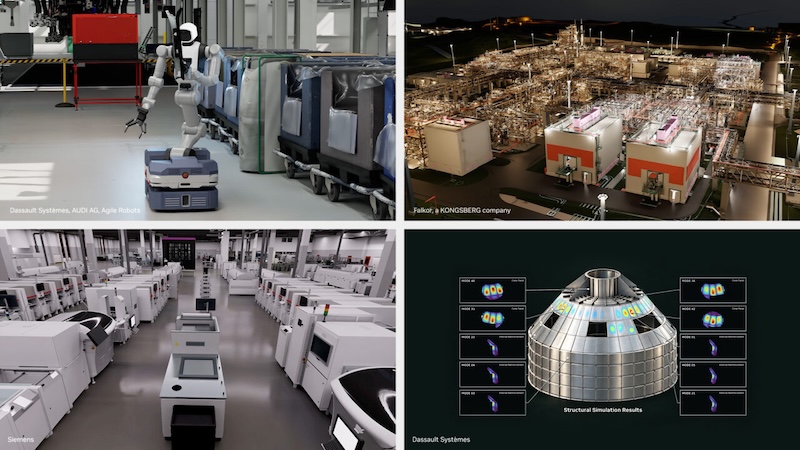
European industrial companies including Siemens, Mercedes-Benz, Audi and Volkswagen are expanding their use of artificial intelligence, simulation and digital twins to improve engineering, manufacturing and factory operations.
The developments were outlined by Nvidia at its recent GTC Berlin event, where the company highlighted industrial applications of its CUDA-X, Omniverse, Cosmos and Isaac technologies.
Nvidia also introduced early access to its Factory Operations Blueprint (FOX), a software framework designed to help developers create AI agents that monitor factory operations, investigate production problems and coordinate activities across equipment and systems.
AI agents for factory operations
Siemens is integrating agents developed using FOX into its Intelligence Center X platform to support factory management and root cause analysis.
The company estimates potential cost savings of 20 percent from the approach.
At its electronics factory in Erlangen, Germany, Siemens has also used Nvidia Cosmos Data Factory tools to generate synthetic defect images for circuit-board inspection, reportedly reducing inspection calibration time by 40 percent.
Mercedes-Benz is using Siemens Simcenter STAR-CCM+ software running on Nvidia GPUs to accelerate aerodynamic simulations during vehicle development.
The automaker is also applying AI-based visual inspection technology to vehicle manufacturing, including windshield assembly verification.
Meanwhile, semiconductor companies imec and Infineon are using GPU-accelerated simulation to improve engineering processes. Nvidia reports speed improvements of up to 40 times for lithography simulations at imec and 12 times for certain semiconductor device simulations at Infineon.
Digital twins for robots and production systems
Audi is using digital twins of battery production facilities to evaluate manufacturing concepts before physical equipment becomes available.
The company is also working with Dassault Systèmes and Agile Robots to simulate mobile humanoid robots and logistics operations in virtual factory environments.
Schaeffler is integrating digital models of its humanoid robot actuators with Nvidia Isaac simulation technology, allowing robotics developers to evaluate component behavior before physical testing.
At Volkswagen Sachsen’s Transparent Factory, Wandelbots is using its NOVA platform with Isaac Sim to validate robotic assembly workflows digitally.
Other projects include Schneider Electric and AVEVA developing an AI infrastructure digital twin for Nscale, while Leonardo is exploring AI-assisted aircraft design with Neural Concept.
Nvidia says these applications demonstrate how AI, simulation and digital twins can support engineering decisions, robot development and industrial operations before changes are introduced into physical production environments.
