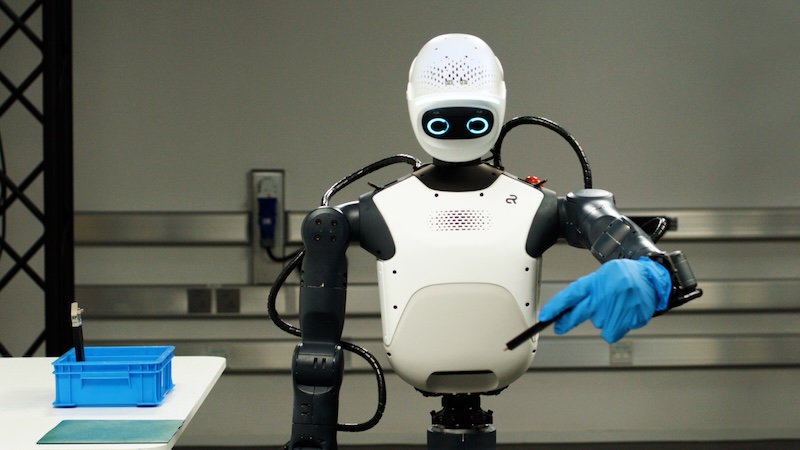
Nvidia has announced a major expansion of its Isaac robotics development platform, introducing new simulation frameworks, AI training tools, datasets and a reference humanoid robot designed to accelerate the development of general-purpose robotic systems.
The announcements, made at GTC Berlin, include Agile ONE SN, a humanoid research platform developed by Agile Robots, alongside updates to Isaac Lab, a new Isaac OS runtime and additional resources for robot learning and simulation.
Jensen Huang, founder and CEO of Nvidia, says: “General-purpose robotics is advancing at extraordinary speed – the ChatGPT moment for robotics is fast approaching.”
“With Nvidia Isaac, our full-stack open robotics platform, we are giving developers the models, data, simulation tools and computing systems to bring physical AI to the world’s largest industries.”
Agile Robots introduces reference humanoid
Agile Robots has introduced Agile ONE SN, a humanoid reference platform incorporating Nvidia’s Isaac GR00T foundation model and Jetson Thor computing system.
The robot stands 1.4 meters tall, weighs 40 kilograms and has 31 degrees of freedom. Its two five-finger robotic hands each provide 20 degrees of freedom, tactile sensing and force control for dexterous manipulation.
Designed for robotics researchers and developers, the platform combines hardware, simulation and AI training tools to simplify the development and testing of humanoid capabilities.
Agile ONE SN is scheduled to become available in early 2027.
Zhaopeng Chen, founder and CEO of Agile Robots, says: “The breakthrough for humanoids is usefulness at scale: one adaptable machine that learns many skills and works across environments built for people.”
New tools for robot learning and simulation
Nvidia has also introduced Isaac OS, an open-source runtime framework designed to connect robot sensors, AI models, control systems and hardware.
Meanwhile, Isaac Lab 3.0 is now generally available, providing developers with tools for training robot behaviors using reinforcement learning and physics simulation.
Additional resources include the SimReady Central Library, containing more than 2,000 simulation-ready robotics and factory assets, and the Human 1M Dataset, which provides human activity recordings and 3D hand-tracking information for robot training.
Nvidia is also releasing reference workflows that combine Isaac GR00T, Cosmos world models and reinforcement learning to support synthetic data generation and robotic manipulation.
European robotics companies expand integration
Several European robotics manufacturers are incorporating Nvidia technologies into their development platforms.
ABB Robotics is integrating Omniverse libraries with RobotStudio HyperReality to support virtual commissioning, while Kuka is using Omniverse through its Visual Components FactoryLens software.
Sereact is using Isaac GR00T and Cosmos Transfer to develop its Cortex robotic manipulation platform, while Neura Robotics is applying Isaac Sim and Isaac Lab to train its Neuron AI foundation model.
Humanoid and Hexagon Robotics are also developing perception, control and simulation capabilities using Nvidia’s computing and software platforms.
In mobile robotics, Toyota Material Handling Europe and SoftServe report that simulation-based development can reduce commissioning time by up to 50 percent.
Other companies, including Schaeffler, Flexion, Franka Robotics and Universal Robots, are contributing to or using Nvidia’s robotics ecosystem.
The developments reflect growing industry interest in combining foundation models, simulation and physical robot hardware to improve the reliability and adaptability of autonomous systems.
