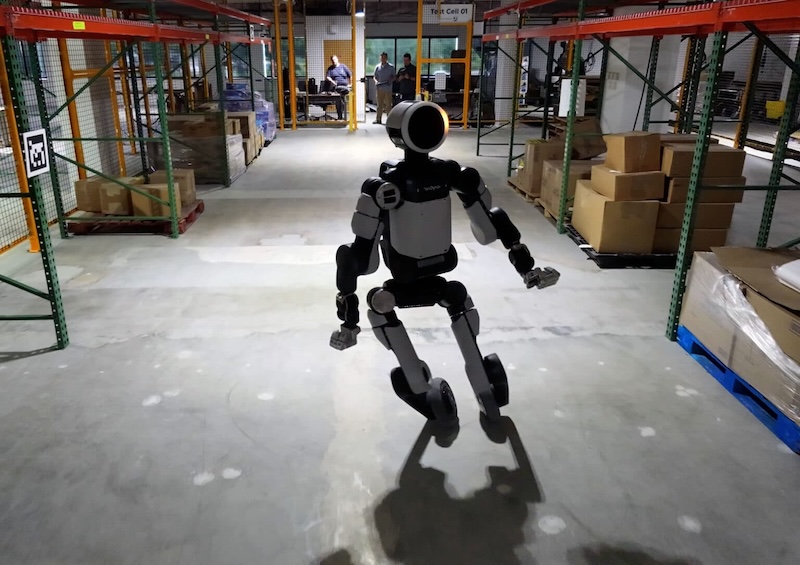
Boston Dynamics has released a new video showing its Atlas humanoid robot performing a series of unusual maneuvers, including rolling on wheels, sliding sideways and executing a 360-degree jump.
The demonstration is part of a research project exploring how reinforcement learning can improve robot movement, test actuator performance and strengthen the reliability of control systems under demanding conditions.
Engineers temporarily replaced Atlas’s feet with wheels, using custom adapters to attach commercially available scooter rims to the robot’s existing ankle actuators.
The modification allowed researchers to test the robot’s motors across a wide range of speeds and torque demands while evaluating how accurately behaviors learned in simulation could transfer to physical hardware.
Xiaoyu (Andy) Wu, a controls engineer at Boston Dynamics, explains: “A wheeled Atlas isn’t a product. It’s a research testbed.”
Closing the simulation-to-reality gap
The project combines traditional motor control engineering with whole-body reinforcement learning, a technique that allows robots to develop movement strategies through repeated simulated training.
Boston Dynamics used millions of simulated scenarios to train Atlas before transferring the learned behaviors to the physical robot.
Some movements were developed using human motion capture recordings, including sliding maneuvers that the robot adapted to its wheeled configuration.
The 360-degree jump was generated using a trajectory-tracking policy based on a recording of a person performing the movement.
Wu says: “It was fascinating to see these little tricks emerge on their own. Give the policy wheels, and it figures out how to use them.”
The research also highlights the importance of accurately modeling motor characteristics during simulation.
If simulated actuators behave differently from their physical counterparts, robots may learn movements that cannot be reliably reproduced in real-world conditions.
Boston Dynamics says the findings are already being applied to Atlas’s standard configuration, with researchers working to improve its ability to respond to actuator failures and other unexpected operating conditions.
The ultimate objective is not to produce a wheeled version of Atlas, but to develop more robust control systems capable of supporting reliable humanoid robot operations in real-world environments.
