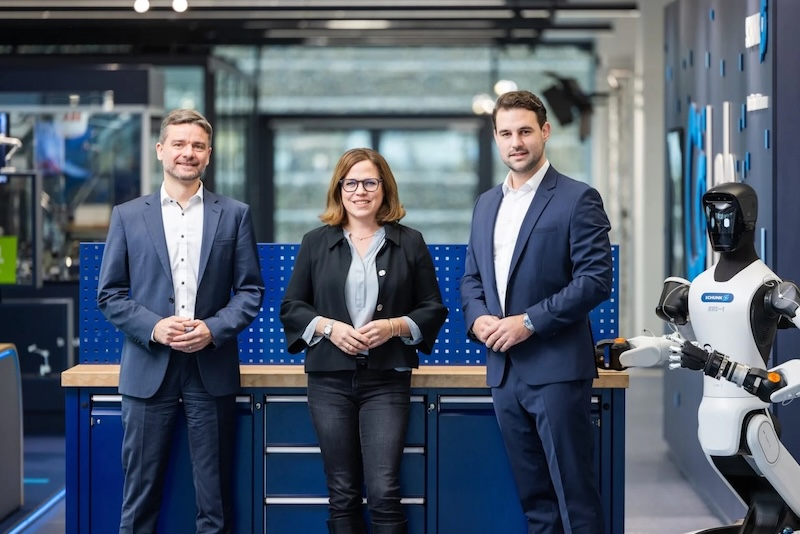
Schunk has renamed its humanoid robotics spin-off Tactilia Robotics, establishing a Munich-based company focused on developing modular robotic hands for industrial automation applications.
Originally founded in January 2026 as Schunk Humanoid Robotics GmbH, the company is developing robotic hands designed to handle a wide variety of objects and components in manufacturing and logistics environments.
The technology is intended for use across different robot platforms, including humanoid robots, collaborative robots and mobile manipulators.
Tactilia aims to address one of the continuing challenges in robotics: enabling machines to grip, manipulate and position objects reliably in changing industrial conditions.
Dr. Markus Netzer, who became CEO on November 1, 2026, says: “The robotic arm has changed the industry. The robot hand will do the same. We want this technology to come from Europe.”
Combining robotics hardware with physical AI
The company’s development program combines mechanical engineering, sensors, actuators, software and physical AI to create robotic hands capable of performing tasks that currently require human dexterity.
Tactilia says its modular approach will allow the technology to be adapted to different industrial applications without being restricted to a particular robot manufacturer or platform.
Timo Gessmann, CTO of Schunk, says: “Robotic hands open up new automation possibilities, especially for tasks that previously required a lot of manual skill. To generate real benefits, they must be simple to integrate and reliable in continuous use. That’s what Tactilia focuses on.”
Although operating independently, Tactilia will continue to draw on Schunk’s expertise in gripping and automation technology.
The company will also have access to Schunk’s network of 15 CoLabs worldwide, where robotic systems can be tested and developed alongside industrial customers.
Tactilia is headquartered in Munich’s Arabellapark district, selected for its proximity to universities, research institutions and robotics companies.
Netzer previously served as vice president of manufacturing at Rolls-Royce Solutions, overseeing high-precision manufacturing operations.
The company says its immediate priority is developing and validating robotic hands that can operate reliably in industrial environments, with an emphasis on practical integration and continuous operation.
