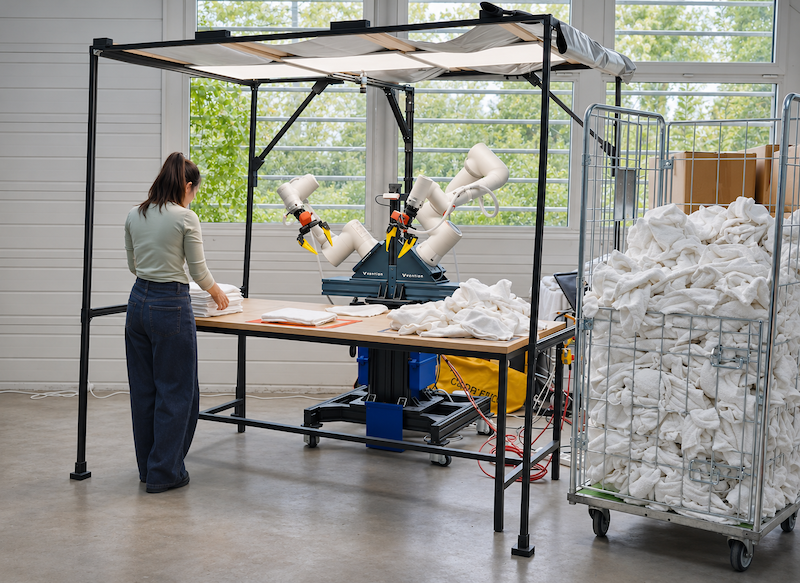
French physical AI startup Gobano Robotics says its autonomous robotic system has achieved a 99.5 percent task success rate at Henri Wartner Group, a French industrial laundry company with a history spanning 150 years.
The company’s Gobano Station handles repetitive towel folding and inspection tasks, operating autonomously for several hours while employees carry out other work.
According to Gobano, the system achieves 68 percent of a human worker’s throughput over an 18-hour shift, with reinforcement learning contributing to improvements in productivity.
The robot is designed to handle variations in towel positioning, fabric folds and gripping conditions without requiring an operator to supervise every movement.
When a grasp fails or a towel lands in an unexpected position, the system checks the outcome and can restart the workflow automatically.
Gobano says this recovery capability is essential for maintaining production without frequent human intervention.
Employees remain responsible for replenishing materials, maintenance and handling exceptions the robot cannot resolve.
Learning from production
The system uses Gobano’s Toutatis reinforcement learning engine, which combines human demonstrations, task-specific world models and experience gathered during operation.
Production data, including successful movements, failed grasps and recovery times, is used to identify opportunities for improving the robot’s performance.
Gobano reports daily throughput improvements of approximately 5 percent, although it has not provided detailed figures on the duration of that improvement rate.
The company says its approach prioritizes reliability before increasing operating speed, since faster movements offer limited benefits if they lead to more failures.
The laundry installation represents an early commercial application of Gobano’s technology, demonstrating how autonomous manipulation systems can perform repetitive industrial tasks involving flexible materials.
Gobano plans to extend operating periods, increase throughput and develop capabilities for handling additional materials and workflows.
The company also aims to transfer learning from existing installations to future robotic systems, reducing the time required to establish reliable autonomous operations.
