Newly developed control method overcomes unexpected movements, improving disturbance rejection and reducing X-axis position error by 53.1 percent
Small flapping-wing (FW) robots could support applications such as inspection and search and rescue. However, they are highly susceptible to disturbances such as wind gusts, making stable flight challenging.
Researchers from Japan’s Chiba University investigated the flight dynamics of a commercial FW robot and discovered a behavior that limits how quickly its control system can correct disturbances.
They developed a control method that accounts for this limitation, helping the robot achieve more stable and accurate flight.
Flapping-wing micro aerial vehicles (FW-MAVs) are small, lightweight robots inspired by the flight mechanisms of birds and insects.
By using rapidly moving wings instead of propellers, these robots can achieve unique flight capabilities, such as hovering like hummingbirds and independently controlling their wings like dragonflies.
Their small size, agility, and ability to operate in confined spaces make them promising for future applications in inspection, monitoring, and search-and-rescue operations.
However, controlling these robots remains challenging; FW-MAVs generate lift through rapid flapping of their wings and are highly susceptible to external disturbances, such as wind gusts.
Now, specially appointed Assistant Professor Abner Asignacion, along with Dr. Satoshi Suzuki from the Graduate School of Engineering, Chiba University, Japan, investigated the flight dynamics of a commercially available FW robot to understand the factors that limit its ability to reject disturbances.
This paper was made available online on June 4, 2026, and will be published in Volume 175 of the journal Control Engineering Practice in October this year.
By studying the robot’s movement, they found that when commanded to move in one horizontal direction, it first moved slightly in the opposite direction before correcting itself – a phenomenon known as non-minimum-phase behavior.
This unexpected response limits how quickly the robot’s disturbance-correction system can compensate for disturbances, such as wind gusts, without causing unstable oscillations.
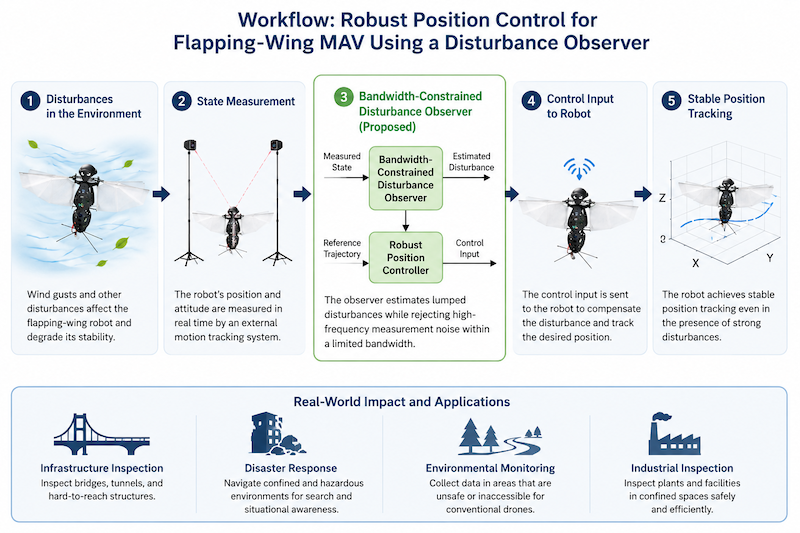
Using this insight, the researchers developed a disturbance observer – a control system that detects and compensates for external disturbances – that accounts for this limitation, allowing the robot to reject disturbances while maintaining stable flight.
“The control method proposed in this study enables FW-MAVs to fly more stably, even in environments subject to disturbances,” says Dr. Asignacion.
The researchers tested their approach using a 103-g Flapping Nimble+ robot, a commercially available hover-capable FW-MAV. They instructed the robot to move back and forth along the horizontal axis while maintaining a hovering position.
The movement commands ranged from very slow (0.08 Hz) to moderately fast (0.8 Hz), allowing the researchers to observe how the robot responded at different speeds.
By analyzing these responses, they identified the robot’s flight dynamics and determined how each horizontal direction responded to control commands.
The researchers found that the robot exhibited strong non-minimum-phase behavior when it moved along the X-axis, which limited how quickly its disturbance-correction system could compensate for disturbances.
They then adjusted how quickly the disturbance observer responded to disturbances to determine the best balance between disturbance rejection and stable flight.
A slower response kept the robot stable but corrected disturbances less effectively, while a faster response improved disturbance rejection but introduced oscillations.
An intermediate response provided the best balance, allowing the robot to recover from disturbances while maintaining stable flight.
When this disturbance observer was applied across multiple movement directions, the robot’s X-axis position error was reduced by 53.1 percent, and its overall 3D position error was reduced by approximately 28 percent.
By improving the stability and control of FW robots, the study could help advance the development of small autonomous flying systems capable of operating safely in environments where conventional drones are less suitable because of their size, maneuverability, or the safety risks posed by exposed propellers.
Dr. Asignacion says: “Future applications are anticipated in areas difficult for humans to access, such as infrastructure inspection in confined spaces, search-and-rescue operations at disaster sites, environmental monitoring, and equipment inspections within factories and buildings.”
