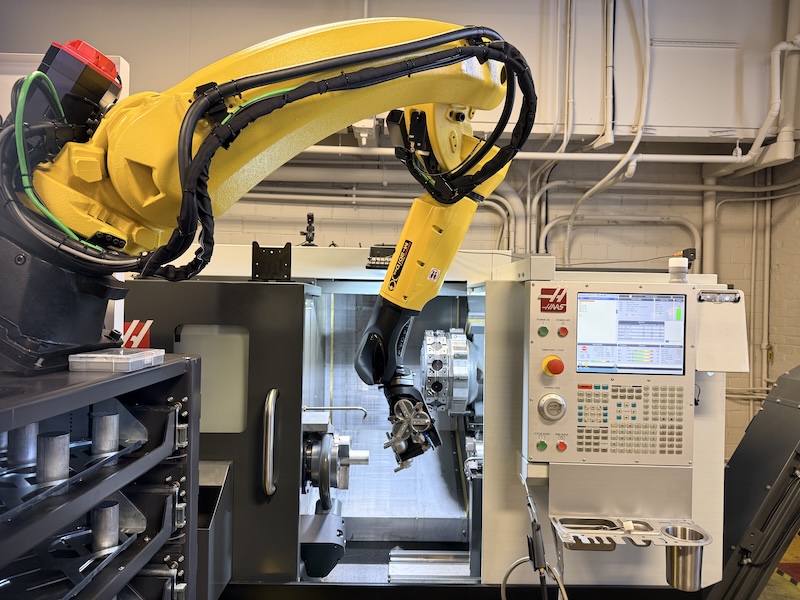
In the fast-paced world of high-mix, low-volume manufacturing, the ability to pivot between different part sizes is the difference between profitability and stagnation.
For many years, machine shops have been tethered to pneumatic systems that, while functional, lacked the intelligence and adaptability required for modern automation.
Automation Within Reach (AWR, formerly Gosiger Automation), a specialist in accessible CNC automation, recognized that to truly empower their customers, they needed to move beyond the mechanical limitations of the past.
To do so, AWR replaced six different pneumatic grippers with OnRobot’s 3FG25 gripper as standard end-of-arm tooling for its next generation lathe tending cells.
Thanks to its large stroke, high payload, and ability to control force and positioning digitally, the electric 3-finger gripper solves the most persistent challenge for high-mix manufacturers: the need to manually adjust grippers every time a new part size enters production.
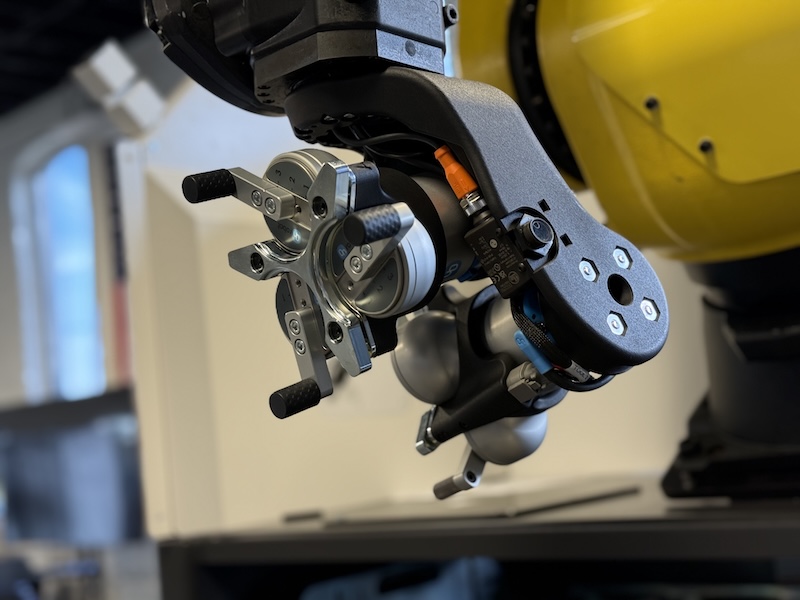
To maximize throughput, AWR developed a dual-tending configuration with two 3FG25 grippers, enabling the robot to pick a finished part and place a blank in a single cycle, reducing production time and increasing return on investment.
The challenge: The limitations of pneumatic ‘all-or-nothing’ grip
Prior to standardizing with OnRobot, AWR utilized pneumatic grippers for tending lathes in CNC cells.
Tyler This, mechanical product design engineer for AWR, recalls the significant hurdles for customers who produce many different part numbers in limited quantities.
“Pneumatic grippers typically offered an ‘all-or-nothing’ stroke and force application, lacked finger position feedback, and required complex, custom fingers to prevent damaging delicate parts,” he says.
Each time a manufacturer switched to a different part size, mechanical adjustments or entirely new grippers were required, stalling production and increasing labor costs. The reliance on pneumatic systems also meant that customers struggled with air pressure loss.
“Customer complaints about changeover and pressure loss were major factors in pursuing OnRobot grippers,” concludes AWR’s design engineer.
The solution: A versatile, intelligent electric standard
AWR’s selection was driven by the 3FG25 gripper’s high payload capacity, compact size, and the ability to control grip force and positioning digitally.
Unlike pneumatic alternatives, the 3FG25 allows handling the different parts with no adjustment when changing part sizes, as the stroke and force can be programmed precisely for each unique part.
The technical transition also simplified the entire automation ecosystem. By switching to electric grippers, AWR eliminated the need for peripheral equipment such as solenoids and external air lines, reducing the overall part count for the CNC automation cell while making the systems easier to service and maintain.
“AWR chose OnRobot’s 3FG25 gripper as the standard for the Next Generation of lathe tending products because of its small size, low weight, payload, built-in force monitoring/adjustment, and position feedback as well as its reliability, and myriad other benefits over similarly rated pneumatic grippers,” says This.
With the 3FG25, workpieces are automatically centered, resulting in a strong, stable grip and precise placement in machine chucks. As the name suggests, the gripper can handle payloads up to 25 kg (55 lbs) with a fully adjustable gripping stroke of 137 mm and a fully adjustable gripping force from 50-450 N.
The 3FG25 supports both external and internal grip modes with intelligent grip feedback that automatically detects when a part is successfully gripped.
Before implementing the switch, AWR put the 3FG25 gripper through rigorous testing in terms of high payload, reach and “part drooping”.
“When we had the gripper hold long parts parallel to the floor, we saw little to no drooping,” explains This. “The performance exceeded expectations.”
Impact: Precision, reliability, and increased ROI
The shift to OnRobot has delivered immediate operational benefits. AWR reports better part picking and less marking of parts, directly improving quality.
For the customer, the most significant impact is the “fantastic amount of flexibility” provided by the 3FG25, says This.
With multiple part-contact tooling options, such as knurled surfaces or rubber sleeves, and the ability to handle various diameters without mechanical intervention, the return on investment has seen a notable increase.
“No other gripper on the market has the same payload, ease of use, or functionality in a reasonable size,” says This.
