
Connected products fail at the application layer now, where firmware telemetry, cloud pipelines, and the user-facing app are often built with different assumptions about the data.
This gap has grown as inference moves to the device, fleets mix cellular, LPWAN, and satellite networks, and the EU Cyber Resilience Act requires secure remote updates from 11 September 2026.
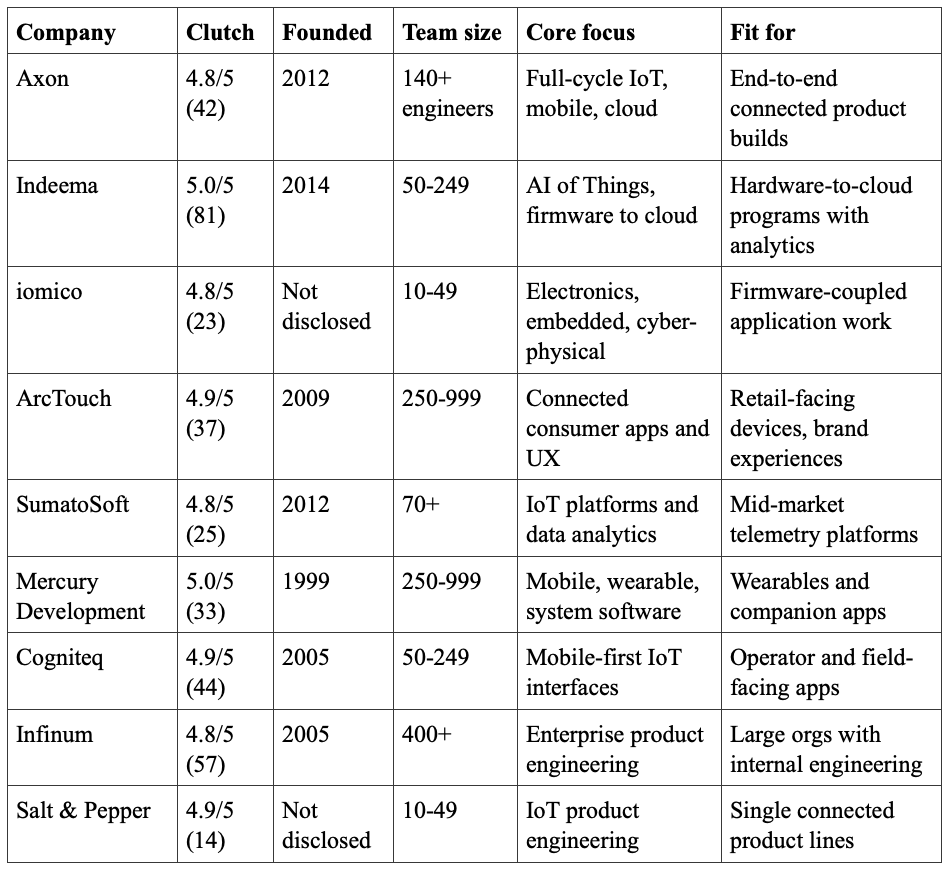
This guide profiles the top-rated IoT app development companies for 2026, with verifiable data on Clutch ratings, founding year, team size, minimum spend, and the connected products they’ve shipped.
TL;DR
- The top-rated IoT app development companies in this guide are Axon, Indeema, iomico, ArcTouch, SumatoSoft, Mercury Development, Cogniteq, Infinum, and Salt & Pepper.
- The application layer now owns device provisioning, updates, offline behavior, and operator tools.
- There were 21.1 billion connected devices in 2025, with 39 billion forecast by 2030, and IoT revenue is expected to reach $1.18 trillion in 2026 (Statista, 2026).
- On this list, minimums range from $5,000 to $100,000 and hourly rates from $25 to $199.
- Evaluate vendors on ownership of the full devicetoapp chain, firmware proximity, update and offline engineering, security posture, and pricing transparency.
Top-Rated IoT App Development Companies: List for 2026
The vendors below all have verified Clutch profiles with IoT development listed as a core service. Each profile shows the key facts and where the team fits best. Clutch ratings verified July 2026.
Axon
- Founded: 2012
- Clutch rating: 4.8/5 (42 reviews)
- Min project size: $5,000+
- Hourly rate: $25-$49
- Core expertise: custom IoT applications, smart-lock and access systems, wearables and connected consumer devices, mobile (iOS, Android, Flutter), cloud architecture, business analysis, and QA
Axon is a top-rated IoT app development company that builds connected products and keeps running them after launch.
Backed by 130+ projects and 140+ engineers, it covers device integration, cloud, and both mobile platforms through a single accountable team. Its portfolio spans automotive systems, smart locks, wireless audio, charging stations, and wearables.
TaskPod shows this depth: a platform for private workspace pods in airports and shopping centers, with offline PIN-based access, smart keys, and duration-based billing through Stripe, all delivered by a 10-person squad from analysis to DevOps.
On Muse Frame, a connected digital art frame, the team built an MVP, rewrote the Flutter app for both platforms, added wallet support, and enabled casting to the frame, resulting in higher sales.
For Wizer, Axon built a portal that turns installations, inspections, and support work into tasks for field technicians, delivered on time or ahead of schedule since 2022.
Main benefits
- Full-cycle delivery across device integration, cloud, and both mobile platforms from one accountable team.
- Offline-first engineering has proven in production, including network-independent physical access control.
- Named connected-product builds with reported outcomes, including TaskPod, Muse Frame, and Wizer.
- Field operations tooling experience, not only consumer-facing screens.
- Low entry point at $5,000, with an hourly band of $25-$49, workable for a first production release.
- Three delivery centers with overlapping hours for Western Europe and a partial overlap with North America.
- Strong client feedback, with a 4.8/5 rating across 42 verified reviews.
Indeema
- Founded: 2014
- Clutch rating: 5.0/5 (81 reviews)
- Min project size: $50,000+
- Hourly rate: $50-$99
- Core expertise: IoT development, firmware development, AI for IoT systems, MVP development, cloud, DevOps, UI/UX
Indeema positions itself around the Artificial Intelligence of Things and splits its work into 65% IoT development and 35% AI development, so both disciplines shape the architecture rather than AI being bolted on later.
The company reports 120+ IoT projects across smart home, energy, solar and wind, oil and gas, automotive, agriculture, healthcare, and drone systems.
It also has the highest verified review volume on this list at 81. The engineering practice covers hardware design, embedded development, and cloud analytics.
Main benefits
- IoT is the primary business, accounting for 65% of the service mix.
- Paired AI capability for programs where sensor data needs a modeling layer.
- 120+ IoT projects across eight named industry verticals.
- Firmware and hardware engineering alongside application development.
- Highest verified review volume in this comparison, with a perfect 5.0/5 across 81 reviews.
iomico
- Founded: 2012
- Clutch rating: 4.8/5 (23 reviews)
- Min project size: $50,000+
- Hourly rate: $50-$99
- Core expertise: electronics engineering and PCB design, embedded development (C, C++, Python, Zephyr, FreeRTOS, ChibiOS), cyber-physical software, IoT app development
iomico dedicates 70% of its service mix to IoT development and cyber-physical software, the highest concentration in this comparison.
The team covers the full vertical stack from schematics and PCB design through embedded firmware to the application layer, which matters when app behavior depends on firmware timing rather than clean API responses.
One documented engagement involved implementing and testing firmware over Zephyr RTOS for two environmental data loggers communicating over Bluetooth, eliminating defects across both units. EU and LATAM development centers with US offices give broad timezone coverage for a team of this size.
Main benefits
- Highest IoT concentration on this list at 70% of service mix.
- Electronics and PCB design in-house, not subcontracted.
- Named RTOS experience across Zephyr, FreeRTOS, and ChibiOS.
- Documented firmware work on Bluetooth environmental sensing hardware.
- Multi-region delivery across Europe, North America, and Latin America.
ArcTouch
- Founded: 2009
- Clutch rating: 4.9/5 (37 reviews)
- Min project size: $100,000+
- Hourly rate: $50-$99
- Core expertise: IoT development, mobile app development, UX/UI design, low-code development, business consulting
ArcTouch allocates 25% of its service mix to IoT development, combined with mobile and a substantial design practice. Its portfolio includes Bluetooth-connected products with real-time visualisation for smart devices, which is the category where onboarding friction decides whether a device gets activated at all.
The team can be engaged as full delivery or as individual specialists joining an existing setup. Reviewers praise professionalism and adaptability while noting budget overruns and staff retention as areas to watch, so scope discipline is worth agreeing upfront.
Main benefits
- Design and engineering under one roof for consumer-facing connected products.
- Bluetooth device experience with real-time data visualisation.
- Flexible staffing as a full team or embedded individual experts.
- Nearshore Brazil delivery alongside US offices for timezone overlap.
- Strong client feedback with a 4.9/5 rating across 37 verified reviews.
SumatoSoft
- Founded: 2012
- Clutch rating: 4.8/5 (25 reviews)
- Min project size: $25,000+
- Hourly rate: $50-$99
- Core expertise: IoT platform development, third-party hardware and software integration, data analytics, PoC and MVP delivery, AI development
SumatoSoft has built IoT solutions since 2012 and reports 150+ custom software solutions delivered for clients in 27 countries, with Toyota among them.
Its work focuses on the software layer rather than hardware: platform development, integration with third-party devices, and analytics.
The documented IoT portfolio covers vital-signs monitoring for farm animals, blood-glucose monitoring applications, fitness tracking, smart-fridge sensor networks, fleet management, and smart traffic lights.
A tech lead participates in code review on every project, regardless of size, which reviewers cite as a key factor alongside transparent communication.
Main benefits
- Fourteen years of continuous IoT delivery since 2012.
- 150+ solutions delivered across 27 countries.
- Documented portfolio spanning healthcare, agriculture, retail, and smart-city work.
- Code review by a tech lead on every engagement, regardless of scope.
- Proof-of-concept and MVP paths before full platform commitment.
Mercury Development
- Founded: 1999
- Clutch rating: 5.0/5 (33 reviews)
- Min project size: $25,000+ Hourly rate: $50-$99
- Core expertise: mobile app development, wearable app development, IoT development, system software, AI development, application testing
Mercury Development has built software since 1999, with a history that spans from DSP and multimedia work to custom hardware support to mobile and wearables.
Early hardware-adjacent projects included an application converting video for display on custom LED panel arrays for a Belgian lighting manufacturer, and that hardware proximity carried forward.
Wearable app development is a separate, named practice alongside IoT, which is unusual yet relevant for battery-constrained devices where processing location determines both responsiveness and runtime. Reviewers repeatedly single out code quality and testing discipline.
Main benefits
- 27 years of continuous operation with documented hardware-adjacent history.
- Wearable app development is a distinct practice, not folded into general mobile.
- Bench of 250-999 staff supporting parallel workstreams.
- Reviewer consensus on code quality and thorough testing processes.
- Perfect verified score with a 5.0/5 rating across 33 reviews.
Cogniteq
- Founded: 2005
- Clutch rating: 4.9/5 (44 reviews)
- Min project size: $10,000+
- Hourly rate: $50-$99
- Core expertise: mobile app development, IoT app development, IoT consulting, web development, custom software
Cogniteq blends mobile and IoT development, and this ratio shows in the kinds of work it suits: device control and field applications used by operators under time pressure, rather than consumer products judged by visual polish.
The company reports 300+ completed projects since 2005 across healthcare, manufacturing, and logistics, with a named capability in real-time data processing, asset tracking, and predictive analytics. Reviewers highlight integration with internal teams and flexible team scaling.
Main benefits
- Two decades of delivery with 300+ completed projects.
- Mobile depth at 75% of service mix for interface-heavy device applications.
- Named experience in asset tracking and real-time data processing.
- Low $10,000 entry point relative to its size and track record.
- Strong client feedback with a 4.9/5 rating across 44 verified reviews.
Infinum
- Founded: 2005
- Clutch rating: 4.8/5 (57 reviews)
- Min project size: $50,000+
- Hourly rate: $150-$199
- Core expertise: enterprise product engineering, mobile and web development, IoT development, cybersecurity, UX/UI design, AI development
Infinum began in 2005 as a two-person venture and now runs 400+ engineers, designers, and product strategists across the US, Canada, and Europe, with Philips, Porsche, and Leica among its clients.
IoT sits at 10% of its mix alongside a standing cybersecurity practice, which shortens security review cycles for programs that include that as a formal stage gate.
Documented outcomes include a leasing application built with 30+ integrations and a banking product release coordinated across nine countries. The $150-$199 rate band reflects enterprise positioning.
Main benefits
- Enterprise client base including Philips, Porsche, and Leica.
- Standing cybersecurity practice alongside product engineering.
- Documented multi-market release coordination across nine countries.
- 400+ specialists supporting long-horizon product partnerships.
- Integration depth demonstrated at 30+ services on a single product.
Salt & Pepper
- Founded: 2016
- Clutch rating: 4.9/5 (14 reviews)
- Min project size: $25,000+
- Hourly rate: $50-$99
- Core expertise: IoT development, custom software development, product design, mobile and web development
Salt & Pepper runs IoT development with a team of 10 to 49, which puts senior engineers directly on the work instead of layering account management on top.
Reviewers report full on-time delivery, flexibility when business needs change, and strong value for cost, with about 70% calling out cultural fit and communication. The shape suits a company building one connected product line well, rather than a large multi-product platform.
Main benefits
- IoT at 40% of service mix within a small senior team.
- Full on-time delivery reported across verified reviews.
- Product design capability alongside engineering.
- European nearshore delivery at mid-market rates.
- Strong client feedback with a 4.9/5 rating across 14 verified reviews.
Business Outcomes to Expect from a Custom IoT Application
A custom IoT application removes the operational drag that generic platforms leave once real devices reach real customers. Built around your hardware and support model, it replaces spreadsheets, vendor dashboards, and manual provisioning with one system.
- Lower field support costs. Remote diagnostics and over-the-air updates cut truck rolls, which are usually the biggest recurring cost in deployed fleets.
- Faster incident response. With EU Cyber Resilience Act reporting starting 11 September 2026, a working update pipeline is the difference between fixing a disclosed vulnerability and reporting one you can’t remediate.
- Higher device activation. Onboarding friction is where consumer IoT loses users; a purpose-built pairing flow converts more units out of the box.
- Usable operator tooling. Support staff can check a device’s history without a database query, which shortens resolution time and reduces escalations.
- Bandwidth and cloud savings. Processing events at the edge instead of streaming raw telemetry lowers ingest volume and the storage bill behind it.
- Scales with the fleet. Provisioning, staged rollouts, and per-device configuration designed in from the start mean adding 10,000 units is an operation.
How to Evaluate a Top-Rated IoT App Development Company
The right partner has already hit the same problems as in your build. 5 quick checks matter more than a slide deck.
- Ownership of the devicetoapp chain. Can they cover device integration, cloud, and mobile with their own team? Where they stop, you become the integrator.
- Firmware proximity. Have they worked close to the device: BLE/MQTT/LoRaWAN or cellular, Zephyr/FreeRTOS if firmware is in scope, and clear data contracts with your hardware partner? Teams that use clean APIs will underestimate the real integration.
- Updates and offline behavior. Have they shipped an overtheair update pipeline with rollback, and designed for devices that go offline for a week? Can they explain how they’d roll out across a fleet on multiple firmware versions?
- Security and compliance. What’s their plan for CRA reporting from 11 September 2026, SBOM ownership, device identity, credential failure, and GDPR handling of personlinked telemetry?
- Engagement and pricing. Do minimums and rates fit how you work? Ask for the seniority mix on your squad, whether the team can scale after funding, and estimates broken down enough that scope creep is visible early.
Conclusion
IoT programs tend to break at the seams between firmware, cloud, and application. The vendors worth shortlisting can say who owns each seam before the contract starts. The ones who ask about provisioning failures and offline behavior during scoping have shipped something real.
For example, Axon covers the full chain with one team at a midmarket rate, with production-grade proof in offline access control, connected consumer devices, and field-operations tooling.
Indeema, iomico, and ArcTouch each hold a narrower but deeper position at the AI, electronics, and consumerdesign ends of the same build. Match the vendor’s shape to your own gaps, and the platform is more likely to stay an asset as the fleet grows.
