
For direct-to-consumer brands shipping across the US and Canada, the doorstep is where margins are won or lost.
ABI Research attributes approximately half of all shipping costs to the final mile, which makes route density, warehouse throughput and delivery sequencing decisive for per-order profitability.
That pressure has pushed automation to the center of outsourced logistics. AI-coordinated fulfillment, autonomous mobile robots, electric delivery fleets and smarter routing are changing how quickly and reliably orders move.
Very few brands will ever automate a warehouse themselves. They outsource and inherit their partner’s technology, which is why the 3PL decision matters more than any individual robot.
Providers built for this segment, such as GoBolt, run fulfillment, last mile and cross-border under one relationship for shippers doing 3,000 or more orders a month.

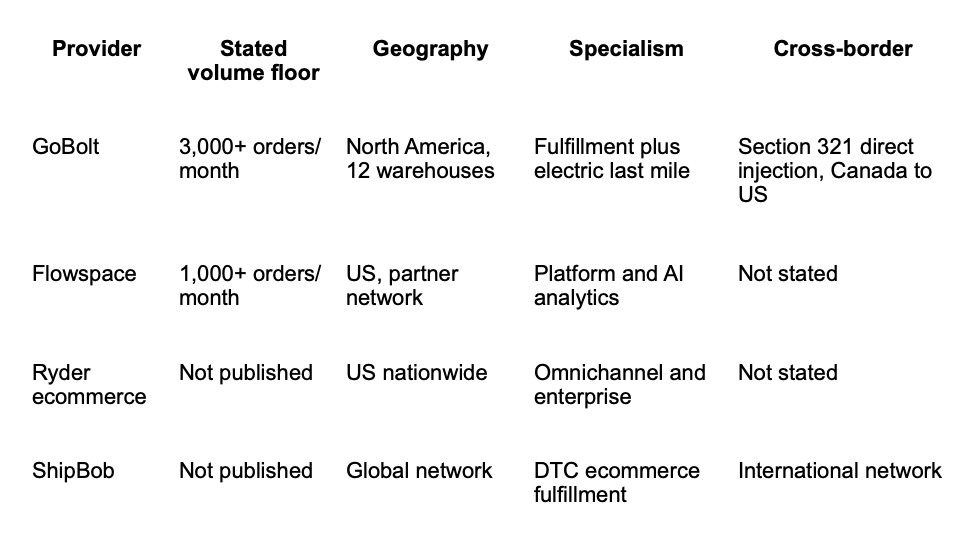
Provider comparison at a glance
Volume floors are the fastest way to shorten a shortlist, and most providers do not publish them. These are the ones that do.
Inside the automated fulfillment center
The clearest change is inside the building, where software coordinates storage, robots and labor in real time.
AutoStore launched its CubeVerse platform and AutoStore Intelligence in its Spring 2026 product update.
According to AutoStore, the intelligence layer applies more than 20 proprietary models to live operational data, optimizing robot movement through CubeControl to clear congestion and raise peak throughput without adding robots or expanding the grid.
That last detail is the one worth noting. The gain comes from sequencing rather than hardware, which is the distinction between a working deployment and an expensive one.
Scale is arriving. AutoStore marked its 300th installation with a system in Aurora, Colorado, at a site operated by Medline, which was AutoStore’s first US customer. The company reports more than 1,900 systems across 65 countries since its founding in 1996.
The cold chain shows what this looks like in practice. Locus Robotics developed a cold-storage hardware modification for HelloFresh that lifted chilled fulfillment capacity fivefold, from 100 SKUs to 500.
HelloFresh began with 13 Locus Origin robots for its Factor brand in July 2025 and added 26 more within three months, with mission times averaging 3 minutes 36 seconds from order induction to box drop-off across roughly 12,000 square feet at its Phoenix facility.
The business case is simple. More orders move through existing space, and cost per order falls as automation absorbs repetitive picking and travel.
Where last-mile automation is actually scaling
Automation is far harder to prove on the street than in a warehouse, though some models have moved well past the pilot stage.
Starship Technologies announced its 10 millionth autonomous delivery in April 2026. The company operates more than 3,000 robots across 300-plus locations in eight countries, has travelled over 22 million autonomous kilometers and completes roughly 125,000 road crossings a day at Level 4 autonomy.
Starship also puts numbers on the economics, claiming autonomous delivery already runs $3 to $4 cheaper than rider-based models with a long-term target near $1 per delivery. Treat that as a vendor projection rather than a market rate, but the direction is the point.
The control layer tying all of it together is route planning. Well-sequenced routes drive on-time performance and lower cost per stop, which is why planning software usually matters more than the vehicle itself.
What outsourcing actually buys you
Most brands hand this over rather than build it, which means inheriting a partner’s technology, process discipline and reporting quality in one decision.
Volume thresholds shape the timing. Flowspace states its platform is best suited to brands fulfilling 1,000 or more orders per month, while GoBolt is built for shippers above 3,000. Below those floors you are usually paying for infrastructure you cannot yet fill.
Cross-border flow is the other variable. Section 321 allows qualifying low-value shipments into the US with reduced or eliminated duties, and only some providers have built workflows around it.
Returns are the piece most brands underestimate. A partner treating returns as a first-class workflow protects both margin and repeat purchase rates.
Where GoBolt fits
GoBolt operates 12 strategically located warehouses across North America and describes itself as building the largest sustainable supply chain network.
Its client base skews to scaling DTC brands, including SodaStream, which named it Canadian fulfillment and last-mile partner in March 2026, alongside tentree, Endy, Castlery, Emma and Rove Concepts.
Three things distinguish it operationally.
Cross-border. GoBolt states that shipments bound for the US ship from its Canadian facilities and inject directly into its US sort facilities, letting qualifying orders use Section 321 to reduce or eliminate import duties.
For a Canadian brand selling into the US, that workflow is the difference between competitive and uncompetitive landed cost.
Modular adoption. You can inject volume into its sort centers or have it collected from your existing warehouse, so the last-mile service works without switching fulfillment providers first. That matters if your current 3PL is adequate on storage but weak on delivery.
Sustainability with numbers attached. GoBolt states its EV delivery percentage typically ranges between 40 and 60 percent, with monthly reporting published on its sustainability page.
The model is EV-first, with carbon sequestration through veritree as the backstop when an electric vehicle is not viable, rather than offsets standing in for the work.
On commercials, GoBolt publishes a single rate card with no fuel surcharge, removing the line item that makes carrier invoices hardest to forecast.
Its Google rating sits at 4.6 across more than 28,000 reviews, an unusually large sample for a logistics provider.
Worth checking: the 3,000-order monthly floor rules it out for earlier-stage brands, and the network is concentrated in North America, so it is not the answer for brands shipping primarily into Europe or APAC.
Alternatives and how they position
No single provider fits every brand, and a shortlist should reflect your catalog, volume and geography rather than network size.
Flowspace publishes the lowest stated floor here at 1,000 orders per month, combining a proprietary WMS with AI-driven analytics and reporting across ecommerce and retail distribution.
ShipBob operates a global network and explains outsourcing scope clearly, which helps first-time outsourcers understand what they are handing over.
Ryder ecommerce entered this market by acquiring Whiplash for $480 million in December 2021, adding 19 warehouses totaling nearly seven million square feet and a roster of more than 250 brands. Whiplash had already deployed over 150 Locus AMRs in a single California facility before the deal.
Match automation maturity and volume floors to your own numbers. Chasing the largest network is how brands end up as a small account inside a system built for someone else.
How to pilot with an outsourced partner
A short measured pilot beats a full migration, and the structure matters more than the length.
- Define KPIs first. On-time rate, cost per stop and pick cycle time, agreed before you start
- Keep scope narrow. One region or one product line, not the full catalog
- Measure the right things. ETA accuracy and warehouse mission times rather than headline delivery counts
- Verify returns end to end. Run actual returns through before scaling volume
- Model cross-border. Test Section 321 or zone-skipping against your current duties and transit times
If a provider cannot report clearly against those measures during a pilot, that is your answer. Reporting quality rarely improves after a contract is signed.
Understanding how warehouse automation connects storage density to shipping speed also helps you read what a provider is offering, rather than accepting a tour of the robots.
Using logistics to support growth
Automation and route optimization make outsourced logistics more predictable and less wasteful. Neither fixes a broken fulfillment process, and no amount of robotics compensates for a partner that cannot report against a KPI.
Shortlist against clear metrics, published volume thresholds and your actual cross-border needs. Then let a small pilot decide, because numbers from your own catalog tell you more than any case study.
FAQ
How much of the shipping cost sits in the last mile?
ABI Research attributes approximately half of all shipping costs to the final leg. Estimates vary by definition and geography, so treat any single figure as directional.
What order volume do I need before outsourcing makes sense?
It depends on the provider. Flowspace states 1,000 orders per month, while GoBolt is built for shippers above 3,000 monthly orders. Most providers do not publish a floor at all, so ask directly.
What is Section 321 and does it matter to me?
It allows qualifying low-value shipments to enter the US with reduced or eliminated duties. It matters if you hold inventory in Canada and sell into the US. GoBolt ships from its Canadian facilities directly into its US sort facilities to enable it.
Can I outsource last-mile delivery without changing fulfillment providers?
Sometimes. GoBolt lets you inject volume into its sort centers or have it collected from your existing warehouse, keeping your current fulfillment relationship intact while you test delivery performance.
How should I evaluate a provider’s sustainability claims?
Ask for reported data rather than commitments. A provider publishing monthly EV percentages and emissions figures is giving you something auditable. One quoting an offset program is usually not.
