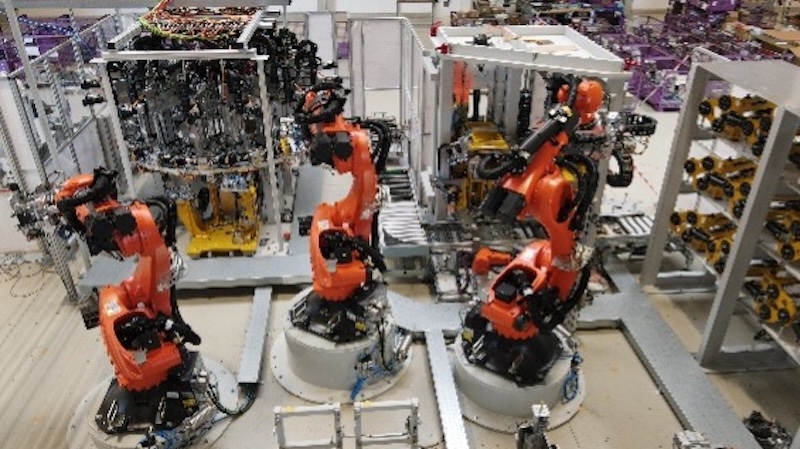
PIA Automation is developing a highly automated assembly line for E-Drive units at the BMW Group plant in Steyr, Austria.
Featuring 78 processing stations, 27 robotic cells and 46 industrial robots across more than 5,600 square meters on two levels, the project ranks among the largest in PIA Automation’s history.
The system first assembles transmissions for electric vehicles before joining them with electric motors to create complete E-Drive units.
PIA Automation is applying customized automation solutions, digital twin technology and Virtual Commissioning throughout the project’s engineering and implementation. Commissioning of the final production line sections is scheduled for 2027.
Challenge: Managing complexity in E-Drive assembly without sacrificing flexibility
The transition to electric mobility is creating new manufacturing applications that require automation, robotics, software and quality monitoring to work together seamlessly.
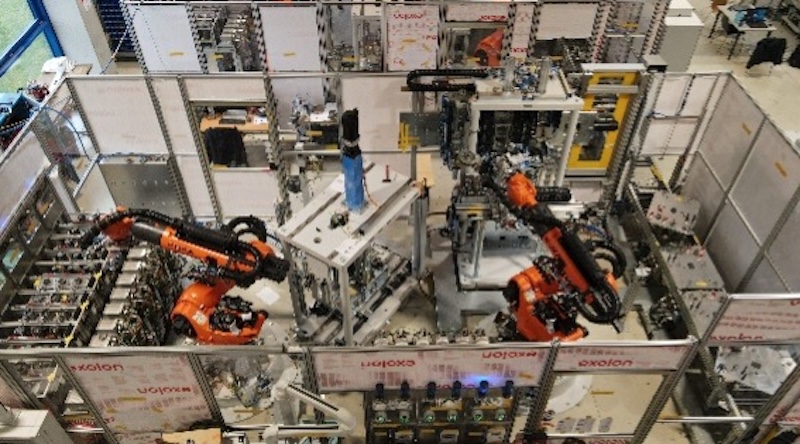
Although electric drivetrains contain fewer mechanical components than conventional combustion engines, their highly automated assembly involves complex processes that must be precisely coordinated.
The E-Drive assembly line combines several key technical characteristics:
- Production of different transmission variants in batch size one
- Short cycle times and consistent assembly quality
- A high degree of automation across two production levels
- Monitoring and documentation of assembly processes
- Integrate into the company’s existing software environment
For a production project of this scale, validating programming logic and process sequences only after the physical equipment has been assembled would result in additional review cycles and resource-intensive adjustments during commissioning.
PIA Automation therefore incorporated digital engineering methods from the earliest stages of the project.
Solution: Digital engineering meets flexible industrial automation
To validate the production system early in the development process, PIA Automation implemented a digital engineering strategy centered on Virtual Commissioning (VC).
Based on the production line design, engineers created a digital twin that maps elements such as axes, sensors, material flow, and the behavior of field devices. This allows potential errors, collisions and areas for optimization to be identified in advance.
By identifying issues early, the project reduced the need for costly modifications during physical commissioning and improved the reliability of overall planning.
The production line spans more than 5,600 square meters across two levels. It first assembles electric vehicle transmissions before combining them with electric motors to form complete E-Drive units.
One of the system’s most advanced processes is the fully automated transmission assembly station. Here, three gears are precisely meshed before being inserted into the transmission housing.
Automatic changeover grippers allow the line to process different transmission variants without manual intervention, enabling batch-size-one manufacturing while maintaining consistent cycle times.
During the final assembly stage, the completed transmission is joined with the electric motor in a robotic “marriage” cell. Twelve synchronized screwdrivers fasten the components simultaneously, ensuring precise and repeatable assembly of each E-Drive unit.
To support quality assurance, the system records key production data throughout the assembly process, including torque values, tightening angles, and force-displacement curves.
Every unit receives digital documentation, providing traceability and enabling manufacturers to quickly identify process deviations or analyze production performance.
While PIA Automation also offers its own Industrial App Suite for digital production control and monitoring, the automation solution for this project is being integrated into BMW Group’s established software environment.
This allows the system to be controlled and monitored in accordance with the company’s established software standards.
Result: A future-ready platform for E-Drive manufacturing
The Steyr project demonstrates how digital engineering and industrial automation can support the industrialization of electric vehicle production.
By combining virtual commissioning, advanced robotics, flexible assembly processes, and integrated quality monitoring, PIA Automation is developing a flexible, future-ready production platform for highly automated E-Drive manufacturing.
Franz Reiter, business segment manager E-Drive and powertrain at PIA Automation, says: “We are particularly pleased that our longstanding expertise in highly efficient automation, our extensive experience in electromobility and the positive results of previous joint projects were key factors in the BMW Group’s decision to partner with us on this exceptional manufacturing system.
“The project is progressing according to schedule, and we look forward to seeing the system enter regular production.”
Key results
- Accelerated production line development through digital twin technology and virtual commissioning
- Reduced commissioning risks by validating automation sequences before physical installation
- Flexible batch-size-one production across multiple transmission variants without manual retooling
- Highly automated manufacturing solution comprising 78 processing stations, 27 robotic cells, and 46 industrial robots
- Production traceability through continuous monitoring and digital documentation
- Integration into BMW Group’s existing manufacturing software environment
