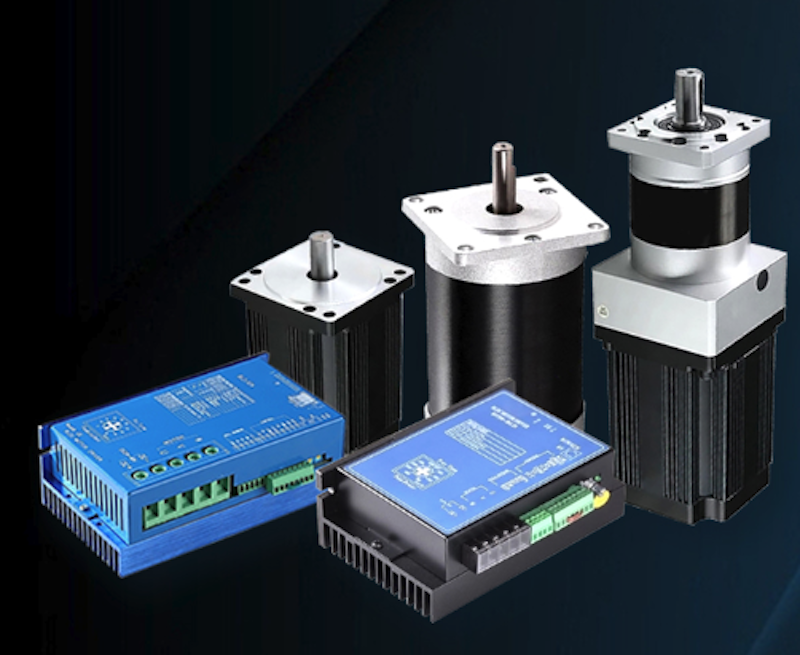
As robotics continues to transform industries such as manufacturing, healthcare, logistics, and agriculture, the demand for precise and energy-efficient motion control has never been greater.
At the heart of many modern robotic systems are Brushless DC (BLDC) motors, known for their high efficiency, reliability, and long service life. However, the true performance of a BLDC motor depends heavily on its motor controller.
A well-designed BLDC motor controller not only ensures accurate movement but also minimizes energy consumption, making it one of the most important components in any robotic system.
Understanding BLDC Motors and their Controllers
Unlike traditional brushed DC motors, BLDC motors do not use brushes to transfer electrical current. Instead, they rely on electronic commutation, where a motor controller continuously switches current between the motor’s windings based on rotor position.
This design eliminates mechanical friction caused by brushes, resulting in quieter operation, lower maintenance requirements, and higher efficiency.
The BLDC motor controller acts as the brain of the motor drive system. It receives commands from the robot’s control unit, interprets feedback from sensors or encoders, and precisely regulates the voltage and current supplied to the motor. This continuous communication allows the robot to execute movements with exceptional precision and consistency.
Improving Robot Accuracy
Accuracy is essential in robotics, especially in applications involving assembly, inspection, surgery, or material handling. Even a small positioning error can reduce product quality or affect operational safety.
BLDC motor controllers improve accuracy by providing precise speed and position control. Most robotic systems use encoder feedback to monitor the exact position of the motor shaft. The controller constantly compares the desired position with the actual position and immediately adjusts motor output to eliminate any deviation.
Another major advantage is smooth motion control. Sudden starts and stops can create vibrations that reduce positioning accuracy. BLDC controllers use advanced control algorithms to produce gradual acceleration and deceleration, allowing robotic joints and arms to move smoothly.
Torque control is equally important. During different tasks, robots require varying levels of force. A BLDC controller dynamically adjusts motor current to deliver the exact amount of torque needed. This prevents unnecessary movement, improves stability, and ensures delicate tasks are completed without damaging components.
Enhancing Energy Efficiency
One of the biggest reasons industries choose BLDC motors is their excellent energy efficiency. Since there are no brushes creating friction, less energy is wasted as heat. However, the motor controller plays an equally important role in maximizing these efficiency gains.
A BLDC controller continuously supplies only the amount of power required for the current operation. Instead of running at full power throughout the entire process, it adjusts motor speed and torque based on workload. This intelligent control significantly reduces electricity consumption.
Pulse Width Modulation (PWM) is commonly used in BLDC controllers to regulate motor speed efficiently. Rather than wasting energy through resistance-based control methods, PWM rapidly switches power on and off while maintaining the desired motor performance. This allows robots to operate efficiently without sacrificing precision.
Lower power consumption also means reduced heat generation. Cooler operating temperatures improve motor reliability, extend component life, and reduce cooling requirements, all of which contribute to lower operating costs.
The Importance of Sensor Feedback
Many robotic BLDC systems use Hall-effect sensors or high-resolution rotary encoders to provide real-time feedback about rotor position. This information enables the controller to synchronize current flow with rotor movement accurately.
Advanced sensorless BLDC controllers are also becoming increasingly popular. Instead of relying on physical sensors, they estimate rotor position using electrical measurements. This reduces hardware complexity while maintaining excellent performance in many robotic applications.
Accurate feedback ensures repeatable movements, which is particularly important in industrial automation where robots may perform the same task thousands of times every day.
Real-World Example: Collaborative Robots in Manufacturing
Collaborative robots, often called cobots, provide an excellent example of how BLDC motor controllers improve robotic performance. Companies such as Universal Robots use BLDC servo motors in their robotic arms because they require smooth, precise, and highly responsive motion.
When a cobot assembles electronic devices or tightens screws on a production line, each joint must move accurately within fractions of a millimeter. BLDC motor controllers continuously monitor encoder feedback and instantly adjust motor speed and torque to maintain precise positioning.
These controllers also optimize energy usage by supplying only the required current during each movement. Since collaborative robots often operate continuously for long production shifts, efficient motor control helps reduce electricity costs while extending the lifespan of both the motors and the batteries or power systems supporting the robot.
Without advanced BLDC motor controllers, these robots would experience reduced positioning accuracy, increased vibration, and significantly higher energy consumption.
Additional Benefits of BLDC Motor Controllers
Beyond accuracy and efficiency, BLDC motor controllers provide several additional advantages:
- Longer motor lifespan due to the absence of mechanical brushes.
- Lower maintenance costs because there are fewer wearing parts.
- Quiet operation, making them ideal for hospitals, laboratories, and collaborative workspaces.
- High-speed performance suitable for drones, autonomous mobile robots, and industrial automation.
- Built-in protection against overheating, overcurrent, and voltage fluctuations, improving overall system reliability.
These benefits make BLDC motors the preferred choice for modern robotic applications where performance and reliability are equally important.
Future Developments
As robotics continues to evolve, BLDC motor controllers are becoming smarter. Artificial intelligence, adaptive control algorithms, and predictive maintenance features are being integrated into modern controllers.
These technologies allow controllers to automatically optimize performance based on operating conditions, reducing energy consumption while improving motion accuracy.
The growing adoption of autonomous mobile robots, warehouse automation, medical robotics, and service robots will further increase the demand for advanced BLDC motor controllers capable of delivering precise, efficient, and reliable motion control.
Conclusion
BLDC motor controllers play a crucial role in determining the overall performance of robotic systems. They provide precise control over speed, position, and torque while maximizing energy efficiency through intelligent power management techniques.
By reducing vibration, improving motion accuracy, and minimizing power consumption, they enable robots to perform complex tasks reliably and efficiently.
Whether powering collaborative robots in factories, autonomous mobile robots in warehouses, or precision medical equipment, BLDC motor controllers have become a key technology driving the next generation of intelligent automation.
As robotic applications continue to expand, advancements in BLDC motor control will remain essential for achieving higher productivity, lower operating costs, and greater sustainability.
