While generative AI has dominated much of the technology debate in recent years, the next major phase of development may increasingly involve AI systems that can perceive, interact with and act in the physical world.
The IEEE’s new Technology Megatrends 2030 report identifies physical AI and robotics as one of the areas with the greatest potential for significant technological advancement over the next four years.
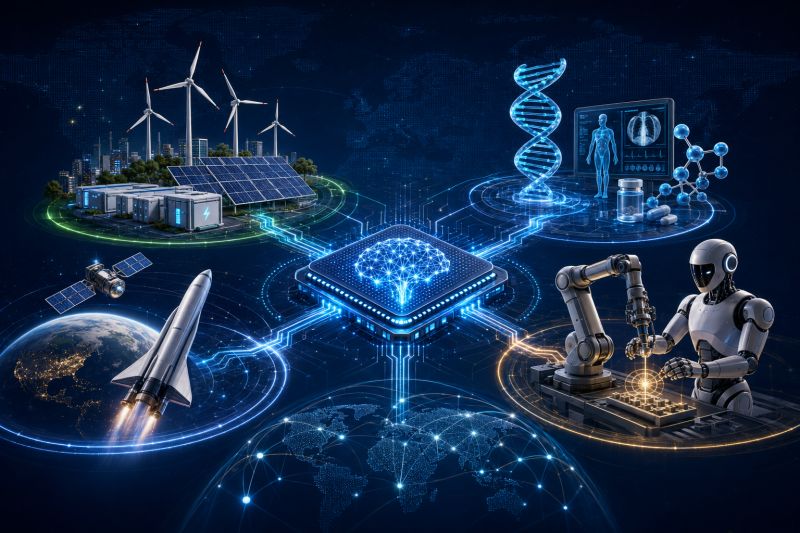
The report examines 30 breakthrough technologies across five broad areas – artificial intelligence, energy, health and biotechnology, space technology, and physical AI – and considers how they could reshape industries and everyday life by 2030.
One of the technologies IEEE highlights as particularly important to the development of physical AI is human-AI interaction.
Interfaces are expected to move beyond conventional text-based interaction toward increasingly natural combinations of speech, video, perception and cognitive capabilities that allow machines to better understand human intentions and work alongside people.
That evolution could have significant implications for robotics. More capable human-AI interfaces could make industrial robots and autonomous machines easier to supervise, teach and collaborate with, while advances in AI could enable robots to operate with greater autonomy in manufacturing, healthcare, transportation and agriculture.
But putting increasingly intelligent machines into physical environments also raises questions around reliability, cybersecurity, safety and trust – particularly when AI systems begin making decisions that directly affect people, equipment and infrastructure.
Dejan Milojicic, chair of the IEEE Future Directions Committee Industry Advisory Board and HPE Fellow and vice president at Hewlett Packard Labs, has been closely involved in examining the technologies likely to shape this transition.
In this Q&A with Robotics & Automation News, Milojicic discusses why IEEE expects physical AI to advance rapidly toward 2030, the growing importance of human-AI interaction, and which robotics applications could reach widespread deployment first. He also considers the challenges of powering autonomous machines, balancing AI flexibility with industrial safety, securing AI-enabled infrastructure, and what increasingly capable physical AI could mean for the future of work.
Interview with Dejan Milojicic
Robotics & Automation News: The IEEE report identifies physical AI as the technology area most likely to see major advances over the next four years. What technical breakthroughs are driving that acceleration, and what has changed to make this timeline more realistic than it appeared just a few years ago?

Dejan Milojicic: The Technology Megatrends 2030 Report evaluates 30 breakthrough technologies across five core areas including AI, energy, health and biotech, space tech, and physical AI (robotics), to determine their potential to reshape industries and human life by 2030.
The primary change was driven by AI, enabling many other breakthroughs. AI is making cybersecurity much more effective, reliable, and trustworthy, while also improving energy efficiency – even though energy consumption remains a major challenge at scale.
In robotics, AI enables new collaborative algorithms. At the same time, important non-AI-related advances remain, such as new materials and sensors. Even in these areas, however, AI is playing an increasingly important supporting role by accelerating design space exploration.
R&AN: The report highlights human-AI interaction as a key enabler of physical AI. Beyond voice commands and natural language, what forms of interaction do you think will have the biggest impact on industrial robots and autonomous systems over the next decade?
DM: Video recognition will enable understanding human intent and supporting its movement. Cognitive capabilities layered on top of the interfaces, such as anticipation, will also play an important role.
Additional interfaces, including sensors on the human body, could further accelerate interaction. Other brain-computer interfaces, however, are still at an early phase and are unlikely to be practical in the near term.
Some use cases in constrained spaces or limited functions, such as manufacturing, health, and agriculture, can go a long way in eventually enabling general, consumer-grade human-AI interaction.
Developing effective guardrails and choke points to prevent undesirable behavior will also be critical, helping make robotics and general-purpose AI use more effective.
R&AN: Many companies are now developing humanoid robots, autonomous mobile robots, and AI-powered industrial machines. Which of these sectors do you believe is likely to achieve widespread commercial deployment first, and what technical hurdles remain before that happens?
DM: Constrained use cases for safe technology development would accelerate development in the near-term. In their early days, autonomous robots were first applied at airports, in manufacturing in very constrained spaces and limited options.
Over time, more degrees of freedom were added as behaviors and risks and opportunities were better understood.
However, robotics is now advancing at a rapid pace . Among the most promising applications are military use cases, both driven by demand and the substantial levels of funding.
Power delivery remains the largest hurdle, except in environments such as manufacturing , where robots can remain continuously connected to a power source. For broader commercial use, power is a hard limitation.
R&AN: Industrial automation has traditionally relied on deterministic, highly predictable systems. How can manufacturers balance the flexibility of AI-driven robots with the need for reliability, safety, and regulatory compliance in production environments?
DM: This is an extremely well-posed question that reflects exactly what is going on. With experience in deployments, developers and operators will increase trust and remove obvious and low-hanging safety hazards. As trust is gained, more autonomous operations will be allowed.
Similarly, as human-AI interfaces improve, more effective human-in-the-loop operations will enable stronger oversight and reduce the risk of disruption caused by unexpected or unpredictable events.
R&AN: The report emphasizes trustworthy AI, cybersecurity, and safety. As AI begins making more autonomous decisions in factories, hospitals and logistics operations, where do you think the industry’s biggest vulnerabilities lie, and how should they be addressed?
DM: Initially, it will be security exploits. I foresee that while AI could be used to find them, it can also be used to prevent them, and we will reach the level where only complex and costly exploits will remain.
One prominent target is power supplies; therefore, some backup solutions would be required to provide continuous supply. While it has previously existed, the power demand and dependency of AI factories is surpassing previous cases, where generators could provide uninterruptible services to hospitals.
R&AN: There’s growing concern that advances in physical AI could disrupt employment. Do you expect AI-powered robots to primarily augment human workers, or are we approaching a point where entire categories of industrial jobs will be automated?
DM: I believe both to be the case. Humanity, especially the workforce, will have to adjust, as they did during every previous technology revolution. This one is developing the fastest, and the impact could be broadest. Your observation about changing categories of jobs is very accurate.
In the past, it was blue-collar; as of lately, white-collar. Any profession that could be automated using AI will possibly be a target.
We are seeing almost daily reports of companies restructuring their workforces – whether by replacing certain roles with AI, repositioning themselves for future opportunities, or redirecting resources toward building AI infrastructure
The time will come when this race results in a reduction of the cost of infrastructure and services; for example, tokens used in LLMs, which will further reduce the need for partial layoffs. But both employees and employers are continuing to evaluate which jobs will go away, open up, and transform.
R&AN: Looking beyond 2030, what development in physical AI do you think the industry is currently underestimating? Is there a technology or application that you believe could become far more significant than most people expect today?
DM: This year, high-risk, high-reward classification was introduced. Some of the highest-risk and highest-reward technologies include genetic manipulation, autonomous weapons, AI cyber warfare, self-evolving cyber-physical systems, and gene editing and synthetic biology.
In all the above cases, there’s huge potential, especially in health, but the risk is also high. A healthy balance between advancing technologies while making them safe will continue to be a tradeoff that scientists will have to make alongside regulators.
