Have you ever seen two people buy the same car, but end up paying very different prices because they live in different places?
Carmakers have one ex-showroom price across the country. But when you add the taxes set by each state, the final number changes a lot. The main reason for this is state road tax.
Each state can set its own rules about motor vehicle tax because of Entry 57 of the State List in the Indian Constitution.
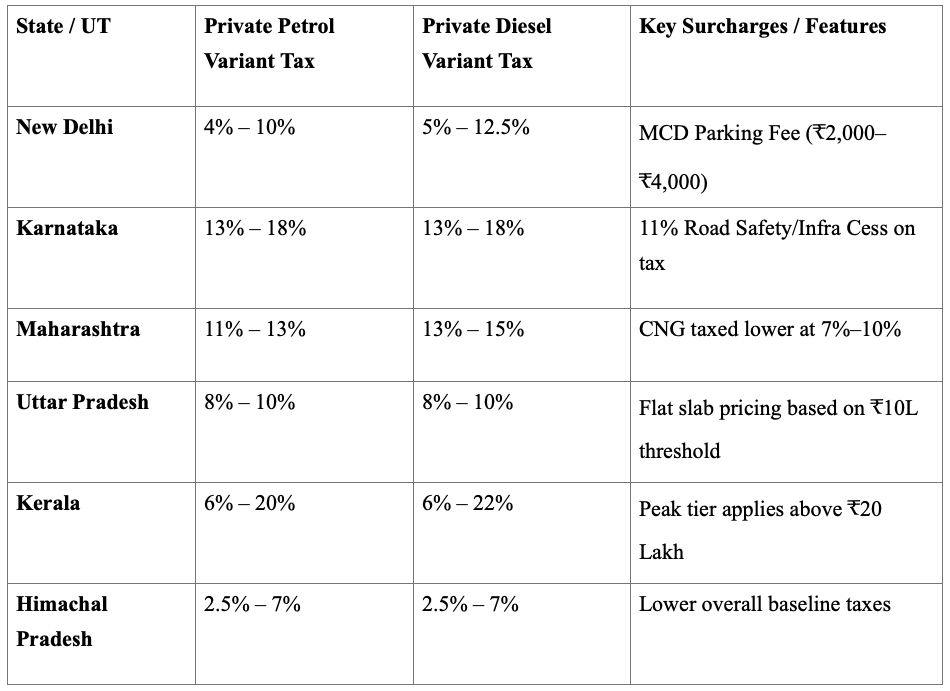
This means road tax might be around 4% in one state but can be as high as 22% in another. A good On Road Price Calculator India tool can help you know more about these costs before you visit the dealership.
Why Road Tax Varies Across States
States collect road tax to pay for road building, highway care, and traffic work in their area. Every state has its own budget, more or less cars, and money problems to think about. So, the way they set these taxes is not always the same.
A few things tend to drive these differences:
- Progressive Tax Slabs: Progressive tax slabs vary from state to state based on cars, and this is based on the ex-showroom cost of the vehicle. An expensive luxury car, which costs more than ₹10 lakh or ₹20 lakh, gets taxed under a high slab category compared to a basic hatchback car.
- Penalty for Fuel Type and Incentive: The tax rate on petrol cars and diesel cars differs from one another. Diesel cars attract more taxes due to pollution concerns. Electric vehicles receive tax exemptions, and in some cases, there will be no such tax.
- Registration Ownership Status: If you put the car in your company’s name instead of your own name, you may have to pay much more tax. It could even be close to double what a person pays when registering with their own name.
- State Cesses and Local Surcharges: States add on their own extra charges on top of the main tax. These can be things like Infrastructure Development Cess, Road Safety Cess, MCD parking charges, or even a Green Tax if your car is old.
State-Wise Road Tax Comparison
The Impact of Vehicle Registration Types: State RTO vs. BH Series
If you have ever had to move for your job and take your car with you, you may know how hard the old road tax rules were for each state. The Bharat (BH) Series registration is here to help with that. It makes things the same for vehicle tax in the country.
Instead of paying a big 15-year tax all at once to one state’s RTO, BH-series owners can pay it in smaller amounts every two years.
- Below ₹10 Lakh: The rate is 8% for Petrol and CNG cars, 10% for Diesel cars, and 6% for EVs.
- ₹10 Lakh – ₹20 Lakh: You will get a rate of 10% for Petrol and CNG, 12% for Diesel, and 8% for EV.
- Above ₹20 Lakh: It is 12% for Petrol and CNG, 14% for Diesel, and 10% for EV.
It’s a much easier way to make a budget. It also saves owners from getting a headache when they deal with fights about moving between states.
Understanding how state road tax works is important if you want to plan your money before you go to the dealership. You will see RTO charges, insurance IDV, and extra fees in your bill.
The final amount you pay could be much higher than the sticker price you first saw. A good On Road Price Calculator India can help you with this.
It shows the real cost, lets you check tax differences from state to state, and makes it simple to find any hidden fees from the dealer before you make a decision.
