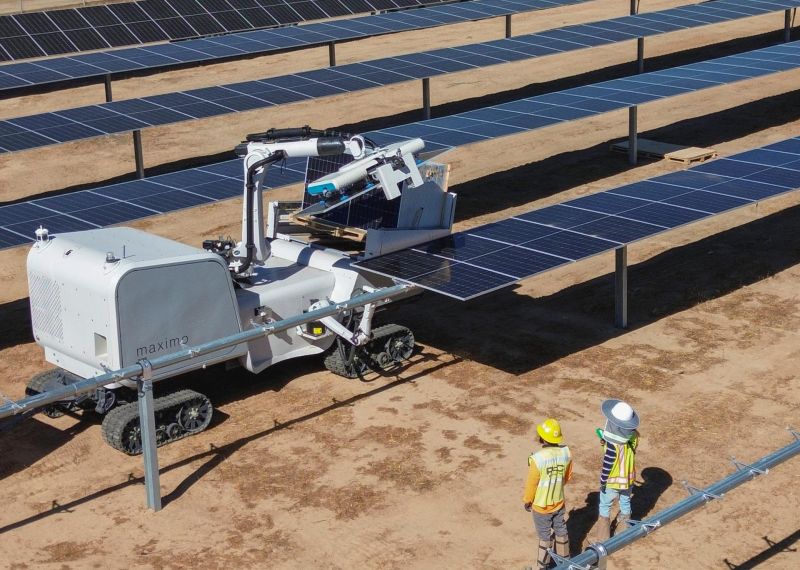
While much of the current discussion around physical AI focuses on technologies still moving from prototype to commercial deployment, AES has already put robots to work on utility-scale solar construction sites.
The global energy company developed Maximo, an AI-powered robotic system designed to automate one of the most physically demanding stages of solar construction: lifting and installing photovoltaic modules.
Rather than operating in the predictable environment of a factory, Maximo works alongside construction crews on active sites, where terrain, weather, equipment and working conditions can change constantly.
The system has now installed more than 180,000 solar modules representing more than 100 MW of generating capacity. According to AES, robots using Maximo have exceeded 500 installations per day, while crews using the technology can install up to 24 modules per person per shift hour.
Maximo was developed through AES Next, the company’s innovation and business-building platform. The project gave its developers an unusual advantage for a robotics venture: access to AES’s own pipeline of live solar construction projects, allowing the technology to be tested and refined under real operating conditions from an early stage.
Nick Hegeman, chief commercial officer for Maximo, is responsible for helping take that technology from internal development and field validation toward broader commercial adoption.
In this Q&A with Robotics & Automation News, Hegeman discusses the technical challenges of deploying autonomous systems on changing construction sites, why field validation is critical to the success of physical AI, and how labor shortages and increasingly heavy solar modules are strengthening the case for automation.
He also explains why integration with existing construction processes has been central to Maximo’s development, how customers’ attitudes toward robotics have changed as deployments have scaled, and where AES sees the next opportunities for automation across renewable energy construction and site logistics.
Interview with Nick Hegeman

Robotics & Automation News: Construction has long been regarded as one of the most difficult industries to automate because every site is different. What were the biggest technical challenges Maximo had to overcome before it could reliably deploy robots on live solar construction projects?
Nick Hegeman: Solar construction operates under extremely strenuous conditions, in open desert and often in extreme heat. At the Bellefield project, Maximo helped crews install 180,000 individual modules, with each one weighing up to 75 pounds. Crews have to lift that hundreds of times a day.
The challenge was building something reliable enough to do that job at that pace without asking EPCs to change anything about their processes.
On top of that was the sheer variety across sites, different terrain, different weather, different module models and wattages from one project to the next, so the system couldn’t rely on being reprogrammed or retrained every time it showed up somewhere new.
It needed to look at whatever was in front of it and know the depth, tilt, and placement on its own. We didn’t want to change the supply chain or reinvent the wheel, we wanted Maximo to slot into existing construction workflows so adoption would be as straightforward as possible.
R&AN: Your robots have now completed more than 180,000 solar panel installations and surpassed 100 MW of autonomous deployment. At what point did customers stop viewing the technology as an experiment and begin treating it as a practical construction tool?
NH: Maximo was incubated as part of AES Next. This has provided our team with the opportunity to deploy pilot programs at various solar projects across the US. When we moved from pilots to utility-scale projects, that shift became apparent. Customers are now counting on us to meet deadlines.
In December 2025 and January 2026, we reached an installation pace of 20MW a month. Two of the five largest EPCs in the country came out to see Maximo running at this pace, and in both cases, they immediately fast-tracked their technology evaluation process.
Watching the robots perform at scale in real conditions moved Maximo from “worth a look” to “worth prioritizing” in their eyes. Today crews using Maximo are installing up to 24 modules per person per shift hour, and EPCs are building that performance capability into their standard construction workflow.
R&AN: Unlike autonomous vehicles operating on mapped roads, solar construction sites are constantly changing, with uneven terrain, moving equipment and people working nearby. How does Maximo enable its robots to operate safely and efficiently in such unpredictable environments?
NH: Safety with Maximo starts before the robot is ever switched on. Crews go through training and site-specific safety checks as part of standard setup, the same way any new piece of heavy equipment would be introduced to a job site.
Once it’s operating, Maximo layers real-time perception on top of that foundation. Max continuously identifies the tracker structure, modules, and anything nearby, and self-corrects the moment conditions change, whether that’s a person entering the work area or an unexpected obstruction.
R&AN: Labor shortages remain a major issue across both the construction and renewable energy sectors. Has your experience shown that customers are adopting robotics primarily to reduce labor costs, to address workforce shortages, or to increase project delivery speed?
NH: All of these items are related, but the key EPC’s are focusing on is keeping their contractual commitments to deliver a project on time for a predetermined cost. Their number one job is looking for ways to derisk a project, but the realities of the construction environment make this increasingly difficult.
All customers want the benefits of robotics, whether it’s speed, costs or safety, but until recently there’s always been the question as to what risks does introducing robotics bring to the project. What’s really accelerated customer adoption for Maximo is the ease of integration and reliable performance.
These projects are already running so tight that most EPC’s can’t afford to take a risk on something that’s unproven. Our track record of successfully installing hundreds of thousands of modules is what takes robotics from something that’s just another thing PM’s must worry about to something that’s making their lives easier.
Customers don’t choose robotics for a single reason anymore, speed-to-power, labor availability, and panel weight have all converged into one problem, and right now, speed-to-power is the concern sitting on top of everything else.
Maximo addresses that pressure by delivering installation rates more than double the industry average, reduces the crew size needed for heavy modules, and can shave up to two months off utility-scale timelines.
While Maximo cannot replace the need for workers, it can give crews a way to close part of that gap and move faster with the labor they already have.
R&AN: Many robotics companies are now promoting “physical AI”, but relatively few have reached commercial deployment at scale. From your perspective, what separates technologies that succeed in the field from those that remain impressive demonstrations?
NH: A lot of companies in this space have raised millions in funding and still haven’t gotten a robot onto a live job site. The technologies that make it past the demo stage are the ones built with the field in mind from day one, which means rigorous testing well before a robot encounters a live site.
Just as important is buy-in, and that’s where being built inside AES Next made a difference. Maximo went through AES’s own structured investment and incubation process, the same model that helped build other businesses like Fluence.
Maximo was designed to slot into existing construction workflows and supply chains rather than force EPCs to change how they build, which is why adoption has been straightforward rather than a hard sell. Physical AI succeeds commercially when the people using it trust it, and that trust is earned through testing, training, and safety discipline.
R&AN: Maximo has demonstrated how robotics can automate one stage of utility-scale solar construction. Looking ahead, which other parts of renewable energy infrastructure do you believe are ready for automation, and where do you see the greatest opportunities for robotics over the next decade?
NH: Solar module installation was the first physical stage ready for automation, but it isn’t the only one. We’re also seeing automation take hold on the digital side of these projects, giving EPCs better real-time visibility into installation progress and crew performance as work happens, not just after the fact. That’s a separate piece of the story we’ll have more to share on soon.
Looking further ahead, material handling and site logistics stand out as the next major opportunity. That covers everything involved in getting the physical components where they need to be, delivering modules and pylons, receiving the parts required for installation, and moving all of it around an active construction site.
It’s a less visible part of the process when compared to installation but it’s just as critical, and the technology behind it is really close to being automated at utility-scale.
We’re also keeping a close eye on modular and tracker OEMs. Panels continue to get larger and heavier. Several manufactures are already starting to adjust their designs with automated installation in mind, which suggests that robotics is starting to influence how hardware gets designed upstream.
R&AN: AES operates one of the world’s largest energy businesses while also developing robotics through Maximo. Has being part of a major energy company changed the way you develop and commercialize robotics compared with a conventional robotics startup, and what lessons does that offer the wider industry?
NH: Being incubated inside AES gave us a real construction pipeline to learn from, which meant we didn’t have to spend years chasing a first site the way a standalone startup would.
Maximo was conceived in Virginia, built in Pittsburgh, and put onto AES’ own active solar projects almost immediately, so instead of testing in a controlled environment and hoping to land a pilot, we were field-proven from day one because we were working on AES’s live construction sites.
That access lets us prioritize getting Maximo into the field as early as possible rather than waiting for a finished product. We could put it through real desert heat, real terrain, and real crews right away and learn fast from actual conditions instead of simulations.
That speed to the field, made possible by working inside a company that already had the projects and the pipeline, was a real advantage and takeaway.
