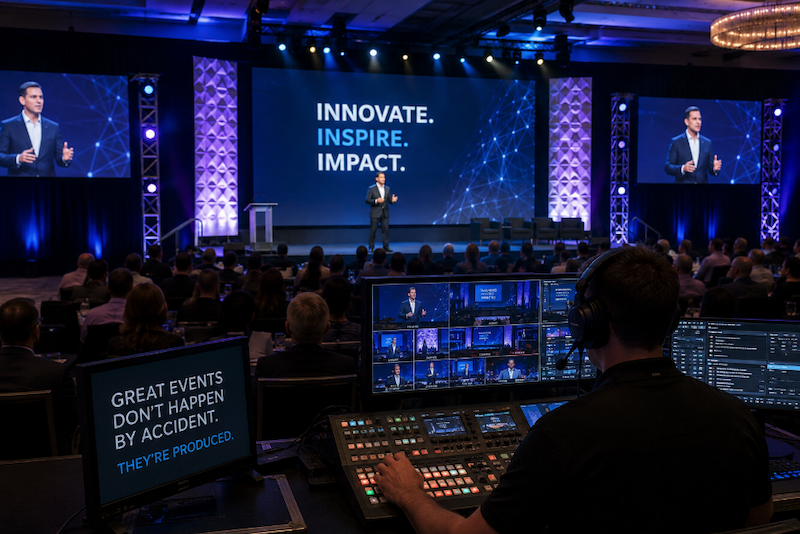
“Remember that the guests remember moments, not agendas,” a producer told me years ago, squinting at a half-built stage.
That’s the thing about corporate events: people don’t walk out quoting slide 17. They walk out remembering the music cue that gave them chills, the CEO who felt unexpectedly human, the way the room itself seemed to wake up.
That’s where professional event production quietly changes everything. If you’ve ever wondered how teams make that leap – how a plan turns into a pulse – stick around.
Why Production is the Difference Between ‘Nice’ and ‘Unforgettable’
It’s wild. You can spend six months planning an event and still fumble the vibe in the first five minutes. Happens constantly.
Part of it is expectation: people want magic, but will settle for smooth. Production folks – the great ones – know the difference.
Bizzabo found that 95% of marketers believe in-person events have a major impact on achieving business goals. Yet engagement – not attendance – is the metric that keeps creeping to the top of post-event reports. You’ve seen it: packed room, half-awake audience.
Production is the layer that decides whether your strategy lands in people’s heads, or just flickers across a screen they barely remember.
In complex markets like South Florida, local organizers often lean on specialized event production services in Miami to wrangle ballrooms, outdoor venues, and hybrid setups without chaos.
AV Services, for instance, handles audio, video, lighting, staging, and streaming as a unified system, so your event feels intentional rather than improvised.
Real production magic lives in those small, invisible details.
How Professional Event Production Creates Moments That Stick
From the back row, professional production looks like boxes of gear and people in headsets waving at each other in the dark.
From the control desk, it’s more like conducting a live orchestra where the instruments are humans, lights, cameras, and timing. That’s where the “I still remember that moment” factor gets built, piece by piece. Let’s break down what they’re actually doing behind the scenes.
1. Designing an Emotional Journey, Not Just an Agenda
It’s one thing to book a venue and slap times on a spreadsheet. It’s something else entirely to make the schedule feel like a story.
That’s what sets the best events apart. A good producer maps out when to let the energy crest, where to let people rest, and what should hit hardest. People crave those “lean forward” moments – the ones where time blurs and a client stops scrolling their phone.
Data from Freeman backs this: 63% of marketers see in-person events as the best shot at deep customer bonds. You earn that through peaks and valleys, not a flat line of PowerPoint.
2. Making Sound and Light Work For the Message
We’ve all been in that room. The AC hums, the mic crackles, and you catch about every third word. It’s exhausting. It’s also avoidable.
A Shure survey found that 81% of workers get frustrated when audio is poor. And when you’re on event number five for the quarter, frustration turns into disengagement fast.
Production professionals obsess over these details. Crisp mics for every speaker; lighting that gently pulls focus; music that shifts with the tone of the moment. When it works, the crowd forgets the tools and just feels… present.
3. Crafting Hybrid and Tech-Heavy Moments That Don’t Break
Let’s face it – today, there’s always someone joining remotely. Hybrid events aren’t an “extra” anymore – they’re central.
According to Salesforce, 63% of marketers see hybrid and virtual as part of their long-term event strategy. That means every live audience now has a virtual twin… which doubles the ways things can go sideways.
The pros layer in backups, streamlined cues, and have a sixth sense for what could tank the experience. When the livestream stays up, Q&A syncs, and energy bounces from the screen into the room? That’s not a happy accident.
The Memory is the Real Takeaway
After the last handshake, what sticks isn’t the seating chart. It’s the moment the crowd gasped as lights dropped, or how the hybrid panel ran without a hitch.
Production, at its best, acts like a stagehand to memory – moving quietly, making sure you leave not just with info, but actual excitement. Maybe you can’t plan for lightning bolts, but with the right team, you can make them a lot more likely.
Next time, which moments do you want to last?
