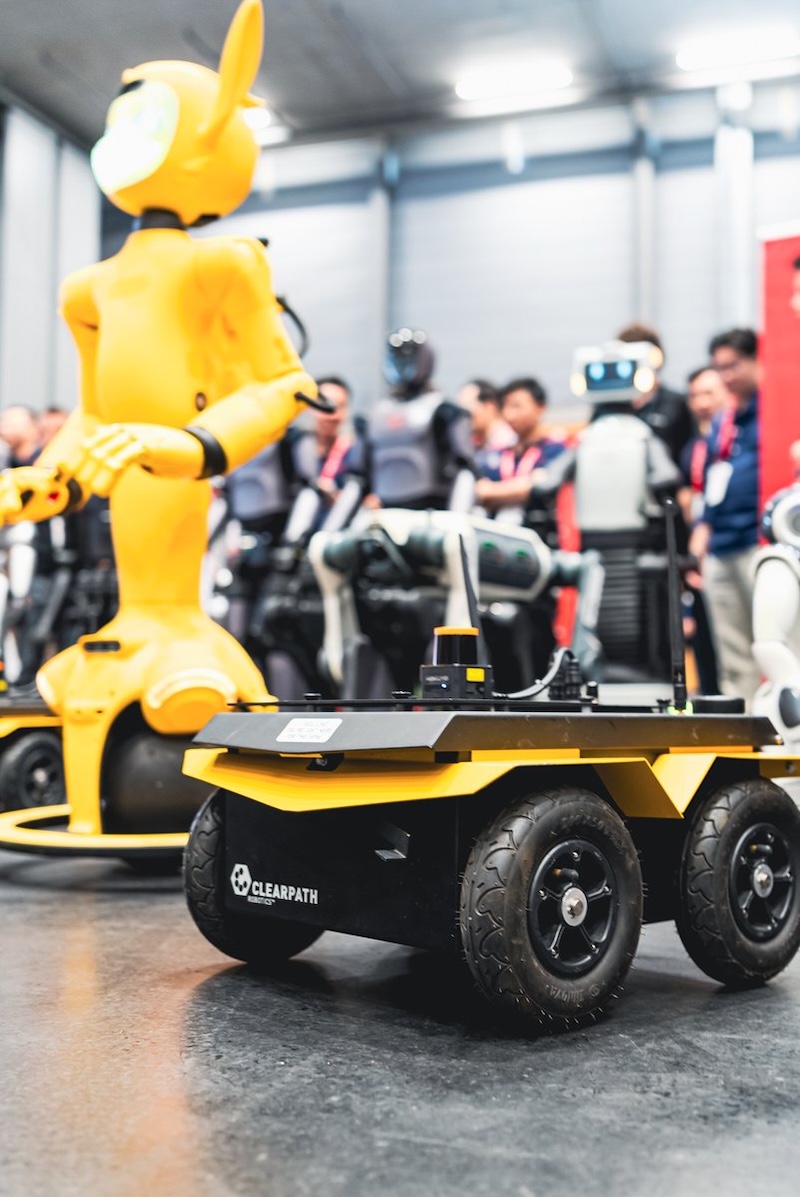
Canada has long been recognized for its contributions to robotics research, producing world-class universities, pioneering robotics startups, and innovative technologies that have found applications across manufacturing, logistics, agriculture, mining, and defense.
Yet despite this strong technical foundation, many observers argue that Canada has not always translated its research strengths into widespread industrial deployment at the same pace as some other leading economies.
Few people have witnessed that evolution more closely than Ryan Gariepy, co-founder of Clearpath Robotics, one of Canada’s most successful robotics companies.
Founded in 2009 as a spinout from the University of Waterloo, Clearpath became a leading supplier of robotic platforms for research and industrial applications.
The company later launched OTTO Motors, a pioneer in autonomous mobile robots for manufacturing and logistics environments.
In 2023, both companies were acquired by Rockwell Automation in a deal that marked one of the most significant milestones in the Canadian robotics sector.
Over the past two decades, Gariepy has seen robotics evolve from a largely academic pursuit into a practical technology capable of solving real-world industrial challenges.
Today, as labor shortages, rising costs, and productivity concerns affect businesses across Canada and beyond, automation is increasingly being viewed not as a future possibility but as a competitive necessity.
In this interview, Gariepy discusses the turning points that convinced him robotics was becoming commercially viable, the barriers that continue to slow adoption, and the sectors he believes offer the greatest opportunities for automation over the coming decade.
He also shares his perspective on Canada’s strengths in manufacturing, agriculture, resource extraction, and Arctic operations, as well as the growing debate around humanoid robots and physical AI.
For engineers, business leaders, and policymakers, the conversation provides a practical assessment of where robotics is delivering value today, what remains difficult, and what Canada must do if it wants to become a global leader in robotics deployment rather than simply robotics research.
Interview with Ryan Gariepy

Robotics & Automation News: Clearpath Robotics began as a university robotics project and grew into one of Canada’s best-known robotics companies before being acquired by Rockwell Automation. Looking back, what were the biggest turning points that convinced you robotics was becoming commercially viable rather than remaining mostly a research field?
Ryan Gariepy: The first turning point was what prompted us to found the company in the first place. A number of enabling technologies in sensing, computing, actuation, and power were all rapidly maturing due to non-robotics factors, but we saw that they’d be able to bring robotics outside of the lab, and that’s absolutely what happened.
The second largest turning point was what prompted us to enter the production logistics space with Otto Motors – we saw that, due to the former turning point having an impact, many open robotics problems were becoming “solved” in certain environments.
At the same time, events such as the Kiva Systems acquisition were getting many other major companies to start paying attention to robotics as a potential solution for their problems.
R&AN: You’ve said automation is becoming a practical tool for improving productivity. Which industries in Canada do you think are currently under-automated relative to their potential, and why have they been slower to adopt robotics?
RG: Most of the industries in Canada are under-automated with respect to where they could be.
There are three main factors here, the first being culture. Robotics is still viewed neutrally or negatively as opposed to a positive tool which absolutely must be adopted.
Second, best practices and references – it’s not easy for a company without robotics experience to evaluate where and how robotics can benefit its operations, much less to deploy them.
Finally, the rate of development – many problems which are applicable to Canadian industries, particularly outdoor-focused industries, have only been solvable in the past decade, which means relevant products and companies are still in the early adopter phase.
R&AN: A lot of manufacturers and logistics companies understand the benefits of automation in theory, but implementation still seems difficult. In your view, what are the main barriers today – capital cost, integration complexity, lack of technical talent, cultural resistance, or something else?
RG: A few years ago, I would have said “all of the above”.
Now, I say “all of the above, plus new messaging confusing the issue”.
There are quite a few well-funded companies that are implying that new AI models are sufficient to substantially change adoption, but at the same time, they’re not paying attention to the rest of the issues at hand.
For example, I don’t think the companies that believe that the best tool to train a factory robot on a new task is a VR headset have ever set foot in a factory.
Though these companies are absolutely pushing the technological frontier, other things are needed to get every worker a robot.
R&AN: Canada has strong capabilities in areas such as advanced manufacturing, mining, agriculture, Arctic operations, and shipbuilding. Which sectors do you think could become globally competitive showcases for Canadian robotics over the next decade?
RG: The entire Canadian economy is a place which can become a global showcase for robotics, but limited to the next decade, I’d say manufacturing, resource extraction, agriculture, forestry, and defence can be fundamentally reshaped by robotics at the societal level.
For the decade after that, construction, health care, fishing, and transportation.
R&AN: Clearpath and Otto Motors were acquired by Rockwell Automation in 2023. Has being part of a much larger industrial automation company changed your perspective on how robotics adoption happens at scale inside real factories and industrial operations?
RG: Surprisingly, it hasn’t, and that’s probably one of the reasons we were acquired in the first place.
Unlike many other companies, we built an understanding of the world we were entering with our products instead of simply assuming that everyone would change their ways of working around us.
What I appreciate is having much more information on the technology and market factors which come into play than I’ve ever had before.
R&AN: There’s growing excitement around humanoid robots and “physical AI”. From your perspective, are humanoids genuinely close to practical industrial deployment, or is the near-term opportunity still dominated by more specialized autonomous systems such as AMRs and industrial mobile robots?
RG: Despite many impressive demonstrations, humanoids are unfortunately not close to practical production-critical deployments.
There’s certainly been a spike in sales of certain models to academic and corporate researchers, but based on my experiences over the years in the research market, that doesn’t necessarily translate to industrial deployments naturally following on.
A small handful of us built and scaled the Husky robot in a small number of years. Doing the same with the Otto AMRs took hundreds of us and over a decade.
That being said, there are absolutely some uses for humanoids in industrial operations, and I look forward to seeing them become more of a reality.
R&AN: Robotics companies often talk about labour shortages, but some workers worry automation will eliminate jobs. How do you respond to concerns that increased robotics adoption could reduce employment opportunities in manufacturing and logistics?
RG: Many North American factories and job sites are idling or not even being built in the first place because of a lack of capacity to build and run them, millions of manufacturing jobs are projected to be vacant due to retirements, and there’s a strong demand to do even more building in North America, not less.
Our workers don’t need to work longer hours; they need better tools. Robots are those tools.
R&AN: If Canada wants to become a global leader in robotics deployment rather than just robotics research, what specific changes would you most like to see from government, investors, and industry over the next five years?
RG: One of the most important things for the industry happened just a couple of weeks ago: the Canadian government’s identification of robotics as one of five priority sectors in our updated National AI Strategy.
This is a great signal to investors and industry, and I’m very interested in how they respond and also how the federal and provincial governments plan to reinforce this statement.
