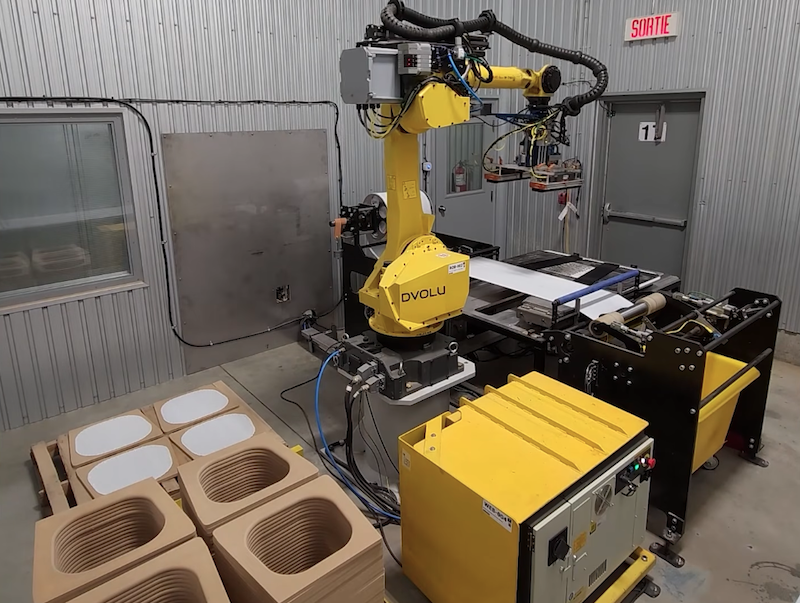
A Canadian furniture manufacturer has automated a traditionally labor-intensive upholstery process using a robotic work cell built around a Fanuc M-710iC industrial robot.
Developed by Fanuc Authorized System Integrator Dvolu, the automated upholstery cell performs a series of tasks that have historically required skilled human workers, including fabric stretching, stapling, trimming, and palletizing chair seat linings.
The project highlights how robotics is increasingly moving beyond traditional manufacturing applications such as welding, machine tending, and material handling into tasks that require a greater degree of dexterity and adaptability.
According to Dvolu, the system uses machine vision to identify the exact position and orientation of seat cushions on pallets before the robot picks, positions, stretches, staples, trims, and palletizes the finished components.
By combining vision guidance, robotic handling, and laser trimming in a single integrated cell, the system can adapt to part variations without manual adjustment.
One of the primary goals of the project was to address labor shortages affecting furniture manufacturers, particularly in jobs that involve repetitive, high-volume manual assembly.
Dvolu says the cell provides “tangible labor relief” by automating one of the industry’s most difficult positions to recruit and retain workers for.
The company described the project as a significant technical achievement due to the challenges associated with handling flexible materials.
“Really proud of this project,” Dvolu said in a reaction to a Fanuc LinkedIn post about the robotic work cell. “Upholstery automation is genuinely hard: fabric behavior, part variability, cycle time constraints, and the Fanuc M-710iC delivered on all fronts. Happy to have helped our client bring consistency and relief to one of their toughest production challenges. Thanks for the shoutout, Fanuc!”
The system is built around Fanuc’s M-710 Series robot, a family of medium-payload robots capable of handling loads ranging from 12 kg to 70 kg. The robots feature a slim wrist design, high-axis speeds, and a reach of up to 3.1 meters.
While industrial robots have long been used in furniture manufacturing for tasks such as material handling and machining, upholstery has remained a challenging process to automate because fabrics can stretch, wrinkle, and behave unpredictably.
The successful deployment suggests that advances in robotics, machine vision, and automated handling are beginning to make even highly variable manufacturing processes suitable for automation.
