For decades, apparel manufacturing has remained one of the most labor-intensive sectors in global industry. While robots have transformed automotive production, electronics assembly, and warehouse operations, handling soft, deformable materials such as fabric has proven far more difficult to automate.
Textiles stretch, wrinkle, drape, and shift unpredictably, creating challenges that traditional industrial automation systems were never designed to solve.
As interest in embodied AI and physical AI continues to grow, many researchers and technology companies see deformable-material manipulation as one of the most important remaining frontiers in robotics.
Success could unlock new opportunities not only in apparel manufacturing, but also in industries ranging from automotive interiors and medical textiles to aerospace composites.
One company tackling this challenge is CreateMe, founded by CEO and entrepreneur Cam Myers, or Campbell Myers to use his full name. Rather than attempting to automate conventional sewing processes, CreateMe has taken a different approach, redesigning garment production around robotics, intelligent material handling, and adhesive-based assembly techniques.
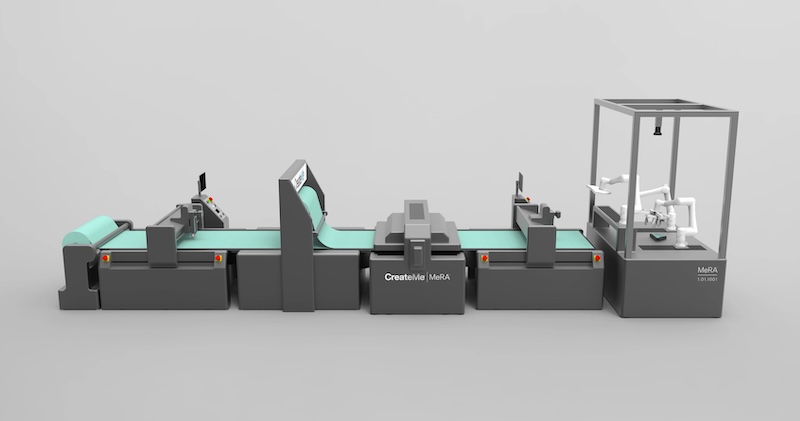
The company’s goal is to create a manufacturing model capable of bringing apparel production closer to end markets while reducing waste, shortening lead times, and improving supply-chain responsiveness.
In this interview, Myers explains why soft-material handling remains one of the most difficult problems in robotics, and why he believes simply adding AI to existing manufacturing processes is not enough.
He discusses CreateMe’s use of adhesive bonding in place of stitching, the role of intelligent grippers and real-time material-state awareness, and the challenges of building robotic systems capable of handling constant variation in fabrics and garment designs.
The conversation also explores broader industry trends, including the potential reshoring of apparel production to higher-cost economies, the relationship between automation and sustainability, and whether technologies developed for garment manufacturing could eventually find applications in other sectors that depend on complex soft-material assembly.
Interview with Campbell Myers

Robotics & Automation News: The apparel industry has been trying to automate sewing and textile handling for decades with limited success. Why have soft materials historically been such a difficult problem for robotics and automation systems?
Campbell Myers: Automated manufacturing has historically struggled with soft materials due to the complexities of deformable manipulation – one of the most challenging problems in robotics.
Unlike rigid components, fabric constantly changes shape during handling, making its behavior unpredictable. It stretches, wrinkles, drapes and shifts in ways that are difficult to predict and control. Traditional automation was built around fixed geometry and repeatable motions.
With textiles, small variations quickly compound, causing preprogrammed approaches to break down. The challenge has never been robot precision alone; it has been understanding material state well enough to act on it reliably and consistently. That insight shaped CreateMe’s approach.
R&AN: You describe deformable-material manipulation as one of the biggest unsolved problems in embodied AI. What makes fabric fundamentally different from handling rigid objects in industrial robotics?
CM: Rigid objects generally maintain a predictable shape and position as they move through a process. Fabric does not. It introduces partial observability, nonlinear behavior and constant variation, meaning a robot cannot always infer what is happening beneath a fold or how the material will respond to force.
That makes apparel a true physical AI challenge, where the system must perceive, decide and act in real time. Physical AI works best when the process is structured so the machine can observe the right material states and adapt accordingly. Without that, AI often compensates for a process that was never designed for automation.
R&AN: CreateMe’s approach seems to rethink garment manufacturing itself rather than simply automating existing sewing processes. At what point did you decide that replacing stitching with adhesive bonding was necessary to make large-scale automation practical?
CM: We started with the hypothesis that sewing itself was the obstacle to large-scale automation. For decades, the industry has focused on automating sewing, but sewing was developed for human hands. It requires fabric to be manipulated and aligned continuously as it stretches, shifts and changes shape.
We took a first-principles approach and asked whether stitching was necessary at all. Adhesive bonding was compelling because precision-applied adhesives are already used successfully in other high-volume manufacturing industries, including consumer electronics, semiconductor manufacturing and footwear.
By replacing stitching with bonding, we could reframe garment assembly around controlled positioning and discrete joins in a static, fixtured state. That process redesign made automation practical; physical AI helps it scale across real-world variability.
R&AN: Your platform combines robotics, adhesives, and Physical AI. Which part of the stack has been the hardest technical challenge to solve – perception, gripping and manipulation, material behavior, motion planning, or the bonding process itself?
CM: The hardest challenge has been manipulating and assembling deformable materials in the presence of constant material variability. Adhesive bonding gives us a more controllable joining method, but before a bond is made, the system still has to understand fabric geometry, manage tension, align edges and control contact with high precision.
Small differences in material properties, stretch, drape or positioning can quickly compound into assembly errors. That makes the challenge much broader than perception, gripping, motion planning or bonding alone. The real problem is closing the loop between all of them so the system can understand material state and adapt its actions in real time.
R&AN: You mention concepts such as single-sided access, intelligent grippers, and thermoreversible adhesives. Could you explain how those technologies work together inside a real production environment, and why they matter for scalability?
CM: Those technologies address different aspects of the manufacturing challenge. Single-sided access is a process design choice that simplifies automation by reducing manipulation requirements. Intelligent grippers help handle and position fabrics despite variation in material behavior and sizing.
Adhesives provide a more controllable joining method than traditional sewing. Thermoreversible adhesives, more specifically, support future disassembly and recycling and complement the commercial adhesive systems we use today.
The breakthrough is not any individual technology. It is rather bringing robotics, materials science and Physical AI together to solve a manufacturing problem that none could solve independently.
R&AN: Much of the discussion around reshoring manufacturing focuses on electronics, semiconductors, or automotive production. Do you think automated apparel manufacturing could realistically return garment production to higher-cost economies such as the US or Europe?
CM: Yes. We believe it is realistic because a new generation of apparel manufacturing technologies is changing both the labor economics and labor requirements of garment production. In fact, the case for reshoring may be even stronger in apparel than in many other industries because the cost of being far from demand is so high.
Apparel suffers from a chronic supply-demand mismatch, leading to excess inventory, markdowns, waste and long lead times. At CreateMe, replacing sewing with automated, adhesive-based assembly reduces labor content while, more importantly, reducing dependence on specialized sewing skills that are increasingly scarce in higher-cost economies.
Producing closer to demand improves responsiveness, resilience and inventory efficiency.
R&AN: One of the longstanding criticisms of the fashion industry is waste – overproduction, excess inventory, and difficult-to-recycle garments. How much of CreateMe’s strategy is about manufacturing efficiency versus broader sustainability and supply-chain redesign?
CM: For CreateMe, the primary objective is not manufacturing efficiency or sustainability in isolation. It is redesigning the apparel manufacturing and supply chain model itself. Much of the industry’s economic and environmental waste stems from long lead times, supply-demand mismatch and production that is disconnected from end demand.
By creating a more responsive, automated manufacturing system closer to consumers, we can reduce both forms of waste simultaneously. Efficiency and sustainability are important outcomes, but we view them as by-products of building a fundamentally better manufacturing and supply chain model.
R&AN: Looking ahead five to ten years, do you see CreateMe primarily as an apparel manufacturing company, or do you think the underlying soft-material robotics platform could expand into industries such as automotive interiors, aerospace composites, medical textiles, or other sectors?
CM: Our focus remains apparel. We view CreateMe not simply as a manufacturer, but as the foundation for a new manufacturing and supply chain model designed to bring production closer to demand.
Apparel is a massive industry in its own right, and the scale of the economic and environmental waste embedded within today’s supply chains creates a significant opportunity to rethink how products are made and delivered.
While apparel remains our primary focus, the underlying technologies we are developing in robotics, materials science and Physical AI have applications beyond apparel.
Industries that work with technical textiles and other soft materials, including automotive, medical, home furnishings and aerospace, face many of the same challenges around material handling and assembly.
We believe the capabilities developed for apparel could ultimately be extended into adjacent industries through partnerships, licensing or direct commercial deployment.
