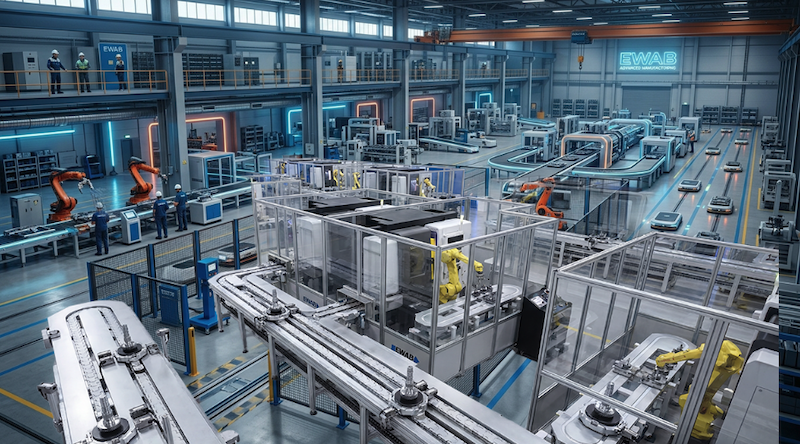
Robot cells and machine tending solutions are transforming manufacturing by driving higher efficiency and adaptability in production lines.
These technologies play a significant role in Modern manufacturing environments, supporting seamless automation across industries.
Their adoption addresses longstanding challenges, streamlining processes and elevating quality standards throughout manufacturing operations.
Industrial manufacturing is changing rapidly as factories turn to Robot cells and machine tending solutions to enhance productivity and maintain competitiveness. Loading and unloading operations, once major bottlenecks, are increasingly automated with the help of Robotics and targeted automation.
Learn more about EWAB robot cells used in these applications, which demonstrate how manufacturers can meet rising demands for throughput, quality, and flexibility in modern manufacturing. This shift signals a move toward more strategic use of automation to address persistent constraints in the sector.
The evolving role of robot cells in industrial manufacturing
Robot cells have rapidly shifted from niche applications to common solutions in a range of manufacturing settings. These modular, programmable systems are designed to perform repetitive processes such as Machine loading, material handling, and assembly tasks with precision and reliability.
By integrating robotics into production lines, manufacturers can reduce manual intervention and the likelihood of errors while increasing both throughput and consistency.
Their adaptability allows factories to respond quickly to changing production requirements. As product variants become more diverse and order sizes more flexible, robot cells provide the versatility necessary for Modern manufacturing.
The integration of automation and robotics ensures factories can scale or adjust flows without extensive downtime or reconfiguration.
Modern robot cells are increasingly equipped with advanced sensors and artificial intelligence capabilities that enable them to handle complex tasks with minimal supervision. These intelligent systems can detect variations in part dimensions, adjust grip pressure automatically, and even predict maintenance needs before failures occur.
The evolution from simple pick-and-place operations to sophisticated material handling demonstrates how robotics technology continues to advance, offering manufacturers unprecedented levels of precision and operational insight that were previously unattainable with conventional automation approaches.
Machine tending solutions and their impact on production
Machinetending plays a pivotal role in ensuring continuous, reliable production cycles. Automated machine tending solutions are responsible for machine loading raw materials, operating machines, unloading finished goods, and inspecting components – all while minimizing human intervention.
When deployed effectively, these systems can operate in tandem with robot cells to maintain an uninterrupted workflow and boost productivity on the shop floor.
Modern manufacturing environments benefit from combining automation, robotics, and advanced tracking systems. These solutions not only support machinetending but also offer data integration, allowing manufacturers to monitor operations in real time and optimize performance.
Integrating these components ensures manufacturers address bottlenecks and maintain high levels of quality throughout production.
Integration strategies and technology synergies
To realize the full benefits of robot cells and machine tending solutions, manufacturers must focus on seamless integration within existing production systems. Automation modules should interface directly and safely with conveyors, fixtures, and other equipment.
This approach ensures that each phase of production flows smoothly and that routine operations, such as changeovers and maintenance, do not disrupt line productivity.
Technological synergies between robotics, sensor-based automation, and monitoring software are key for effective manufacturing solutions. Vision systems, safety technology, and robust control platforms enable Machine tending and functions that can adapt to diverse products and dynamic schedules.
As these technologies mature, they further minimize downtime and support continuous improvements in efficiency and product quality.
Workforce transformation and industry outlook
The adoption of robot cells and machinetending is transforming roles within the workforce. Operators now focus on process supervision, troubleshooting, and preventive maintenance, while robotics handles repetitive or ergonomically challenging tasks.
This shift improves workplace safety and creates opportunities for staff to develop skills in advanced manufacturing and automation.
Looking forward, modern manufacturing is expected to rely increasingly on flexible automation platforms that allow rapid adaptation to market changes. Standardized and modular automation components will be central to future production strategies.
By leveraging advancements in robot cells, automation, and machine tending, manufacturers will continue to increase productivity, address labor challenges, and reinforce their competitive edge.
