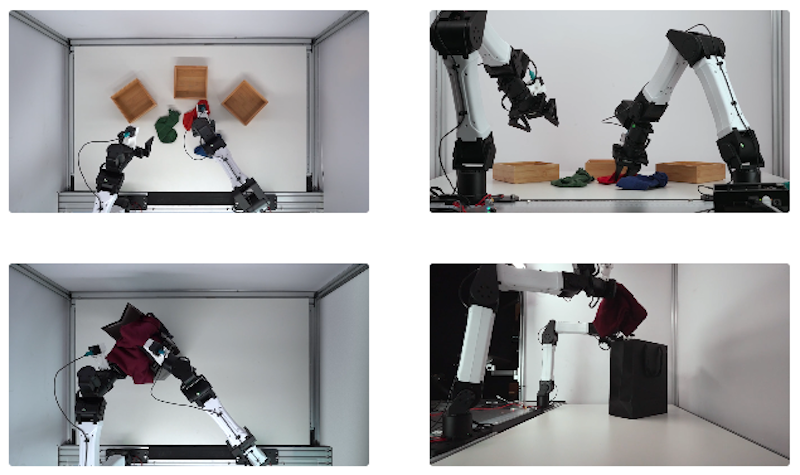
Runway, which claims to be “the world’s top rated AI video model”, has released Praxis-1, an open-weight world action model designed to enable robots to learn physical tasks using knowledge acquired from large-scale video training. The company says the model has achieved “leading results” among open-weight robotics models on a major industry benchmark.
Originally introduced in September, Praxis-1 is now publicly available under the Apache 2.0 license, allowing researchers and developers to adapt the technology for commercial and research applications.
The 27-billion-parameter model combines video prediction with robot action generation, enabling robots to anticipate how objects and environments will change as they perform tasks.
Unlike approaches that rely primarily on robot-specific training data, Praxis-1 uses general video footage to learn how objects behave and interact, before being adapted to particular robotic systems.
Leading benchmark results
According to Runway, Praxis-1 achieved a 46.2 percent success rate on Nvidia’s RoboLab-120 benchmark, which evaluates robotic manipulation across 120 simulated tabletop tasks and 1,200 trials.
This compares with 42.9 percent for FLUX 3 Action, 36.8 percent for Cosmos 3 Nano and 28 percent for π0.5.
The results place Praxis-1 ahead of other open-weight robot foundation models evaluated on the benchmark, although several closed models and general-purpose AI agents achieved higher scores.
Runway also reports that Praxis-1 achieved 80 percent success on the SimplerEnv benchmark after fine-tuning for Google’s RT-1 robot, compared with 52.4 percent for the original RT-1 policy.
Adapting to different robots
Runway says the same underlying model can be adapted to different robotic configurations, including industrial arms, dual-arm warehouse robots and humanoid systems.
Development partners include Noble Machines, Standard Bots and Ultra.
The company has demonstrated Praxis-1 performing everyday manipulation tasks, including sorting objects, closing drawers, placing items into containers and coordinating two robotic arms.
The model’s weights, inference software and fine-tuning tools are available through GitHub and Hugging Face, with support for the LeRobot framework.
Runway says its approach could reduce dependence on expensive robot-specific training datasets, making advanced robotic manipulation capabilities more accessible to developers.
However, the company acknowledges that the model still struggles with visually similar objects, ambiguous instructions and complex tasks requiring multiple sequential actions.
Runway plans further research into long-term reasoning, autonomous planning and self-improving world action models.
