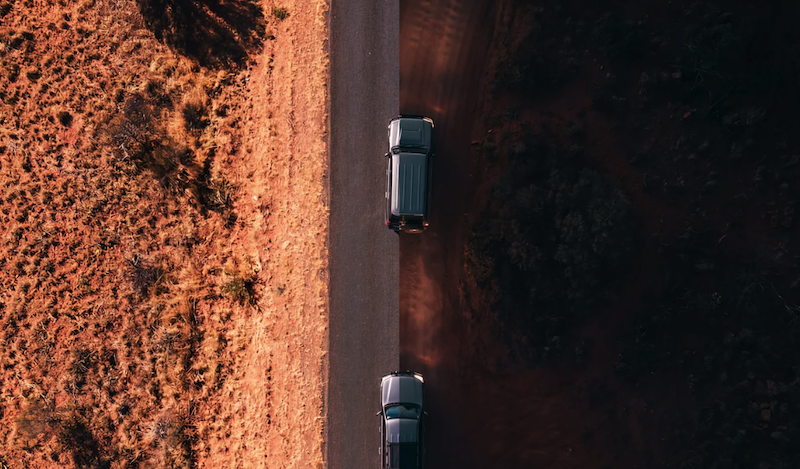
The track looked fine at midday. By 5 pm, the light had dropped behind the ridge, the surface had changed from packed dirt to loose shale, and the headlights were showing maybe thirty meters of trail ahead, not enough to react to what came next. Nobody plans for that moment. Most builds aren’t ready for it either.
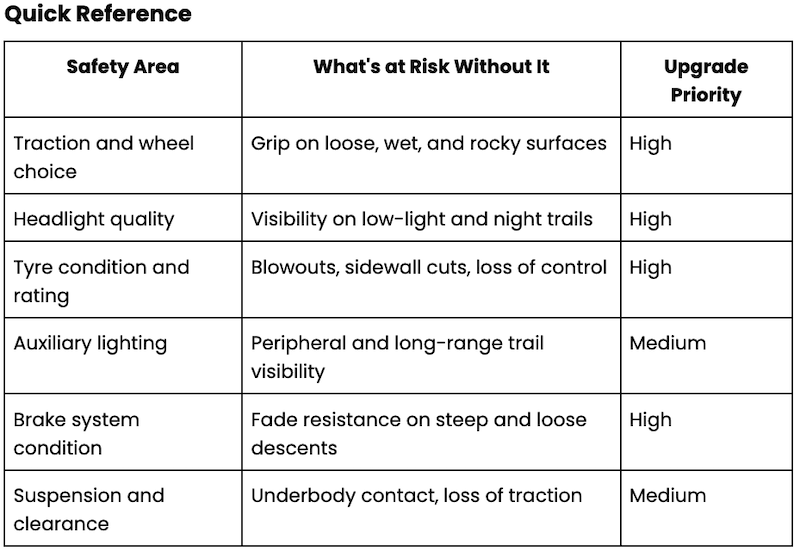
The Two Things That Cause Most Off-Road Incidents
Strip back every off-road incident report, and two factors come up more than anything else. The vehicle couldn’t see what was coming. Or the vehicle couldn’t grip the surface. Sometimes both at once.
The rest, recovery situations, mechanical failures, and rollovers almost always trace back to one of those two root causes. A driver who couldn’t see the edge of the track until it was too late.
A tire that broke traction on a surface the build wasn’t prepared for. Dangerous terrain doesn’t create new problems. It exposes the ones that were already there.
Getting lighting and traction right before heading off-road isn’t about going faster or looking better on the trail. It’s about having the reaction time and the grip to handle what serious terrain puts in front of you.
Traction (What Your Tires and Wheels Are Actually Doing Out There)
The tire is the only thing between the vehicle and the terrain
Every decision about power, suspension, and braking ultimately manifests through the four patches of rubber in contact with the ground. A tire that can’t grip the surface makes every other upgrade less effective. A tire that fails on a remote trail creates a situation that good lighting and a capable suspension can’t fix.
For dangerous terrain, loose rock, wet clay, deep mud, and sharp shale, tyre selection is the safety decision, not just the performance one. Mud-terrain tires with reinforced sidewalls and aggressive tread patterns grip surfaces that all-terrain tires slide on.
The sidewall rating matters most on rocky ground, where the tire is being asked to support the vehicle’s weight against a sharp edge under low-speed pressure. A standard sidewall cut.
Check tire pressure before any serious terrain. Lower pressure increases the contact patch and improves grip on soft and uneven surfaces. Too low and the sidewall is at risk of rolling off the bead.
The right pressure for off-road use is lower than road pressure but above the minimum specified by the tire manufacturer for the load being carried.
Wheel choice affects grip more than most people realize
The wheel behind the tire isn’t passive. The width, offset, and weight of the wheel shape how the tire sits, how it flexes, and how the suspension responds to terrain input.
A wider wheel spreads the tire’s contact patch. On loose surfaces, that spread helps with flotation, the same principle as a snowshoe versus a boot heel. A lighter wheel reduces unsprung mass, allowing the suspension to react faster as the terrain changes under the tire.
For builds that need traction on difficult terrain without sacrificing road manners on the drive there, shop the best chrome wheels at DWW for fitments that cover both use cases. Chrome alloy construction combines finish durability with the weight and strength properties that off-road terrain demands.
Confirm the offset and hub bore against your vehicle’s specs, the wrong offset on a lifted vehicle puts the tire in the wrong position relative to the suspension geometry, which affects how the vehicle handles in exactly the situations where handling matters most.
Lighting: Seeing the Terrain Before it Becomes a Problem
Why stock headlights aren’t enough on dangerous terrain
Factory headlights are engineered and tested for road use. The beam pattern is designed for tarmac, wide enough for a lane, far enough for road speeds, and aimed at a flat surface.
Off-road terrain is none of those things. The track cambers, dips, and rises in ways that constantly shift the beam’s direction relative to what’s ahead.
Overhanging vegetation cuts the beam. Dust reduces range. Uneven terrain tilts the vehicle and aims the light at the ground ten meters ahead instead of the obstacle thirty meters ahead that needs to be seen.
The reaction time available at 40 kilometers per hour on a dirt track is already tight. Headlights that only show the immediate ground in front of the vehicle cut that reaction time in half.
Headlight upgrades that actually change what you can see
For Holden Colorado owners taking their trucks onto serious terrain, Holden Colorado headlights sourced through DMS Engineering cover replacement and upgrade options built to the vehicle’s specific electrical and mounting requirements.
This matters more than it sounds. A headlight unit that isn’t specced for the vehicle’s voltage regulator can flicker under load, fail to reach its rated output, or fail outright in wet conditions if the sealing isn’t matched to the housing. Sourcing a unit that’s engineered for the specific vehicle removes those variables.
LED headlight technology produces a whiter, broader beam than halogen units at a fraction of the power draw. The color temperature of quality LED units falls in a range that the human eye processes faster than the yellow tint of halogen, particularly in low-contrast conditions like dust, fog, and dim dawn light, where dangerous terrain is most likely to present surprises.
Auxiliary lighting fills the gaps that headlights can’t reach
A bull bar or A-pillar-mounted light bar extends the forward beam on fast dirt roads beyond what headlights alone provide. Spot beam patterns throw light far ahead of the vehicle, useful on open tracks where obstacles appear at a distance.
Flood beam patterns spread light wide, useful on tight, twisting trails where what matters is seeing the edge of the track rather than the next straight section.
Corner-mounted auxiliary lights or pod lights fill the peripheral gap that headlights miss entirely. The edge of the track on a tight bend. The drop-off on the passenger side of a cambered traverse. The obstacle to the driver’s left that the headlights point past.
A complete lighting setup on a serious off-road build covers three zones: long-range forward visibility from a light bar, wide peripheral coverage from auxiliary pods, and the standard headlight beam filling the middle ground. Each zone handles what the others can’t.
Braking (Traction Going Forward and Stopping Going Down)
Steep descents on loose or wet terrain test braking systems in ways road driving never does. Stock brake pads on most production 4x4s are specced for road use, they handle normal deceleration without drama.
On a sustained steep descent with repeated brake applications, they build heat. Once the pads reach their temperature limit, brake fade sets in.
Upgraded brake pads with higher temperature ratings maintain bite through the repeated applications demanded by a long technical descent.
Stainless-braided brake lines replace the rubber lines that expand slightly under high pressure, a small change that produces a firmer, more consistent pedal feel in exactly the conditions where inconsistency is dangerous.
Bleed the brake fluid before any serious terrain run. Brake fluid absorbs moisture over time, and its boiling point drops as a result. Old fluid in a system working hard on a steep descent boils before the pads do, and vapor in a brake line doesn’t stop a vehicle.
Putting Lighting and Traction Together as a Safety System
The reason lighting and traction are the two areas that cause most off-road incidents is that they work together. Better lighting gives the driver more time to make a traction decision. Better traction gives the vehicle more margin to execute it.
A driver who sees the loose shale section thirty meters ahead has time to slow down, pick a line, and adjust tire pressure if needed. A driver who sees it at ten meters has none of those options, and whatever traction the tires have at that moment is all there is to work with.
Chrome alloy wheels paired with terrain-appropriate tires give the traction side of that equation genuine capability. Upgraded headlights and auxiliary lighting give the visibility side the range to make traction decisions before the terrain forces them.
Neither upgrade works at its best without the other, and on dangerous terrain, both need to be sorted before the trip starts.
Frequently Asked Questions
1. What tyre pressure should I run on dangerous off-road terrain?
Lower than road pressure, but not below the tire manufacturer’s minimum load rating for the weight being carried.
A common starting point for most off-road situations is 20 to 25 PSI, adjusting down for soft ground and back up for rocky terrain where sidewall protection matters more than contact patch size. Always carry a quality compressor to reinflate before returning to road speeds.
2. Do chrome wheels hold up on serious off-road terrain?
Quality chrome alloy wheels built for off-road use handle rough terrain as well as any standard alloy finish. The key factor is the wheel’s structural rating and design – not the finish.
Confirm the load rating supports the vehicle’s gross weight with gear, and check the offset is correct for the suspension setup. A correctly specced chrome alloy wheel on a capable build performs exactly as needed.
3. Why do factory headlights fail on off-road terrain even when they work fine on roads?
Factory headlights are designed and aimed for flat road surfaces. Off-road terrain constantly tilts, cambers, and pitches the vehicle, shifting the beam away from where obstacles are. The beam pattern that covers a straight road leaves the edges and the area ahead of corners in shadow on a trail.
Auxiliary lighting and upgraded units with broader beam patterns compensate for the vehicle movement that factory headlights can’t account for.
